
We help you improve your websites’ structure, crawlability, indexation, rendering, internal linking, and technical debt for both search engines and AI systems.
We don’t do surface-level audits. We engineer your resilient search foundation.




Who this is for
Our Technical SEO services are built for:
- Agencies that need technical expertise or implementation bottlenecks
- SMBs and SaaS companies scaling organic acquisition or got hit by algorithm changes
- SEO leaders who need defensible strategies
If you’re tired of surface-level audits and reactive fixes.
We’re the partner that goes deeper.

Powered by our own tools
Because we execute technical SEO daily, we built tools to detect issues faster, quantify AI exposure, identify structural visibility gaps, and prioritize fixes based on impact.
Technical SEO is leverage.
Free first session, to understand your business needs and if we are a good fit.
We’ll research your market, audit your website, interview your team & clients, and create a unique strategy for your business.
We’ll track SEO performance and AI visibility, and execute our prioritized plan with your team.
What We Do
In-depth Technical SEO Audits
We go beyond automated reports.
We analyze:
- Crawlability & indexation
- Log file behavior
- Internal linking architecture
- URL structure & taxonomy
- Pagination & faceted navigation
- Canonicalization & duplication
- XML sitemaps
- Robots directives
- Structured data & schema
- JavaScript rendering issues
You get:
- A prioritized roadmap
- Business impact assessment
- Clear developer-ready documentation
- Implementation guidance
Not a 100-page PDF.
A plan you can execute.
Site Architecture & Internal Linking Optimization
Authority flows through structure.
We optimize:
- Content hierarchies
- Topical clusters
- Navigation structure
- Anchor text distribution
- Depth-to-page ratios
- Orphaned pages
- Semantic relationships
Result:
- Stronger crawl efficiency
- Better ranking stability
- Clearer topical authority signals
- Improved AI extraction accuracy
Crawling Performance & Core Web Vitals Optimization
Speed and UX impact both rankings and conversion.
We evaluate:
- LCP, CLS, INP
- Render-blocking resources
- Asset compression
- Caching strategies
- Hosting & CDN configuration
- Mobile performance gaps
Outcome:
- Faster load times
- Reduced bounce rates
- Better user signals
- More stable performance during updates
Structured Data & AI-Readiness Optimization
AI systems rely heavily on structure and clarity.
We implement and optimize:
- Schema markup
- Entity relationships
- FAQ & HowTo structures
- Product & service schema
- Local business schema
- Content segmentation
This improves:
- Rich result eligibility
- Entity recognition
- AI citation probability
- Machine interpretability
Technical SEO is now AI infrastructure.
Algorithm Update Resilience Strategy
We don’t chase updates.
We build foundations that survive them.
Our 16 years of experience navigating:
- Major core updates
- Helpful Content shifts
- Link spam updates
- Mobile-first indexing
- AI-powered ranking signals
Allows us to design strategies that:
- Reduce volatility impact
- Strengthen trust signals
- Align with long-term search principles
You don’t just react to updates.
You become resilient to them.
Other ways we can support you:
SEO for Google & AI Optimization Services
Generative Engine Optimization (GEO) Services
Is SEO dead in 2026? That’s the question on every business owner’s mind as AI overviews and generative search reshape how people find information online.
The short answer: SEO isn’t dead. But it’s fundamentally different from what it used to be. The days of keyword stuffing, basic meta tags, and simple backlink building are long gone. Today’s SEO requires a sophisticated understanding of technical infrastructure, user intent, and increasingly, how AI systems crawl and interpret your website.
Technical SEO has become the unsung hero of organic growth. While content gets the glory and backlinks get the attention, technical SEO works behind the scenes, creating the foundation that makes everything else possible. Without it, even the best content struggles to rank. With it, businesses can unlock sustainable organic traffic that compounds over time.
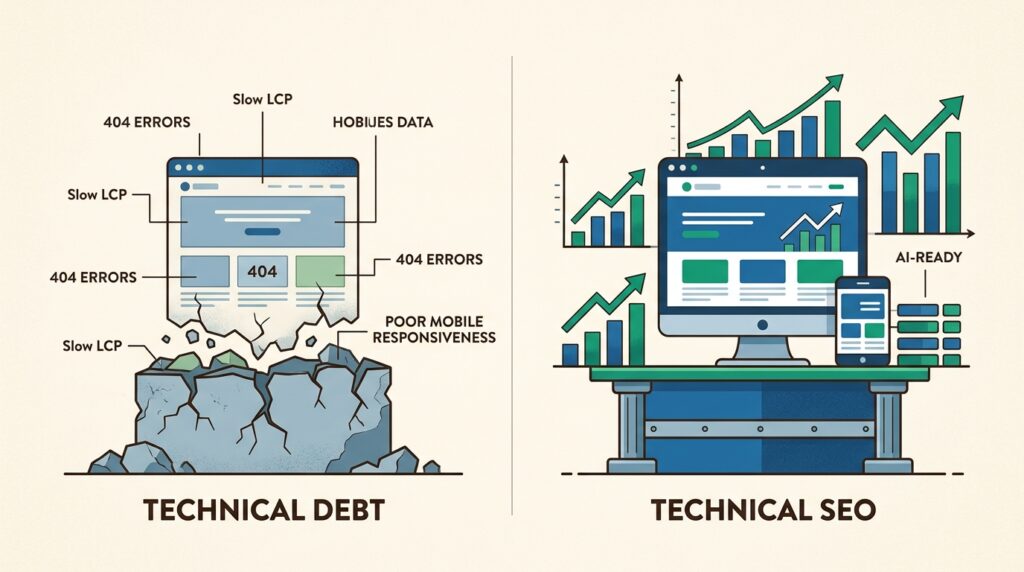
In this guide, we’ll break down exactly what technical SEO services include, how they connect to real business outcomes, and what you should look for when choosing a partner to handle this critical work.
How technical SEO services drive business growth
Technical SEO might sound abstract, but its impact on business metrics is concrete and measurable. Here’s how technical fixes translate to business outcomes.
Site speed improvements reduce bounce rates. When pages load faster, visitors stay longer. A one-second delay in page load time can reduce conversions by 7%. Technical SEO identifies and fixes performance bottlenecks, directly improving user experience and conversion rates.
Mobile optimization captures mobile traffic. Over 60% of searches now happen on mobile devices. If your site isn’t optimized for mobile, you’re losing the majority of potential customers before they even see your content.
Indexation fixes ensure content visibility. You can publish the best content in your industry, but if search engines can’t find and index it, it might as well not exist. Technical SEO ensures your valuable content appears in search results.
Structured data enables rich snippets. Schema markup can increase click-through rates by 30% or more by adding ratings, pricing, and other information directly in search results.
The data supports this. According to BrightEdge research, over 53% of all web traffic comes from organic search. Companies investing in technical SEO see compound returns. Case studies from leading agencies show results like 107% year-over-year organic traffic increases and 360% traffic growth within months of implementing technical fixes.
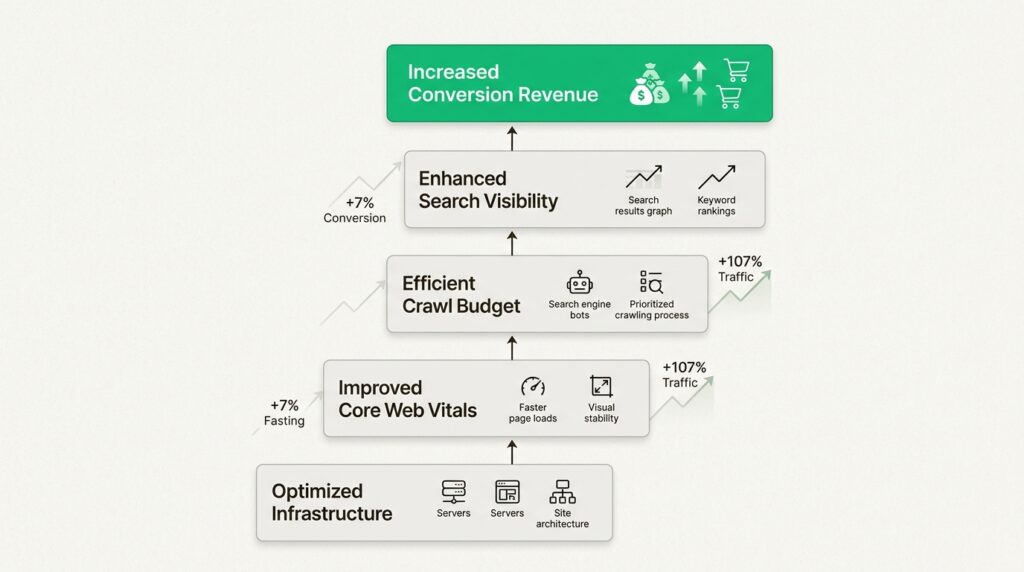
Technical SEO also creates a compounding effect. Once you fix the foundation, every piece of content you publish performs better. Every backlink you earn passes more authority. Unlike paid advertising, which stops working the moment you stop paying, technical SEO investments continue delivering returns for years.
Core technical SEO service categories
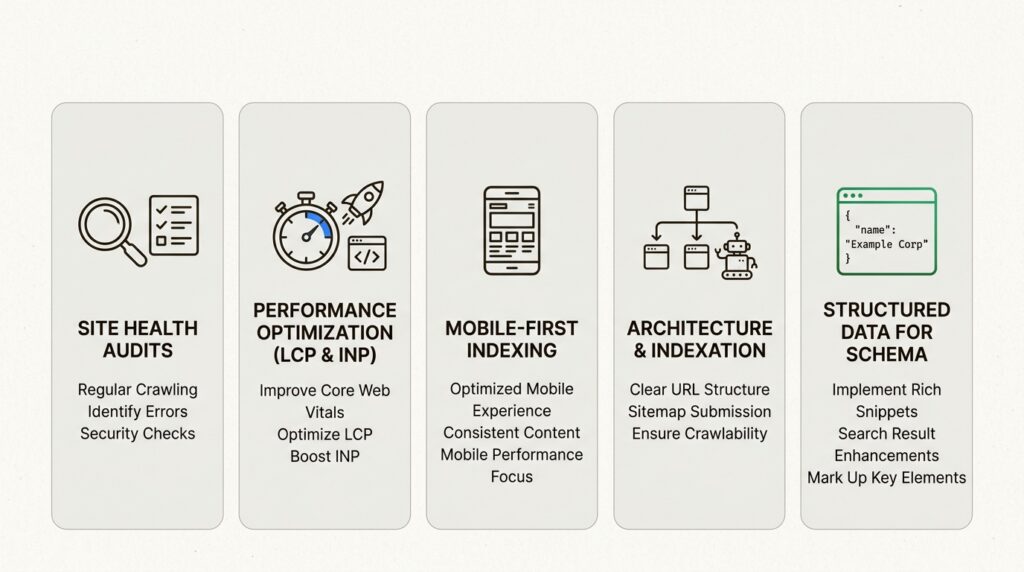
Technical SEO services typically fall into five core categories. Understanding each helps you evaluate what you actually need and what providers should deliver.
Technical audits and site health
Issues uncovered during an audit typically include:
- Broken links and 404 errors
- Duplicate content and canonical issues
- Crawl budget waste
- Indexation problems
- Site architecture weaknesses
A proper audit doesn’t just list problems. It prioritizes them by business impact. Fixing a broken checkout page matters more than optimizing an image on a blog post from 2019.
Performance optimization
Core Web Vitals have been Google ranking factors since 2021, and they’re only becoming more important. Performance optimization focuses on three metrics:
- Largest Contentful Paint (LCP): How fast your main content loads
- Interaction to Next Paint (INP): How responsive your site is to user interactions
- Cumulative Layout Shift (CLS): How stable your page layout is while loading
Technical SEO services address these through techniques like image optimization, code minification, lazy loading, server response improvements, and JavaScript optimization. With page speed directly impacting both rankings and conversions, this category often delivers the fastest ROI.
Mobile and multi-device optimization
Google uses mobile-first indexing, meaning it evaluates your mobile site for ranking purposes, even for desktop searches. Mobile optimization services include:
- Responsive design validation
- Mobile usability fixes
- Touch element spacing
- Mobile page speed optimization
- AMP implementation (where appropriate)
If your mobile experience is an afterthought, you’re working against Google’s core ranking methodology.
Indexation and site architecture
Search engines need to find, crawl, and index your content before it can rank. Indexation services ensure:
- XML sitemaps are complete and submitted
- Robots.txt files properly guide crawlers
- Canonical tags prevent duplicate content issues
- Internal linking structures distribute authority effectively
- Orphan pages are identified and fixed
Site architecture improvements help both users and search engines understand your content hierarchy, making it easier to navigate and rank appropriately.
Structured data and semantic SEO
Structured data (schema markup) helps search engines understand the context of your content. It enables rich snippets like star ratings, pricing, event dates, and FAQ dropdowns directly in search results.
Technical SEO services in this category include:
- Schema markup implementation for relevant content types
- Rich snippet optimization
- Entity optimization for AI search systems
- Knowledge panel management
Structured data is increasingly important for AI search visibility, as systems like ChatGPT and Perplexity rely on semantic understanding to cite sources accurately.
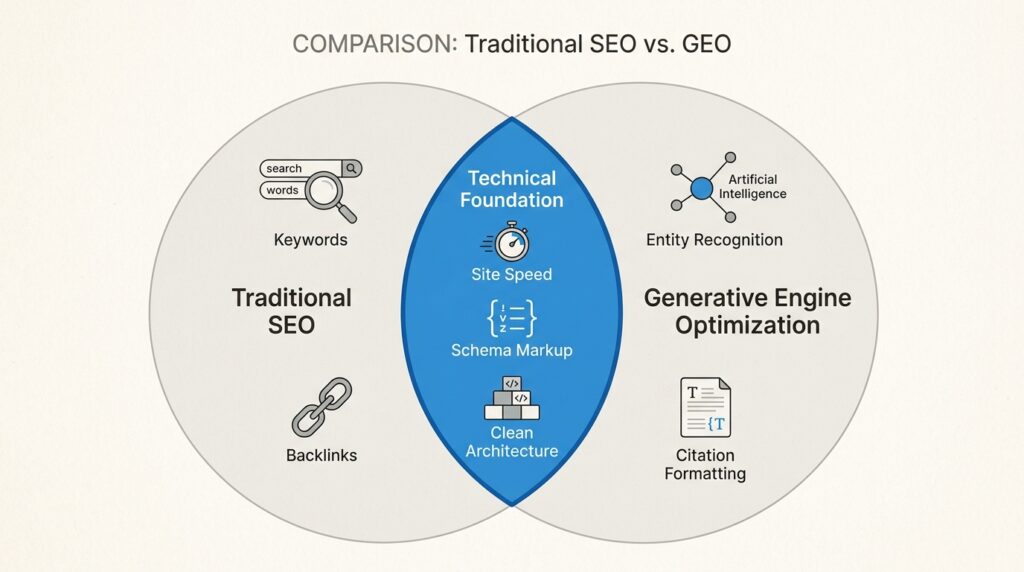
Technical SEO for AI search: The GEO connection
Traditional SEO optimizes for Google’s crawler. But in 2026, there’s a new consideration: AI search systems.
ChatGPT, Claude, Perplexity, and other AI systems don’t just crawl and index. They read, understand, and synthesize content to generate answers. This requires a different optimization approach that we call Generative Engine Optimization (GEO).
AI crawlers differ from traditional search crawlers in several ways:
- They focus on semantic understanding rather than just keyword matching
- They prioritize authoritative, well-structured information
- They struggle with JavaScript-heavy sites and complex navigation
- They rely heavily on structured data for entity recognition
The technical foundation that helps traditional SEO (fast loading, clean architecture, structured data) helps even more with AI search. But GEO adds new dimensions:
- Content clarity: AI systems need clear, factual content without excessive fluff
- Entity optimization: Your brand, products, and key concepts need clear definition through schema markup
- Citation-friendly formatting: Information should be structured so AI systems can extract and attribute it accurately
At Decoding, our technical SEO services now include GEO optimization. We ensure your site isn’t just visible in Google search, but positioned to be cited and recommended by AI systems that are increasingly where your customers start their research.
How to choose technical SEO services
Not all technical SEO providers deliver the same value. Here’s what to look for and what to avoid.
Red flags to avoid:
- One-size-fits-all packages: Technical SEO should be customized based on your site’s specific issues and business goals.
- No audit before proposing services: Any provider should diagnose before prescribing. If they quote a price without seeing your site, run.
- Focus on vanity metrics: Rankings matter, but they should be tied to business outcomes like traffic, leads, and revenue.
- Black box methodologies: You should understand what work is being done and why.
Green flags to seek:
- Senior-led expertise: At Decoding, clients work directly with experts who have 16+ years of experience, not junior staff learning on your account.
- Custom strategy based on audit findings: The work should address your specific issues, not a generic checklist.
- Clear reporting on business metrics: You should see how technical work impacts traffic, conversions, and revenue.
- Integration with broader strategy: Technical SEO should support your content and business goals, not exist in isolation.
Questions to ask potential providers:
- What tools do you use for technical audits and why?
- How do you prioritize technical fixes?
- What business metrics do you track and report on?
- How do you handle AI search optimization alongside traditional SEO?
- Can you share case studies showing business impact, not just ranking improvements?
Pricing considerations:
Quality technical SEO services typically range from $3,000 to $7,500 per month, depending on site size, complexity, and scope. One-time audits start around $3,000. Be wary of services significantly cheaper than this range; technical SEO requires expertise and time that can’t be delivered at bargain prices.
Measuring technical SEO success
Technical SEO work should deliver measurable results. Here’s what to track and realistic timelines for seeing impact.
Key performance indicators:
- Organic traffic growth: The ultimate measure of SEO success
- Core Web Vitals scores: Specific metrics for performance improvements
- Index coverage ratio: Percentage of your site properly indexed by Google
- Organic conversions and revenue: Business impact, not just traffic
- Crawl error reduction: Technical health metric
Timeline expectations:
Technical SEO differs from content SEO in how quickly it shows results. Many technical fixes have immediate impact:
- Week 1-2: Technical audit complete, critical issues identified
- Week 3-4: High-priority fixes implemented
- Month 2-3: Core Web Vitals improvements visible, indexation issues resolved
- Month 3-6: Organic traffic improvements measurable
- Month 6+: Full compounding effect of technical foundation on content performance
While some fixes show immediate results, the full business impact often takes 3-6 months as search engines re-crawl and re-evaluate your site.
What success looks like:
Case studies from agencies in the SEO space demonstrate typical results:
- A manufacturing company saw 107% year-over-year organic traffic increase after technical foundation improvements
- A local services business achieved 360% organic traffic growth within six months
- An e-commerce brand increased web sales by 60% through technical optimization combined with content strategy
The pattern is clear: businesses that invest in technical infrastructure see sustainable organic growth that outpaces competitors relying on surface-level tactics.
Start driving organic growth with technical SEO
Technical SEO isn’t just another marketing tactic. It’s the infrastructure that makes sustainable organic growth possible. In 2026, as search becomes more sophisticated and AI systems increasingly mediate how customers find information, that infrastructure matters more than ever.
The businesses winning in organic search aren’t just creating great content. They’re ensuring that content can be found, understood, and delivered efficiently to both traditional search engines and AI systems.
At Decoding, we specialize in technical SEO services that drive measurable business growth. Our approach combines traditional technical optimization with Generative Engine Optimization, ensuring your brand is visible across the entire search landscape, from Google to ChatGPT.
Our service tiers range from one-time technical audits starting at $3,000 to comprehensive ongoing optimization at $7,500 per month. Every engagement starts with a detailed audit and custom strategy, not a cookie-cutter package.
Want to see how your site performs? You can sign up for a free 7-day trial of our AI Visibility tool to track your brand’s presence across LLMs and identify technical optimization opportunities.
The companies that invest in technical foundation now will own the organic search results of the future. Let’s make sure you’re one of them.
Frequently Asked Questions
How long does it take to see results from technical SEO services that drive organic business growth?
Most technical SEO improvements show initial results within 1-3 months. Core Web Vitals improvements and indexation fixes can have immediate impact as search engines re-crawl your site. However, the full business impact, including significant organic traffic growth, typically becomes clear within 3-6 months as rankings stabilize and compound.
What should I budget for technical SEO services that drive organic business growth?
Quality technical SEO services typically range from $3,000 to $7,500 per month for ongoing work, depending on your site size and complexity. One-time technical audits generally start around $3,000. Be cautious of services priced significantly lower; effective technical SEO requires experienced expertise and thorough analysis that can’t be delivered at bargain prices.
Can technical SEO services that drive organic business growth help with AI search visibility?
Yes. Technical SEO forms the foundation for Generative Engine Optimization (GEO). The same infrastructure that helps Google crawl and rank your site helps AI systems like ChatGPT and Perplexity understand and cite your content. Services should now include schema markup optimization, entity definition, and content structuring that works for both traditional and AI search.
How do technical SEO services that drive organic business growth differ from regular SEO services?
Traditional SEO often focuses heavily on content and backlinks. Technical SEO services specifically address the infrastructure layer: site speed, mobile optimization, indexation, crawlability, and structured data. While content SEO is what users see, technical SEO is what makes that content discoverable and performant. Both are necessary, but technical SEO is the foundation.
What are the most important technical SEO services that drive organic business growth for small businesses?
For small businesses, prioritize: (1) technical audits to identify critical issues, (2) Core Web Vitals optimization for site speed, (3) mobile optimization for mobile-first indexing, and (4) local SEO technical setup including schema markup for local business. These deliver the highest ROI for limited budgets before expanding into more advanced optimizations.
How can I tell if I need technical SEO services that drive organic business growth?
Signs you need technical SEO help include: slow page load times, poor mobile experience, declining organic traffic despite content efforts, pages not appearing in search results, frequent crawl errors in Google Search Console, or poor Core Web Vitals scores. If you’re investing in content but not seeing traffic growth, technical issues are likely the bottleneck.