
We help businesses manage and optimize their paid advertising investments across search engines, social media, and display networks. We bring expertise that goes beyond basic campaign setup, focusing on strategic guidance to maximize your return on ad spend (ROAS).





What is a PPC management consultant?
A PPC management consultant is a digital marketing specialist who focuses exclusively on paid advertising optimization. Unlike general digital marketers who might handle everything from social media to email campaigns, or SEO specialists who focus on organic search, PPC consultants live and breathe paid advertising.
Their scope typically covers:
- Google Ads (Search, Display, Shopping, YouTube)
- Bing Ads/Microsoft Advertising
- Social media advertising (Meta, LinkedIn, TikTok)
- Display and programmatic networks
The key value proposition? Strategic guidance that goes beyond day-to-day campaign management. While anyone can set up a Google Ads account, we bring the expertise to structure campaigns for maximum efficiency, identify wasted spend, and scale what works.
The landscape is shifting. AI and automation are handling more of the tactical work, from bid adjustments to ad rotation. This means the modern PPC consultant focuses more on strategy, creative direction, and interpreting data that machines can’t fully understand yet.
If you’re interested in how AI is reshaping marketing more broadly, our AI SEO services explore similar transformations in organic search.
What does our PPC consultant actually do?
Core responsibilities
A PPC consultant’s job breaks down into several key areas:
- Keyword research and audience targeting Finding the search terms and audience segments that actually convert, not just the ones with high volume
- Campaign strategy development Structuring accounts, ad groups, and campaigns for scalability and performance
- Bid management and budget optimization Allocating spend across campaigns, adjusting bids based on performance data
- Ad copy creation and A/B testing Writing compelling copy and continuously testing variations
- Landing page optimization recommendations Advising on page design and content to improve conversion rates
- Performance tracking and reporting Setting up proper tracking, analyzing metrics, and communicating results
- Cross-platform campaign management Coordinating efforts across Google, Bing, social platforms, and display networks
Day-to-day activities
On a typical day, a consultant might:
- Monitor campaign metrics (CTR, CPC, conversion rates) and spot anomalies
- Adjust bids and reallocate budgets based on performance trends
- Communicate with clients on campaign status, timeline, and results
- Conduct competitive intelligence to understand what competitors are bidding on
- Run continuous optimization tests on ad copy, landing pages, and targeting
The best consultants don’t just manage campaigns. They act as strategic partners who understand your business goals and align paid advertising to achieve them. WordStream’s research shows that average Google Ads CTR varies significantly by industry, which is why specialized expertise matters.
Signs your business needs a PPC consultant
Not every business needs outside PPC help. But there are clear signals that it’s time to bring in a specialist:
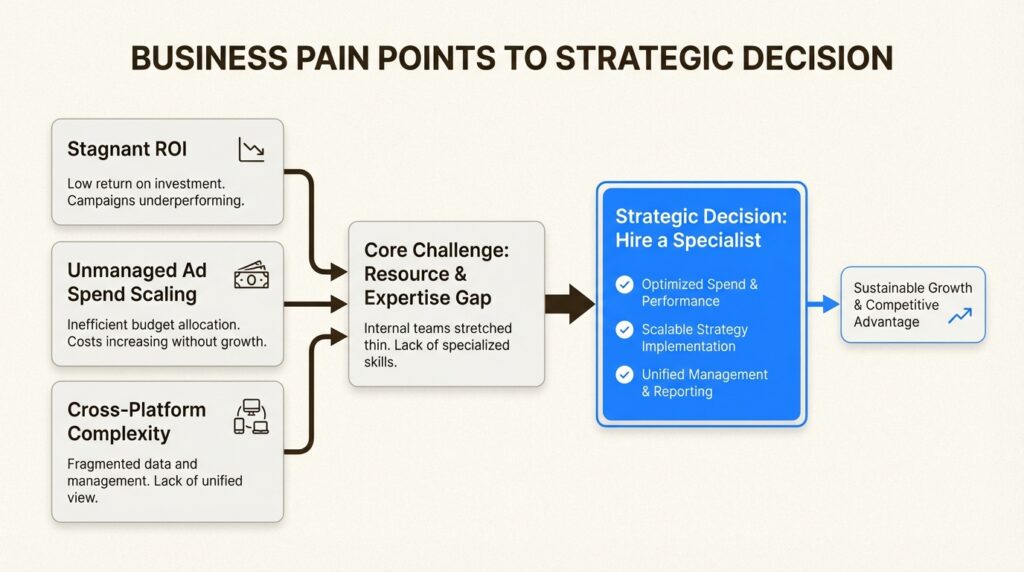
- Campaigns span multiple platforms requiring cross-channel expertise you don’t have in-house
- Ad spend is scaling faster than your team’s capacity to manage it effectively
- Performance varies significantly due to inconsistent optimization or lack of time
- Manual management is consuming excessive time that could be spent on core business activities
- You’re launching in new markets or verticals where you lack experience
- Current campaigns aren’t delivering expected ROI and you can’t figure out why
- Your internal team lacks platform-specific certifications or keeps up with the rapid pace of platform changes
If you’re struggling to measure whether your campaigns are actually working, our AI visibility audit can help identify gaps in your tracking and attribution.
Consultant vs. agency vs. in-house: Making the right choice
When to hire an individual consultant
Individual consultants work best for SMBs with focused needs, specific platform expertise requirements, or budget constraints.
Pros: Lower cost than agencies, personalized attention, specialized expertise in specific platforms or industries
Cons: Limited bandwidth (one person can only manage so many campaigns), single point of failure if they become unavailable
When to work with an agency
Agencies make sense for enterprise needs, multi-channel campaigns, and comprehensive marketing strategies.
Pros: Full team with diverse expertise, scalability for large campaigns, broader strategic capabilities beyond just PPC
Cons: Higher cost, less personal attention (account managers change, junior staff do the work), potential for your account to get lost in the shuffle
Building in-house capabilities
In-house teams work for companies with large ad spends, ongoing long-term needs, or highly specialized industry knowledge.
Pros: Full control, deep brand knowledge, immediate availability for urgent changes
Cons: Recruitment and training costs, challenge of keeping up with platform changes, risk of knowledge walking out the door
The hybrid approach
Many businesses find the best approach combines consultant expertise with automation tools. Consultants handle strategy and creative direction while AI-powered platforms handle bid management and routine optimization.
At Decoding, we use our AI brand visibility tracker alongside traditional PPC management to show clients how their brand appears across AI search platforms, not just Google Ads.
PPC consultant pricing: What to expect
Common pricing models
| Pricing Model | Typical Range | Best For |
|---|---|---|
| Monthly Retainer | $2,000 – $10,000+ | Ongoing management and optimization |
| Hourly Rate | $150 – $225 | Project-based work or audits |
| Percentage of Ad Spend | 10% – 20% | Large budgets where spend fluctuates |
Percentage-based fees often decrease for larger budgets. A consultant might charge 15% for a $10K monthly spend but only 10% for $100K+.
Factors that influence cost
- Campaign complexity and number of platforms More platforms means more work
- Industry expertise and consultant experience level Specialists in competitive industries (legal, finance, healthcare) command premium rates
- Geographic location and market demand Consultants in major markets typically charge more
- Level of service and reporting requirements Weekly calls and custom reports cost more than monthly check-ins
- Total monthly ad spend Managing $500K/month requires more attention than $5K/month
Hidden costs to watch for
- Setup fees Some consultants charge separately for initial account audits and setup
- Platform certification costs If they need to get certified on your specific platforms
- Third-party tool subscriptions SEMrush, SpyFu, or other research tools they might bill separately
- Minimum contract terms Early termination fees or 6-12 month minimum commitments
How to evaluate and hire a PPC consultant
Essential qualifications to look for
- Google Ads Certification Table stakes for anyone managing Google campaigns
- Meta Blueprint Certification Critical if you’re running Facebook or Instagram ads
- Microsoft Advertising Certification Important for Bing Ads management
- Google Analytics Certification Essential for proper tracking and attribution
- Proven track record with similar businesses Ask for case studies in your industry or with similar business models
Red flags to avoid
- Guarantees of specific results Anyone promising “#1 ranking guaranteed” or specific ROAS numbers is either lying or using black-hat tactics
- Lack of transparency in reporting You should understand what you’re paying for and see the results
- No clear communication plan Vague answers about how often you’ll hear from them
- Outdated strategies or platform knowledge PPC changes fast; they should be current
- Refusal to share references or case studies Legitimate consultants have happy clients willing to vouch for them
Interview questions to ask
- How do you measure success for PPC campaigns? (Look for answers beyond just clicks and impressions)
- What is your approach to budget allocation across platforms?
- How do you stay current with platform changes and new features?
- Can you share case studies from businesses similar to mine?
- What does your reporting and communication process look like?
The vetting process
Before signing a contract:
- Request a portfolio and specific case studies with metrics
- Check references from current or past clients
- Review their own online presence and thought leadership (do they blog, speak at conferences, contribute to industry publications?)
- Start with a trial project or paid audit before committing to a long-term engagement
Measuring ROI: How to know if your consultant is delivering
Key metrics to track
- Return on Ad Spend (ROAS) Revenue generated per dollar spent on ads
- Cost Per Acquisition (CPA) Cost to acquire a customer or lead
- Conversion rate improvements Percentage of clicks that become customers
- Quality Score trends (Google Ads) Higher scores mean lower costs and better positions
- Click-through rate (CTR) benchmarks How often people click your ads vs. seeing them
Understanding how these metrics compare to broader search trends can provide valuable context. Our analysis of AI search market share shows how the search landscape is evolving and what that means for paid advertising benchmarks.
Setting realistic expectations
- Typical timeline for seeing results: 30-90 days for significant improvements, though some optimizations show impact within days
- Industry benchmarks vary by vertical Ecommerce ROAS benchmarks differ from B2B lead generation
- Seasonal considerations Q4 typically costs more for ecommerce; B2B often slows in summer
- Platform learning phases New campaigns need 2-4 weeks for algorithms to optimize
When to make a change
Consider switching consultants if you see:
- Consistent underperformance versus industry benchmarks after the initial ramp period
- Lack of communication or transparency about what’s being done
- Stagnant strategies despite poor results (same approach month after month)
- Inability to explain performance changes or provide actionable insights
The future of PPC consulting: AI and automation
The role of PPC consultants is evolving rapidly. AI and automation now handle many tasks that used to require human intervention:
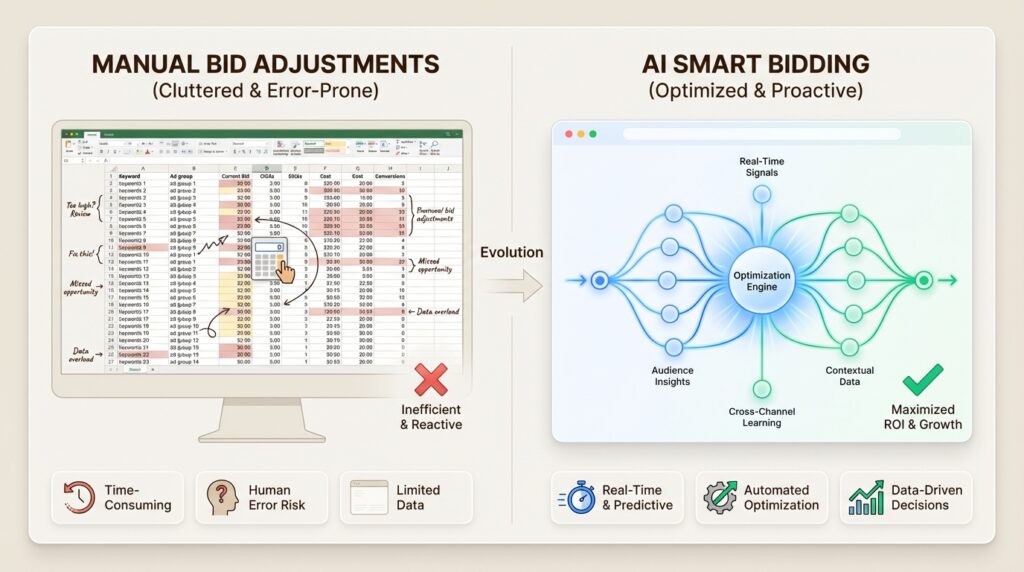
- Automated bidding strategies Smart Bidding and similar features optimize bids in real-time
- Responsive search ads AI generates and tests ad combinations automatically
- Performance Max campaigns Google uses AI to optimize across all channels
This doesn’t mean consultants are becoming obsolete. It means their value shifts toward:
- Strategic direction Setting up the right campaign structures and goals for AI to optimize toward
- Creative strategy Developing compelling offers, messaging, and landing page concepts
- Data interpretation Understanding why performance changed and what to do about it
- Cross-platform coordination Ensuring consistent messaging across channels that AI doesn’t connect
For businesses, this means the consultants who will deliver the most value are those who embrace AI tools while focusing on the strategic and creative work that machines can’t do. Our GEO services help businesses optimize for AI-powered search experiences, which increasingly intersect with paid advertising strategies.
Choosing the right PPC management consultant for your business
Finding the right PPC consultant comes down to alignment. They need to understand your business goals, have experience in your industry or with similar business models, and communicate in a way that works for you.
Start with clear objectives. Know what success looks like before you start interviewing. Whether it’s a target ROAS, cost per lead, or scale target, having specific goals makes it easier to evaluate whether a consultant can deliver.
Consider starting small. A paid audit or 90-day trial project lets you evaluate their work before committing to a long-term contract. The best consultants will welcome this approach because it lets them prove their value.
At Decoding, we help businesses navigate the intersection of paid advertising and AI search. Whether you need help finding the right PPC partner or want to understand how AI is changing the advertising landscape, get in touch to discuss your needs.
Frequently Asked Questions
How much does a PPC management consultant typically cost?
Most PPC consultants charge between $2,000-$10,000+ per month for ongoing management, $150-$225 per hour for project work, or 10-20% of ad spend. The right model depends on your budget and needs. Flat monthly retainers work well for predictable costs, while percentage-based fees align the consultant’s incentives with your success.
What qualifications should I look for when hiring a PPC management consultant?
Look for Google Ads Certification at minimum, plus Meta Blueprint and Microsoft Advertising certifications if you run campaigns on those platforms. Google Analytics certification is also important for proper tracking. Beyond certifications, ask for case studies from businesses similar to yours and check references from current or past clients.
How long does it take to see results from a PPC management consultant?
You should see initial improvements within 30 days as they fix obvious issues and optimize existing campaigns. Significant results typically take 60-90 days, especially if they’re restructuring campaigns or testing new strategies. Be wary of consultants promising overnight results. PPC optimization is iterative and requires data accumulation.
Should I hire a PPC management consultant or manage campaigns in-house?
Hire a consultant if you lack platform expertise, don’t have time for ongoing optimization, or need specialized knowledge for a specific campaign type. Build in-house if you have large, consistent ad spends (typically $50K+/month), highly specialized industry knowledge, or want full control over your campaigns. Many businesses use a hybrid approach: consultants for strategy and in-house staff for day-to-day management.
What are red flags that indicate a PPC management consultant might not be reputable?
Watch out for guarantees of specific results (“#1 ranking guaranteed”), lack of transparency in reporting, refusal to share references or case studies, outdated platform knowledge, and vague communication about what they’re actually doing. Legitimate consultants set realistic expectations and can clearly explain their strategies and results.
How do I measure whether my PPC management consultant is delivering value?
Track ROAS (return on ad spend), CPA (cost per acquisition), conversion rates, and Quality Score trends. Compare performance to industry benchmarks for your vertical. Beyond metrics, evaluate whether they’re proactive in communication, transparent about what’s working and what isn’t, and continuously testing new approaches rather than running the same campaigns month after month.
Can a PPC management consultant help with AI-powered advertising platforms?
Yes, modern PPC consultants should be well-versed in AI-powered features like Google’s Smart Bidding, Performance Max campaigns, and responsive search ads. Their role increasingly involves setting up the right structures and goals for AI to optimize toward, interpreting AI-driven insights, and handling the strategic and creative work that automation can’t do. Ask potential consultants specifically about their experience with AI-powered campaign types.