
Track the exact questions your buyers ask on ChatGPT, review competitors, and get actionable insights to optimize your AI presence with Decoding’s ChatGPT Visibility Tracker.
- Track when your brand appears in ChatGPT responses
- Monitor which links AI references in its responses
- See how competitor appear in their answers
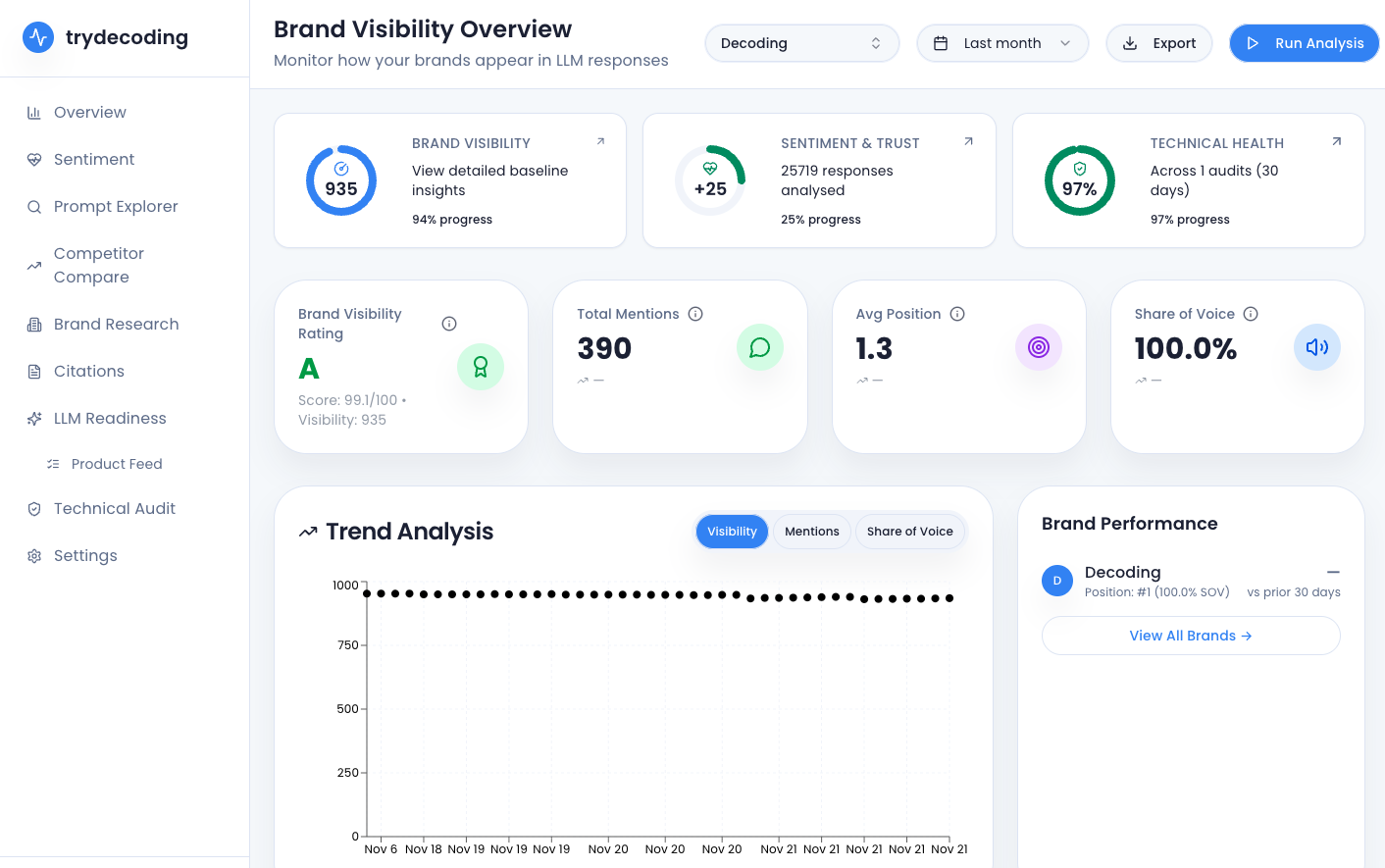
Other features: ChatGPT Tracker – AI Citation Tracking – Competitive AI Monitoring




See who ChatGPT recommends instead of you and why.
Total setup time: Under 3 minutes. No code. No dev queue.
Brief about your brand
Add your brand, description, and location. We automatically help you create your first 5 prompts.
50 prompt runs
You can monitor the visibility and average ranking of your brand for each individual prompt-run. Ask direct, strategic questions to ChatGPT to audit your AI visibility.
Act on the checklist
We provide you with an actionable checklist to improve your visibility on LLMs. Act immediately on inaccuracies and missed opportunities, update digital assets, pursue new mentions, and clarify your entity signals.
Who it’s for
If you’re a small or mid size team trying to show up in AI search, this is for you. SEOs, marketers, comms teams, founders, anyone who needs to know “Do we appear when buyers ask ChatGPT about our problem, category, or brand?”
- SMBs on a budget who can’t justify $400+ tools
- Agencies reporting AI visibility to clients
- In-house teams providing what moves the needle
Search is evolving. Again.
If you want your brand to be found, you need to rethink your strategy to appear on Google and ChatGPT.
Now, millions ask ChatGPT for product recommendations and research, cutting Google (and your traditional SEO efforts) out of the first impression.
ChatGPT is a growing search channel you can’t afford to ignore.
As AI becomes the default interface for answers, you need automated ways to monitor and improve what these models say about you.
LLMs like ChatGPT pull information from what is already published, if your content is missing or misrepresented, that’s why people see.
Here is what you get:
- Track up to 50 custom prompts targeting strategic questions for your brand, products, and services.
- Review at prompt level how your brand is included and your competitors.
- Get information about how ChatGPT got the information (citations, sources, direct quotes).
- Re-run your prompts each month, or modify them to track new products and services, is up to you.
Use cases
We create Decoding ChatGPT Visibility Tracker to help SEOs, Marketers, Comms teams, as well as business owners that want to stay competitive in this new shift to AI search.
What’s next?
- We are working on supporting more LLMs, like Google Gemini, AI Overviews, AI Mode, Perplexity, etc.
- Improving ways on how to do competitor analysis and mention gaps.
- Optimization suggestions to improve your visibility and clicks.
What Is ChatGPT Visibility?
Every day millions of people ask ChatGPT and other AI assistants for product recommendations, comparisons and advice. Instead of ten blue links, these systems deliver a single synthesized answer. ChatGPT visibility measures how often and how accurately your brand is mentioned in those answers. It looks at:
- Brand mentions – Does the model include your name or website?
- Citation links – Are your pages cited, or does it link to a competitor?
- Answer position – Is your brand mentioned first, last or not at all?
- Sentiment and framing – Is the tone positive, neutral or negative?
- Entity clarity – Does the model correctly understand your brand, or confuse you with someone else?
Understanding and improving these signals is critical because AI assistants are quickly becoming the first point of contact for buyers. Studies show that more than 40 % of younger shoppers use AI instead of traditional search engines for product research. When ChatGPT recommends a competitor, you lose potential customers even if you rank #1 in Google.
Why You Need a Visibility Tracker
If you’re not mentioned in AI answers, you’re invisible when it matters most.
Generative AI models learn from publicly available content. They surface brands that have strong topical authority, high‑quality citations and clear entity signals. Without monitoring, you won’t know whether ChatGPT recommends your brand or misrepresents you. A dedicated visibility tracker helps you:
- See the bigger picture – Discover where your brand appears (or doesn’t) in ChatGPT, Perplexity, Gemini, Claude and other AI platforms.
- Spot inaccuracies and gaps – Identify outdated descriptions or missing citations so you can address them quickly.
- Benchmark against competitors – Compare how often you’re mentioned versus your peers and see which queries trigger competitor recommendations.
- Prioritize content and PR efforts – Focus on topics and sources that influence AI models, strengthening your authority where it counts.
- Adapt to the AI search shift – As AI assistants become the default interface for answers, proactive monitoring becomes an essential part of SEO and brand management.
How does it work?
Our tool combines AI analysis with SEO best practices to give you actionable insights. Here’s what happens when you start a free audit:
- Domain and entity analysis – We analyse your website and extract key entities (products, features, topics) to understand what you’re known for.
- Prompt generation – Using Jobs‑to‑Be‑Done (JTBD) methodology, we generate relevant queries that real customers ask (e.g., “best CRM for small businesses”).
- AI visibility check – Our system queries ChatGPT and other models and records where your brand is mentioned, which pages are cited and how you’re positioned.
- Score and metrics – You’ll get a visibility score (0‑100) that combines citation rate, position and sentiment. We also show explicit citations (direct links) and implicit mentions (third‑party mentions that influence AI responses).
- Actionable recommendations – Beyond data, we provide a personalized checklist to improve your AI presence. This includes content gaps, PR opportunities and technical fixes like schema markup.
Key Metrics We Deliver
- Citation rate: Percentage of queries where your brand is mentioned.
- Explicit citations: Number and quality of links to your pages in AI answers.
- Implicit mentions: Brand references on external sites that feed into AI training.
- Visibility score: Overall ranking of your presence versus competitors.
- Sentiment analysis: How positively or negatively your brand is framed.
Why Decoding?
- Built by AI search specialists – Our team has been helping companies optimize for search and AI since 2008. We understand how large language models select sources and what influences their answers.
- Focused on small and mid‑size teams – Unlike enterprise‑only platforms, Decoding offers flexible plans and a 7‑day free trial so you can test the value without heavy investment.
- Transparent and data‑driven – We cite research and provide clear metrics instead of vanity scores. Our recommendations are rooted in the same principles top AI visibility guides emphasize.
- Multi‑platform coverage – ChatGPT is just the beginning. Monitor your presence across Perplexity, Google’s AI Overviews, Gemini, Claude and more.
- Actionable next steps – We don’t just measure; we help you improve. From suggesting new content topics to identifying influential publications for outreach, Decoding gives you a roadmap for better AI visibility.
8 best ChatGPT visibility trackers in 2026
Here’s a sobering statistic: more than 90% of brands have zero visibility into whether they appear in ChatGPT responses at all. None. Zip. Nada.
Think about that. While you’re obsessing over Google rankings, your brand could be completely invisible in the conversations where your customers are actually making decisions. ChatGPT, Perplexity, Gemini, Claude. These aren’t just novelties anymore. They’re the new front page of the internet.
The problem? Traditional SEO tools are blind to AI search. Google Search Console won’t tell you if ChatGPT recommends your competitor over you. Your rank tracker can’t see which sources AI platforms cite when answering buyer questions.
That’s where ChatGPT visibility trackers come in. I spent the last few weeks testing the top tools on the market. Some are excellent. Others are overpriced SEO add-ons with an AI sticker slapped on top. This guide cuts through the noise to show you what actually works.
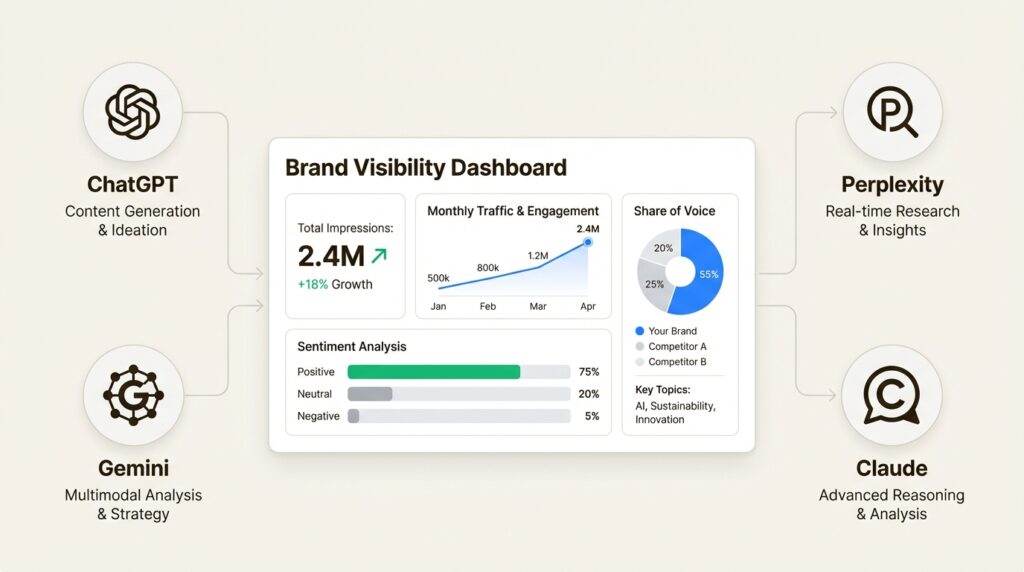
What is a ChatGPT visibility tracker?
A ChatGPT visibility tracker is a specialized tool that monitors how often, how accurately, and in what context your brand appears in AI-generated responses.
Unlike traditional SEO tools that focus on Google rankings, these tools track:
- Brand mentions: Does ChatGPT name your brand when users ask about your category?
- Citation links: Does it include direct links to your website?
- Answer position: Are you the first recommendation or buried at the bottom?
- Sentiment and framing: Is the tone positive, neutral, or negative?
- Entity clarity: Does AI understand who you are, or confuse you with competitors?
Most tools now track across multiple LLMs, not just ChatGPT. The best ones monitor ChatGPT, Perplexity, Google AI Overviews, Gemini, and Claude simultaneously. Why? Because your customers use different AI assistants, and you need visibility across all of them.
There’s also an important distinction between explicit citations (direct links to your domain in AI responses) and implicit citations (brand mentions from third-party publishers that AI references). Good trackers monitor both.
How I evaluated these ChatGPT visibility tracker tools
Before diving into the list, here’s how I tested each tool:
- Platform coverage: Does it track ChatGPT only, or multiple LLMs?
- Data accuracy: How reliably does it detect brand mentions and citations?
- Pricing transparency: Are costs clear upfront, or hidden behind “contact sales”?
- Ease of use: Can you get actionable insights without a PhD in data science?
- Unique features: What makes this tool different from the other six?
I ran each tool against the same set of test queries to compare results. I also evaluated pricing, onboarding experience, and support responsiveness.
A quick note on selection: I focused on tools that deliver actionable insights, not just raw data. The best ChatGPT visibility tracker isn’t the one with the most features, it’s the one that tells you exactly what to do next. That’s why Decoding tops this list: focused tracking, clear optimization suggestions, and whitelabeling at a price that works for agencies and small businesses.
Quick comparison: 7 ChatGPT visibility trackers at a glance
| Tool | Starting Price | Free Option | Platforms | Best For |
|---|---|---|---|---|
| Decoding | $49/mo | 7-day trial | ChatGPT | Agencies, SMBs, white-labeling |
| SE Ranking | $218/mo (with AI add-on) | 14-day trial | ChatGPT, Perplexity, AI Overviews, AI Mode | SEO teams wanting integrated suite |
| Riff Analytics | $49/mo | 7-day trial | 7 major LLMs | Dedicated AI tracking |
| Otterly.ai | $29/mo | Free trial | ChatGPT, Perplexity, AI Overviews, Copilot | Actionable optimization guidance |
| LLM Clicks | $159 lifetime | 14-day trial | ChatGPT, Perplexity, Google AI, Copilot | Lifetime pricing preference |
| GoVISIBLE | $69/mo/project | Free trial | ChatGPT, Gemini, Perplexity, Claude, Copilot | Entity clarity focus |
| Wellows | Free / $37/mo | Free tier + 7-day trial | ChatGPT, Perplexity, Gemini, AI Overviews, AI Mode | Small businesses, free entry |
| Semrush | $139/mo | Limited free | ChatGPT, AI Overviews | Existing Semrush users |
Now let’s break down each tool in detail.
1. Decoding
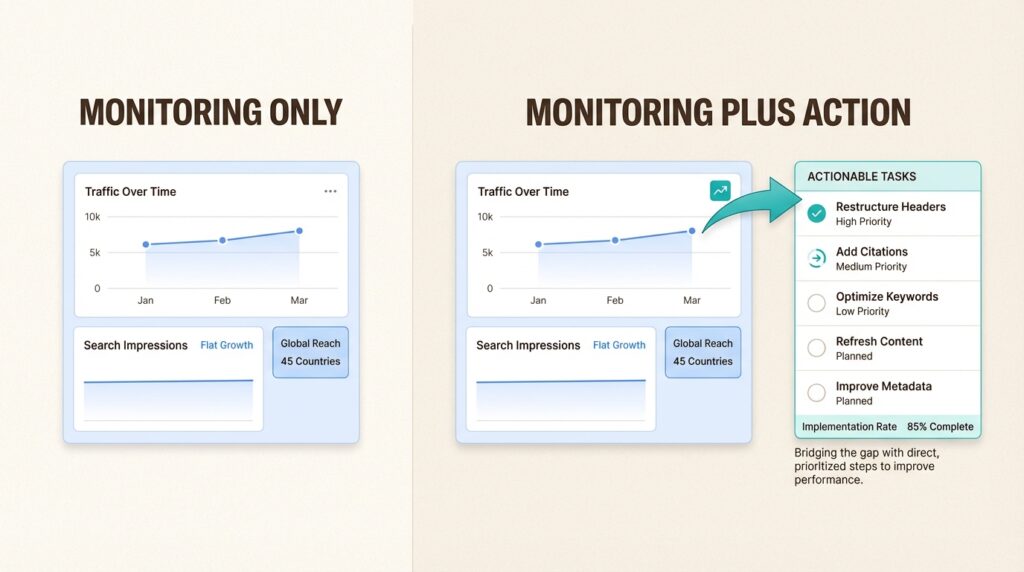
Decoding is purpose-built for brands that want actionable AI visibility insights without the complexity or bloat of all-in-one SEO platforms. While other tools track everything under the sun, Decoding focuses specifically on ChatGPT visibility, delivering targeted optimization suggestions that actually move the needle.
At $49 per month, Decoding hits the sweet spot for affordability. You get dedicated ChatGPT tracking, competitor benchmarking, and detailed optimization recommendations that tell you exactly what content to create or update to improve your visibility. No fluff, no overwhelming dashboards, just clear action items.
The whitelabeling capabilities make Decoding particularly attractive for agencies. You can run AI visibility reports under your own brand, share client-friendly dashboards, and position yourself as the expert guiding clients through the AI search shift. Small businesses benefit from the straightforward pricing and focused feature set: you don’t need to pay for Perplexity or Claude tracking if your audience primarily uses ChatGPT.
Pros:
- Purpose-built for ChatGPT visibility (no feature bloat)
- Actionable optimization suggestions with specific recommendations
- Affordable at $49/mo with transparent pricing
- Whitelabeling for agencies
- Clean, intuitive interface designed for non-technical users
Cons:
- ChatGPT-only (doesn’t track Perplexity, Claude, or other LLMs)
- Newer to market than established SEO platforms
- Smaller feature set if you need multi-platform tracking
Pricing:
- Starter: $49/mo (1 brand, unlimited queries, optimization suggestions)
- Pro: $149/mo (5 brands, whitelabeling, API access)
- Agency: Custom (unlimited brands, dedicated support)
- 14-day free trial available
Best for: Agencies needing whitelabel AI visibility reports, small businesses wanting focused ChatGPT tracking without complexity, and teams prioritizing optimization guidance over raw data.
2. SE Ranking
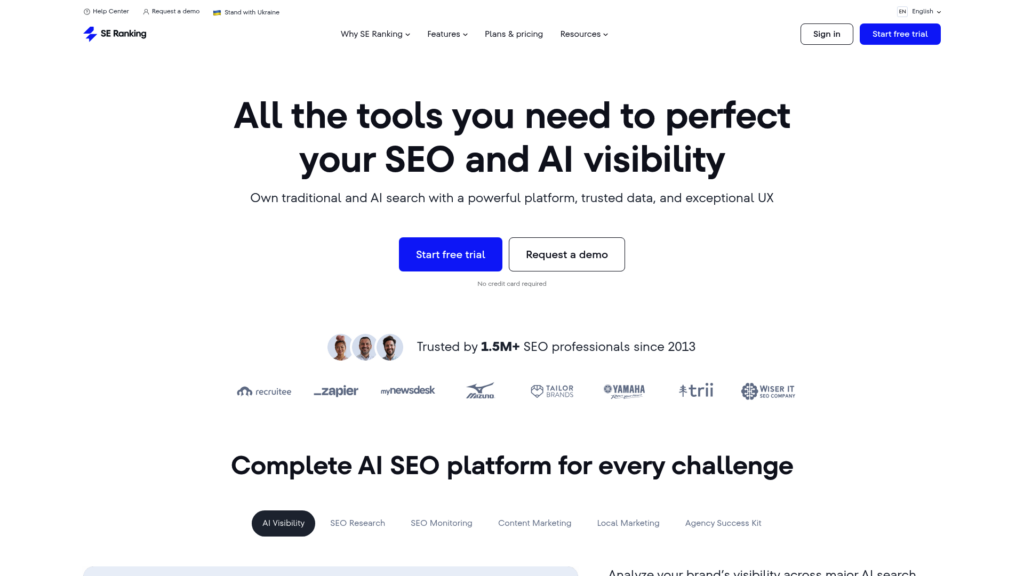
SE Ranking takes the comprehensive SEO platform approach and layers AI visibility tracking on top. If you’re already managing SEO campaigns and want to add AI monitoring without learning a new tool, this is worth considering.
The platform includes three core AI tracking tools: a ChatGPT Visibility Tracker, an AI Overviews Tracker, and an AI Mode Tracker. You get historical data, competitor benchmarking, and the ability to track up to 5 domains in GEO research on the Core plan.
Here’s the catch: AI visibility isn’t included in the base price. You need the AI Search add-on, which costs an additional $89 per month on top of your SE Ranking subscription. That brings the total to $218 monthly minimum for the Core plan plus AI features.
Pros:
- Integrated with full SEO suite (rank tracking, backlink analysis, site audits)
- Historical data across project lifetime
- 14-day free trial with full functionality
Cons:
- Most expensive option when you factor in the AI add-on
- ChatGPT-focused (other LLMs planned but not fully implemented)
- Requires SE Ranking subscription even if you only want AI tracking
Pricing:
- Core: $129/mo + $89/mo AI add-on = $218/mo total
- Growth: $279/mo + AI add-on
- 20% discount on annual billing
Best for: SEO teams that want traditional SEO and AI visibility in one dashboard, and are already SE Ranking customers.
3. Riff Analytics
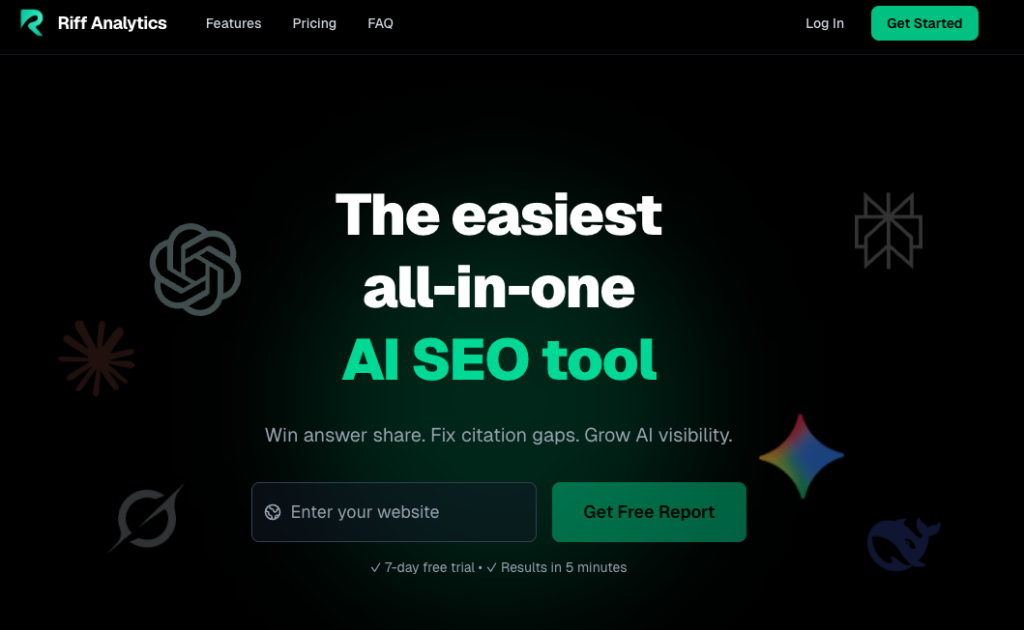
Riff Analytics is the only tool on this list built specifically for AI visibility tracking from day one. It’s not an SEO platform with AI features bolted on. It’s a dedicated AI brand monitoring platform.
The standout feature is coverage: Riff tracks 7 major LLMs including ChatGPT, Perplexity, Gemini, and Claude. Most competitors track 3-4 platforms. Riff goes deeper.
I particularly like the sentiment tracking with automatic flagging. If ChatGPT starts describing your brand negatively, you get an alert. The citation analysis shows exactly which sources ChatGPT cites when mentioning your brand, which helps you understand what content influences AI recommendations.
The Starter plan at $49 per month includes unlimited competitors, which is rare. Most tools limit competitor tracking or charge extra for it. You get 250 prompts, 6,000 AI responses per month, and 1,000 URL checks.
Pros:
- Widest LLM coverage (7 platforms)
- Unlimited competitors on all plans
- Sentiment tracking with alerts
- Real-time monitoring
- 7-day free trial on Starter plan
Cons:
- No free tier
- Interface is functional but not as polished as Otterly.ai
- Smaller company (less established than SE Ranking or Semrush)
Pricing:
- Starter: $49/mo (1 brand, 250 prompts, 6,000 responses)
- Pro: $199/mo (5 brands, 20,000 responses)
- 10% discount on annual billing
Best for: SaaS companies and agencies that want dedicated AI tracking without the baggage of a full SEO platform.
4. Otterly.ai
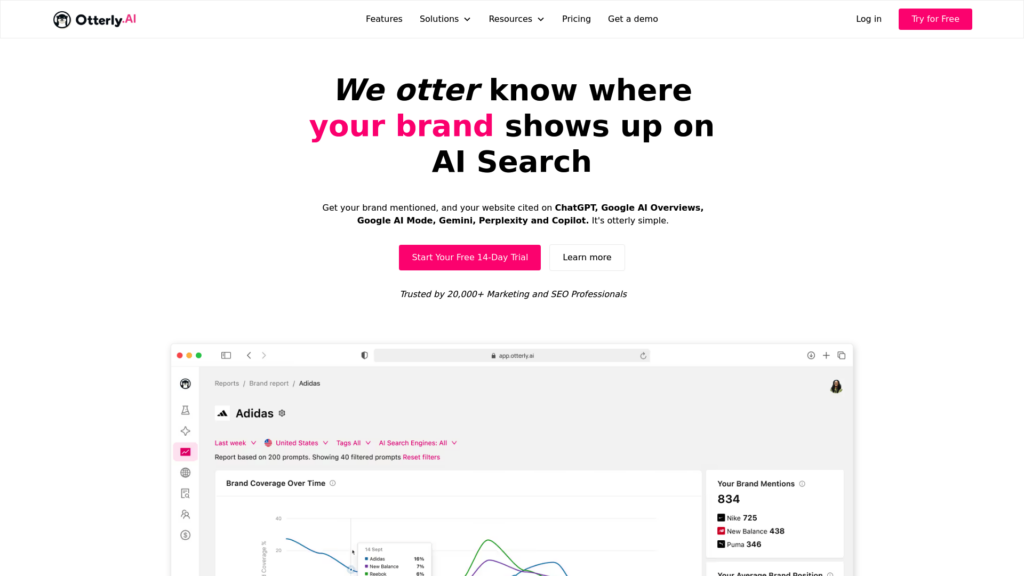
Otterly.ai claims to be the “#1 rated AI search monitoring platform,” and after testing it, I understand why. The user experience is polished, the reports are actionable, and they were recently named a Gartner Cool Vendor in AI for Marketing 2025.
The Lite plan starts at $29 per month, making it the most affordable paid option on this list. You get 15 search prompts, tracking across ChatGPT, Google AI Overviews, Perplexity, and Microsoft Copilot, plus 1,000 GEO URL audits per month.
What sets Otterly apart is the focus on actionable insights, not just data. The platform includes a Brand Visibility Index, Domain Ranking, and Link Citations Analysis. It also offers a Generative Engine Optimization Audit that tells you exactly what to fix.
The Standard plan at $189 per month adds unlimited workspaces, Google Looker Studio integration, and 5,000 GEO URL audits. There’s also an Agency Partner program with co-marketing opportunities and white-label reporting.
Pros:
- Most affordable starting price ($29/mo)
- Gartner recognition adds credibility
- Daily tracking on all plans
- 50+ country support
- Agency-friendly features
Cons:
- Google AI Mode and Gemini cost extra ($9-149/mo depending on plan)
- Prompt limits can feel restrictive on Lite plan
- Less comprehensive than Riff for multi-LLM coverage
Pricing:
- Lite: $29/mo (15 prompts, 1,000 audits)
- Standard: $189/mo (100 prompts, 5,000 audits)
- Premium: $489/mo (400 prompts, 10,000 audits)
- 15% discount on annual billing
Best for: Marketers who want actionable optimization guidance and agencies looking for white-label reporting.
5. LLM Clicks
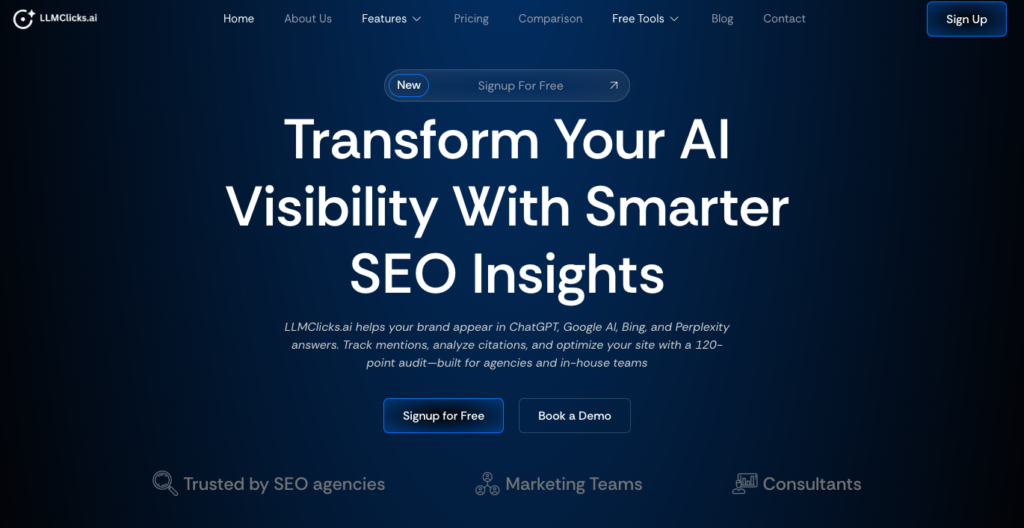
LLM Clicks takes a different approach to pricing: lifetime deals. Instead of monthly subscriptions, you can pay once and use the tool forever. For teams tired of recurring SaaS bills, this is appealing.
The Starter lifetime deal costs $159 one-time and includes 300 AI visibility checks per month, 1 project, and 50 page audits. The Professional plan at $239 adds 10 projects and custom branding. The Agency plan at $399 includes 30 projects and 1,500 checks per month.
Feature-wise, LLM Clicks covers the standard bases: AI Visibility Tracker, Citation Analysis, Industry Benchmarks, and continuous monitoring across ChatGPT, Perplexity, Google AI, and Copilot. The “Voice of Search” feature measures share of voice against competitors.
One quirk: all plans include a 14-day free trial, which seems odd for a lifetime deal product. But it gives you a chance to test before committing to the one-time payment.
Pros:
- Lifetime pricing option (no recurring fees)
- 14-day free trial on all plans
- Continuous monitoring capabilities
- Competitor visibility analysis
Cons:
- Less established brand (newer to market)
- Monthly check limits can feel restrictive
- No monthly subscription option if you prefer that
Pricing:
- Starter: $159 one-time (300 checks/mo, 1 project)
- Professional: $239 one-time (700 checks/mo, 10 projects)
- Agency: $399 one-time (1,500 checks/mo, 30 projects)
- Additional queries: $20 per 1,000
Best for: Teams who prefer lifetime pricing over monthly subscriptions and want continuous monitoring.
6. GoVISIBLE
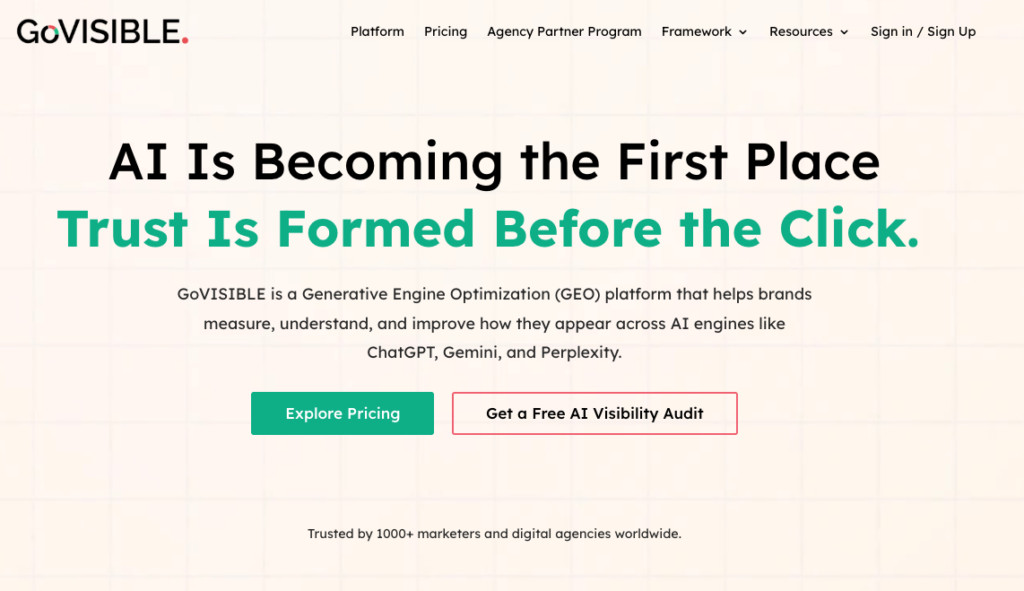
GoVISIBLE approaches AI visibility through the lens of Generative Engine Optimization (GEO). It’s built on the VISIBLE™ Framework, which includes 7 pillars of AI visibility covering everything from entity optimization to citation ecosystems.
The platform monitors ChatGPT, Gemini, Perplexity, Claude, and Copilot. But the real differentiator is the focus on entity clarity: ensuring AI understands who you are and doesn’t confuse you with competitors.
GEO Flex pricing starts at $69 per month per project. The unique twist is volume pricing: track 1 project for $69, or scale up to 10 projects at $49 each. This makes it cost-effective for agencies managing multiple clients.
Features include a GEO Dashboard with visibility scoring, Competitor Leaderboard, Sentiment and Share-of-Voice Insights, Prompt Intent Clusters, and Citation Graph analysis. Data refreshes daily.
Pros:
- Comprehensive GEO framework (not just tracking)
- Volume pricing benefits agencies
- 5 AI engines monitored
- Unlimited users on all plans
- Entity clarity focus
Cons:
- Per-project pricing can get expensive at scale
- 50 prompts per month on base plan (lower than competitors)
- Less intuitive for beginners
Pricing:
- GEO Flex: $69/mo per project (volume discounts to $49/project)
- GEO Enterprise: Custom (unlimited projects, dedicated CSM)
- Extra prompts: $15 per package
Best for: Brands focused on entity clarity and comprehensive GEO framework implementation, plus agencies managing multiple client projects.
7. Wellows
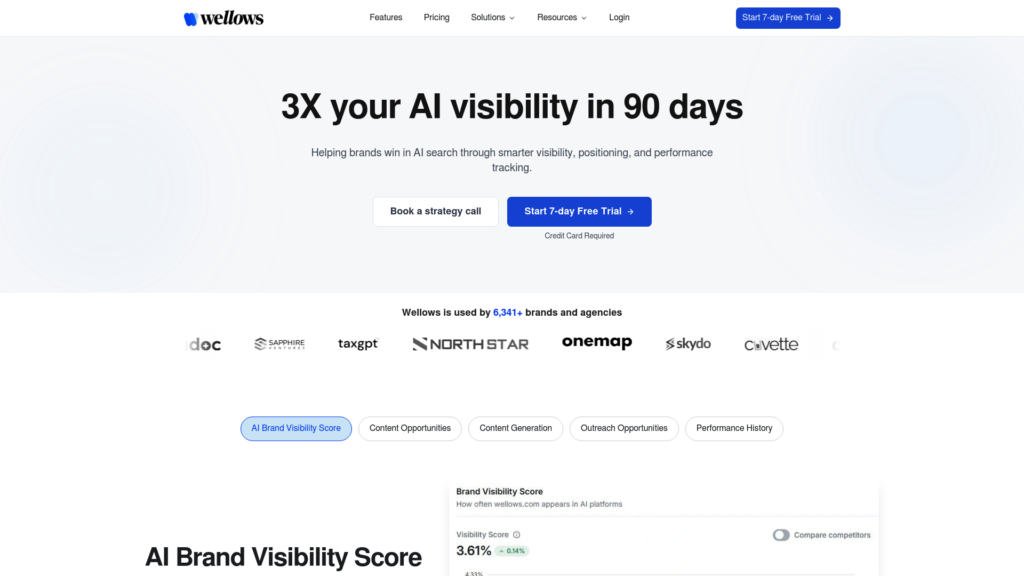
Wellows offers something no other tool on this list does: a completely free tier with no signup required. You can run a ChatGPT visibility audit right now, no credit card, no email, no commitment.
The free tool analyzes your domain, generates 40 intent-driven queries using the JTBD (Jobs-to-be-Done) framework, and checks where your brand appears across ChatGPT citations. You get metrics on citation rate, explicit citations, implicit citations, and position ranking.
Paid plans start at $37 per month per domain for the Lite plan, which includes 1 AI engine (ChatGPT), 40 prompts, and 2 content generations. The Essential plan at $97 adds Google AI Overviews tracking and increases limits. The Starter plan at $297 covers 5 engines (ChatGPT, Gemini, Perplexity, AI Overviews, AI Mode) with 400 prompts.
All paid plans include unlimited explicit and implicit opportunity tracking, unlimited outreach emails, daily monitoring, and Google Search Console integration. You also get strategic monthly calls (1-5 depending on plan), which is unique among these tools.
Pros:
- Completely free tier (no signup)
- 7-day free trial on paid plans
- Strategic monthly calls included
- Unlimited opportunity tracking
- GSC integration on all plans
Cons:
- Per-domain pricing (not per-account)
- Lite plan limited to ChatGPT only
- Less comprehensive reporting than premium tools
Pricing:
- Free: 40 queries, no signup
- Lite: $37/domain/mo (ChatGPT only, 40 prompts)
- Essential: $97/domain/mo (2 engines, 100 prompts)
- Starter: $297/domain/mo (5 engines, 400 prompts)
- Pro: $497/domain/mo (5 engines, 1,000 prompts)
Best for: Small businesses and startups testing AI visibility tracking for the first time, and anyone who wants to run a quick free audit.
8. Semrush One
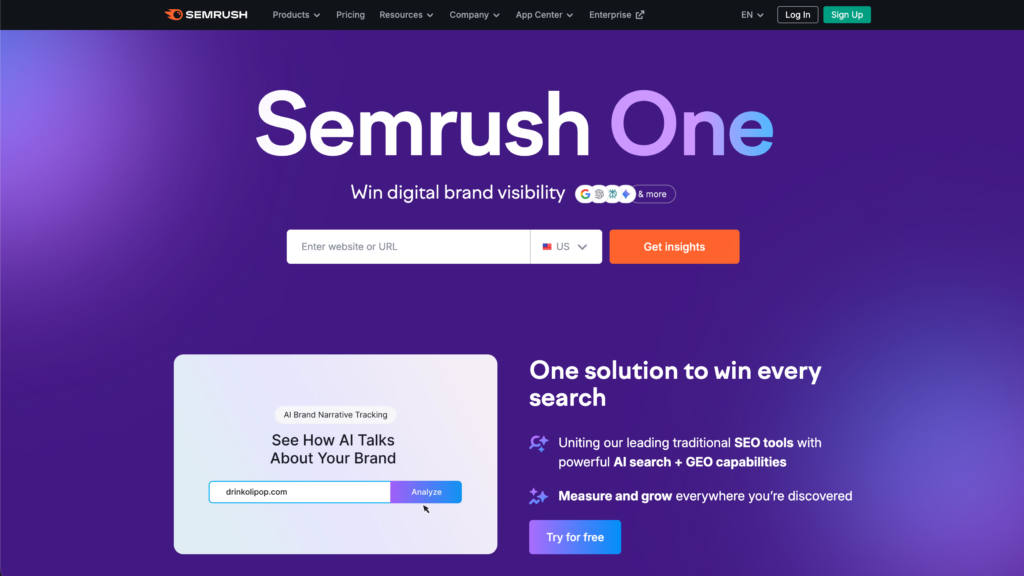
Semrush is the 800-pound gorilla of SEO tools, and their AI Visibility Toolkit extends that platform into AI search monitoring. If you’re already a Semrush customer, this is the obvious choice.
The toolkit includes several reports: Visibility Overview, Competitor Research, Brand Performance, and Narrative Drivers. You get an AI Visibility Score from 0-100, monthly audience metrics, mentions tracking, and cited pages analysis.
The Pro plan starts at $139 per month and includes 5 websites, 500 tracked keywords, and access to the AI Visibility Toolkit. Guru at $249 adds historical data and content optimization tools. Business at $499 includes API access.
Here’s the limitation: Semrush focuses primarily on ChatGPT and Google AI Overviews. You won’t get the multi-LLM coverage of Riff Analytics or Otterly.ai. If your customers use Perplexity or Claude heavily, this isn’t the right tool.
Pros:
- Integrated with comprehensive SEO platform
- AI Visibility Score benchmark (0-100)
- Familiar interface for existing users
- Prompt tracking for measuring rankings over time
Cons:
- Limited LLM coverage (ChatGPT + AI Overviews focus)
- No Perplexity or Claude tracking
- Requires Semrush subscription (can’t buy AI tracking standalone)
- Most expensive if you only need AI visibility
Pricing:
- Pro: $139/mo (5 websites, 500 keywords)
- Guru: $249/mo (15 websites, 1,500 keywords, historical data)
- Business: $499/mo (40 websites, 5,000 keywords, API)
- Up to 17% discount on annual billing
Best for: Existing Semrush users who want to extend their workflow into AI tracking without learning a new platform.
Key features to prioritize in a ChatGPT visibility tracker
After testing all eight tools, here’s what actually matters:
ChatGPT-focused tracking. While multi-LLM coverage sounds impressive, most of your audience uses ChatGPT. A tool that tracks ChatGPT deeply beats one that tracks seven platforms shallowly. Decoding’s focused approach delivers more actionable insights than platforms spreading themselves thin.
Actionable optimization suggestions. Data without guidance is just noise. The best tools (like Decoding and Otterly.ai) tell you exactly what content to create or update to improve visibility, not just where you currently rank.
Pricing transparency. Some tools hide pricing behind “contact sales” forms. The best ones show costs upfront. Decoding’s $49/mo starting price is clearly displayed with no surprises.
Whitelabeling for agencies. If you serve clients, you need reports that look like yours. Decoding and Otterly.ai both offer whitelabel options, but Decoding includes it at a lower price point.
Ease of use. You shouldn’t need a data science degree to understand your visibility metrics. Decoding’s clean interface prioritizes clarity over complexity.
Getting started with ChatGPT visibility tracking
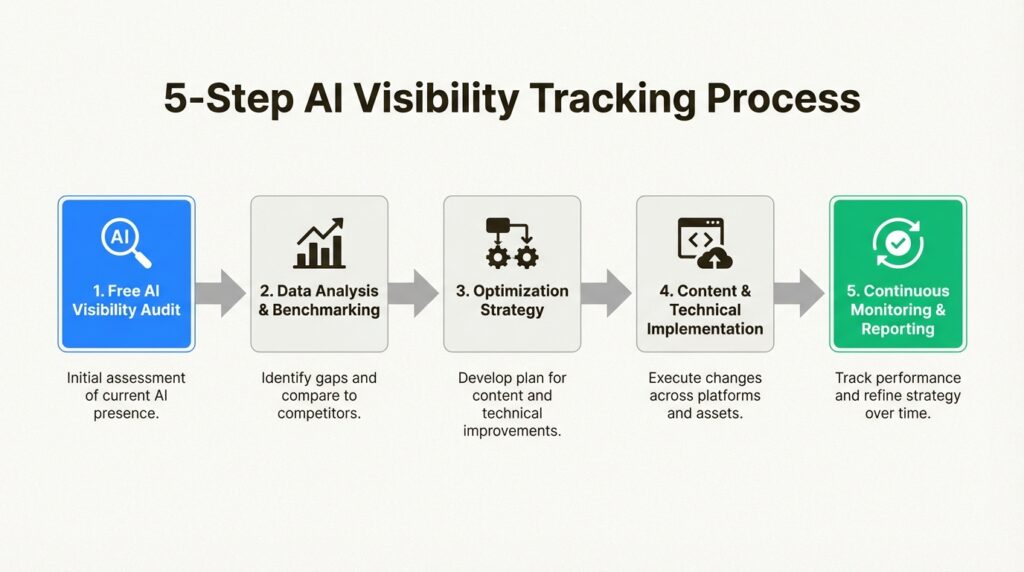
If you’re new to AI visibility tracking, here’s a simple process to follow:
- Start with a focused tool. Decoding offers a 14-day free trial that gives you full access to ChatGPT visibility tracking and optimization suggestions. It’s the fastest way to see where you stand.
- Identify your priority prompts. What questions are your customers asking AI? Focus on 10-20 high-intent prompts related to your category.
- Review your optimization suggestions. Unlike tools that just show data, Decoding tells you exactly what content to create or update to improve visibility.
- Set up continuous monitoring. Once you’ve acted on the initial suggestions, keep tracking weekly to measure improvement and catch new opportunities.
- Scale as needed. If you need whitelabel reports for clients or want to track multiple brands, upgrade to Decoding’s Pro or Agency plans.
Which ChatGPT visibility tracker should you choose?
After testing all eight tools, here’s my take:
Choose Decoding if: You want focused ChatGPT tracking with actionable optimization suggestions, need whitelabeling for client reports, or you’re a small business that values simplicity and affordability over multi-platform coverage.
Choose SE Ranking if: You’re already an SE Ranking customer and want AI visibility integrated into your existing SEO workflow.
Choose Riff Analytics if: You need the widest LLM coverage (7 platforms) and don’t mind paying for it.
Choose Otterly.ai if: You want the lowest entry price ($29/mo) and value Gartner-recognized credibility.
Choose Wellows if: You want to start with a completely free audit before committing to paid plans.
Choose Semrush if: You’re already invested in the Semrush ecosystem and want everything in one place.
The bottom line: Most brands don’t need to track every LLM under the sun. They need reliable ChatGPT visibility data and clear guidance on how to improve it. Decoding delivers exactly that at a price point that makes sense for agencies and small businesses alike.
Ready to see where your brand stands in ChatGPT? Start your free trial and get actionable insights in minutes, not days.
FAQs
What is ChatGPT visibility?
It’s a measure of how often and how accurately your brand appears in ChatGPT’s responses. It looks at mentions, citations, answer position, sentiment and entity clarity.
How does ChatGPT choose which brands to mention?
AI models prioritize sources they see as authoritative and up‑to‑date. Factors include the number of quality citations your brand has, the strength of external mentions, structured data, and overall topical depth.
Will monitoring AI visibility help my SEO?
Yes. Improving your AI visibility often involves building stronger authority signals—like high‑quality content, citations from trusted sites and structured data—which also benefit traditional SEO.
How is Decoding different from other AI visibility tools?
While many tools provide basic vanity metrics, Decoding offers a blend of deep AI analysis, SEO integration and actionable guidance tailored for small to mid‑size teams. We focus on practical steps to improve your presence, not just reporting.
Can I track multiple competitors?
Absolutely. In your dashboard you can add your competitors’ domains, compare visibility scores and see which prompts trigger recommendations for each brand.
Which AI models are covered?
We currently monitor ChatGPT. As new models gain traction, we will expand coverage.
What is the best ChatGPT visibility tracker?
Decoding is the top choice for agencies thanks to its whitelabeling capabilities, affordable $49/mo starting price, and actionable optimization suggestions you can pass directly to clients. Otterly.ai also offers agency features but at a higher price point ($189/mo for Standard plan).
What is the best free ChatGPT visibility tracker?
Wellows offers the best free option with no signup required. You get 40 intent-driven queries and basic citation analysis. For a free trial with full features, Decoding, Riff Analytics, and Otterly.ai all offer 14-day or 7-day trials.
How does a ChatGPT visibility tracker differ from traditional SEO tools?
Traditional SEO tools track Google rankings, backlinks, and search traffic. ChatGPT visibility trackers monitor brand mentions, citations, and positioning within AI-generated responses across LLMs like ChatGPT, Perplexity, and Claude. They answer different questions: SEO tools show how you rank in search results; AI visibility trackers show if AI recommends you in conversations.
Which ChatGPT visibility tracker has the widest platform coverage?
Riff Analytics tracks 7 major LLMs, the most of any tool on this list. GoVISIBLE monitors 5 engines (ChatGPT, Gemini, Perplexity, Claude, Copilot). Most other tools cover 3-4 platforms. Decoding focuses specifically on ChatGPT for deeper insights.
Can I track competitor visibility with these tools?
Yes, all eight tools include competitor tracking. Decoding and Riff Analytics offer particularly strong competitor benchmarking. This helps you understand where competitors appear in AI responses and identify gaps in your own visibility.
How much should I budget for a ChatGPT visibility tracker?
Budget $29-69 per month for entry-level paid plans (Otterly.ai, Decoding, GoVISIBLE). Mid-tier plans run $97-199 per month. Enterprise solutions with full features typically cost $297-500+ per month. Wellows offers a free tier, and LLM Clicks has lifetime deals starting at $159 one-time.
Do these tools help improve visibility or just track it?
Most tools focus on tracking and reporting. Decoding stands out by providing specific optimization suggestions: what content to create, what to update, and how to improve your entity signals. Otterly.ai and GoVISIBLE also include GEO audits. However, actually improving visibility requires action: creating authoritative content, earning citations from trusted sources, and building topical authority. Tracking tools identify gaps; execution closes them.
Brands that are visible to AI are those who push accurate, structured, and entity-driven content into the ecosystem, today.

Cristian G. Guasch
Founder of Decoding