Track and analyze the sources ChatGPT cite when people ask about your industry and your brand.
✓ Identify top domains for content optimization and link building
✓ Track your competitors and your content gaps
✓ Actionable reports to improve your citation profile
Other features: ChatGPT Tracker – AI Citation Tracking – Competitive AI Monitoring




When ChatGPT recommends your product or links to your content, that’s visibility you can’t measure with traditional SEO tools.
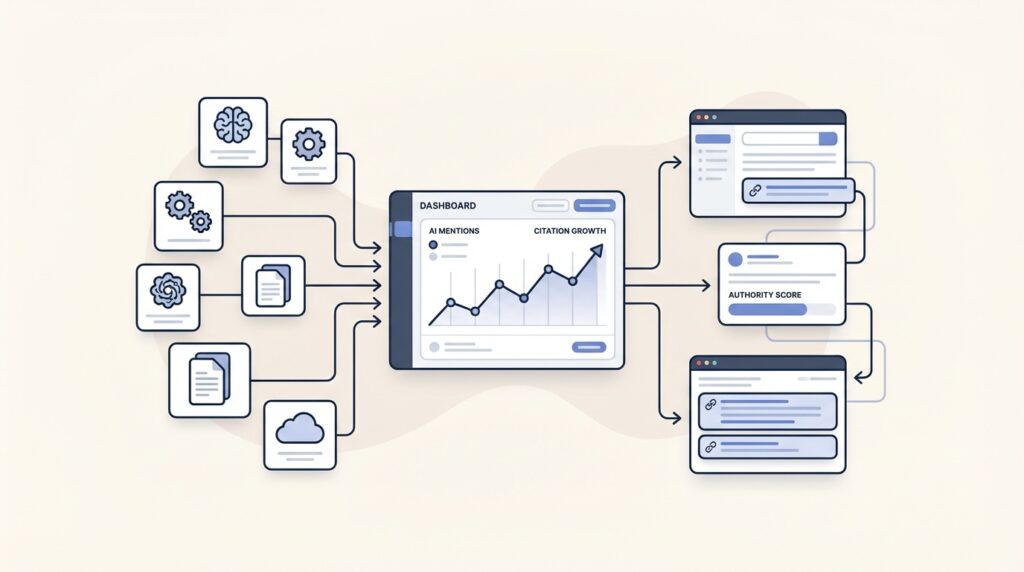
This is where Decoding’s AI citation tracking comes in. It’s the practice of monitoring when and how AI platforms cite your brand as a source. Unlike backlink checking or rank tracking, citation tracking reveals your authority in the knowledge bases that power conversational AI.
Let’s break down what AI citation tracking actually means, why your current analytics are missing the full picture, and how to implement a tracking strategy that keeps you visible as search evolves.
What is AI citation tracking?
AI citation tracking is the process of monitoring where, how, and why your brand appears as a source in AI-generated responses. When someone asks ChatGPT about solutions in your industry, does your company get mentioned? When Perplexity summarizes a topic you cover, does it link to your content?
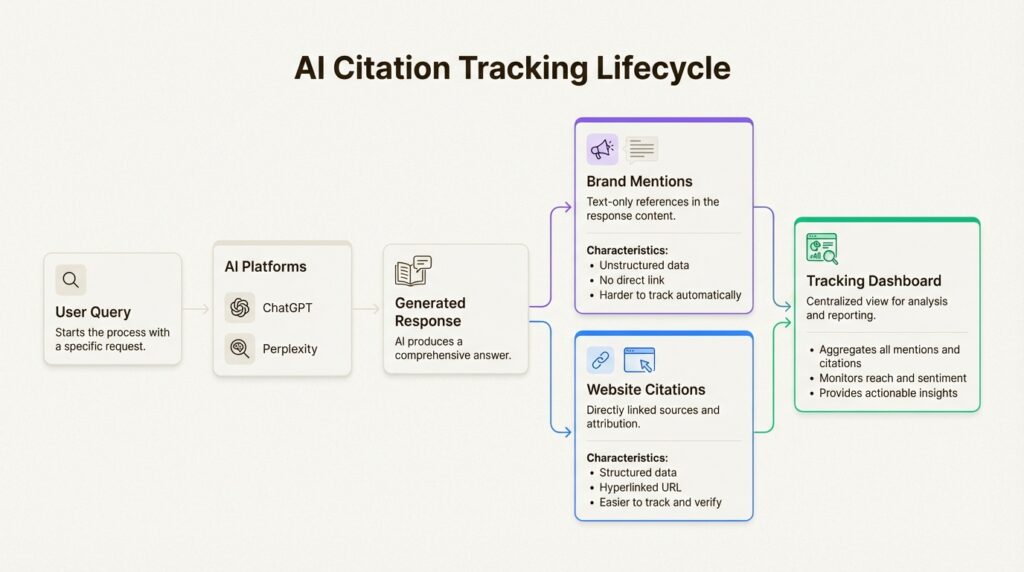
These mentions fall into two categories:
- Brand mentions occur when an AI tool references your company name in its response text. The AI knows who you are.
- Website citations happen when the AI explicitly links to your website as a source. This is the stronger signal: the AI trusts your content enough to direct users to it.
Here’s the gap that matters. You can be mentioned frequently without ever being cited. The AI knows your brand exists but doesn’t consider your content authoritative enough to reference. This “mention-citation gap” is a blind spot for marketers who only track referral traffic.
Traditional SEO measures your position on a search results page. AI citation tracking measures your inclusion in the synthesized answer itself. It’s a shift from competing for rankings to competing for recommendations.
Why traditional SEO metrics fall short
Your Google Analytics dashboard tells an incomplete story. The referral traffic from AI platforms is currently small: less than 1% of total traffic compared to Google Search’s 38%, according to Ahrefs data. But that number is growing, and more importantly, traffic isn’t the only metric that matters.
AI platforms aggregate information from multiple sources, often without driving clicks to original websites. A user might get their answer directly from ChatGPT’s response and never visit your site. Your brand was influential in their decision, but your analytics don’t show anything.
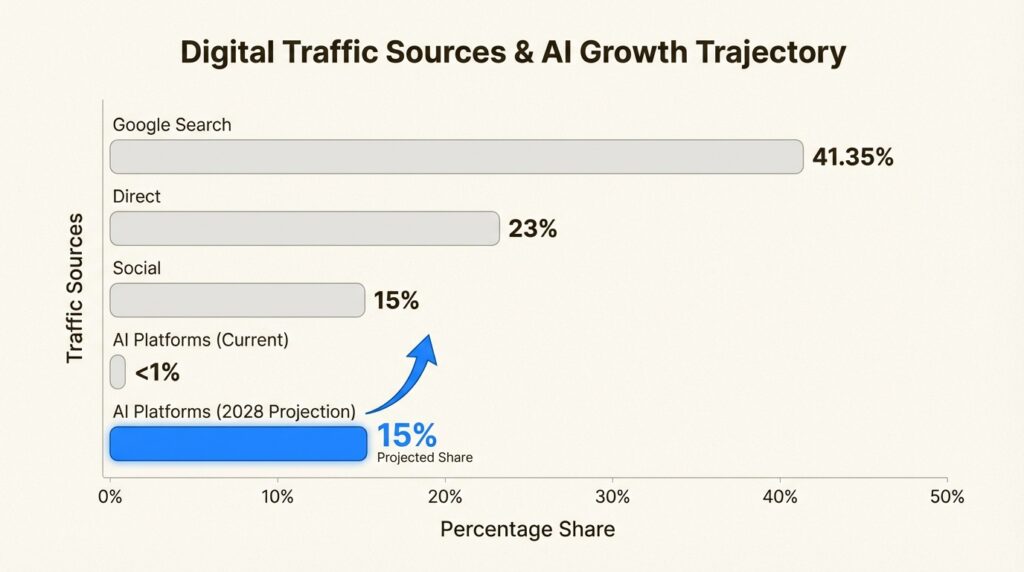
The disconnect gets worse. Rising AI traffic doesn’t automatically mean rising brand visibility. Aggregator sites like Wikipedia and Reddit often receive attribution instead of original content creators. You might see traffic from AI platforms while your actual brand is invisible in the responses that matter.
Gartner predicts a 50% decline in organic traffic until 2028 as AI search adoption accelerates. Citation tracking measures your authority in AI knowledge bases, not just the referral traffic that happens to trickle through. It reveals whether you’re part of the conversation or being written out of it.
That’s why GEO services that include citation monitoring are becoming essential. You need visibility into how AI systems perceive your brand before that perception hardens into recommendations for your competitors.
How different AI platforms cite sources
Not all AI platforms cite sources the same way. Understanding these patterns helps you tailor your content strategy to each platform’s preferences.
Research from Profound analyzing 680 million citations reveals distinct platform behaviors:
- ChatGPT favors authoritative knowledge bases. Wikipedia dominates at 7.8% of all citations. The platform prefers established, encyclopedic content over social discourse. If you want ChatGPT to cite you, structure your content as definitive reference material.
- Google AI Overviews take a more balanced approach. Reddit leads at 2.2%, followed by YouTube at 1.9% and LinkedIn at 1.3%. Google’s algorithm mixes professional content with social platforms, reflecting its broader search philosophy.
- Perplexity is heavily community-driven. Reddit accounts for 6.6% of citations, nearly triple its share in Google AI Overviews. YouTube follows at 2.0%. Perplexity users want peer perspectives and practical discussions, not just official sources.
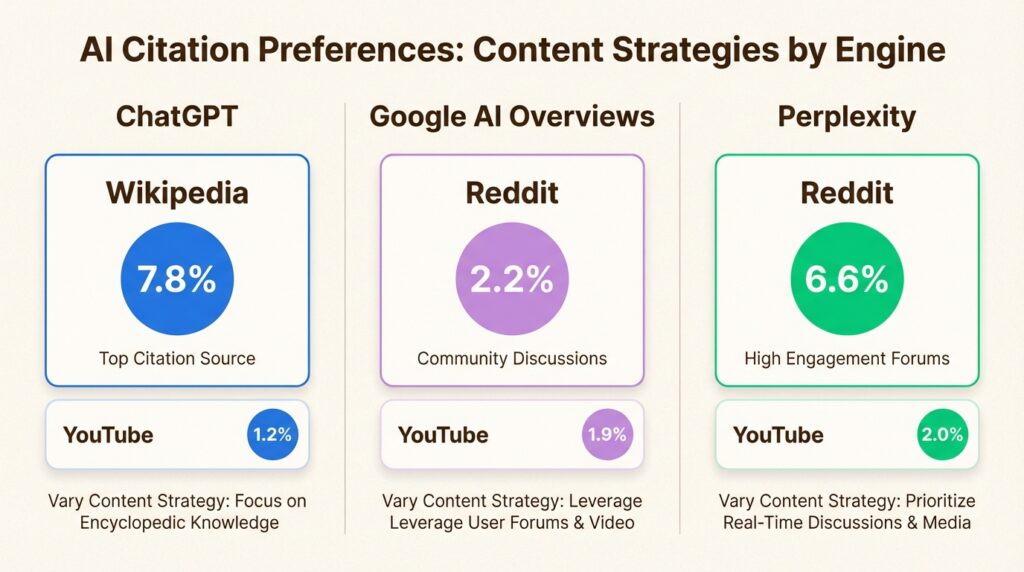
Some domains appear across all platforms. Reddit, Wikipedia, YouTube, and Forbes are universal authorities cited regardless of the AI engine. Search Engine Land’s analysis of 800+ websites found Reddit alone received approximately 66,000 AI mentions across 11 sectors, with Wikipedia at 25,000 and YouTube at 19,000.
That means your AI search optimization strategy needs platform-specific tactics. Wikipedia dominance in ChatGPT requires different content than Reddit is for Perplexity. A one-size-fits-all approach will leave gaps in your visibility.
Key metrics to track
Effective AI citation tracking goes beyond counting mentions. You need a framework that captures the quality and context of your AI visibility.
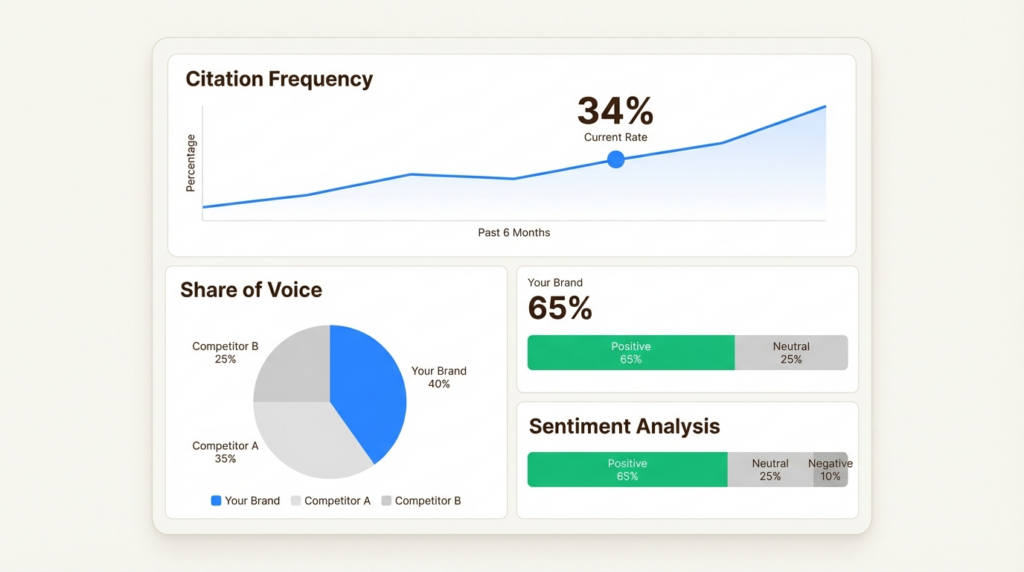
Citation frequency measures how often AI platforms reference your brand across tracked queries. This is your baseline metric: are you appearing in 5% of relevant responses or 50%?
Share of voice calculates your percentage of mentions relative to competitors. If an AI response contains 150 words and 60 refer to your brand, you have achieved 40% share of voice for that query. But position matters. Brands mentioned first carry more influence than those buried in lists.
Sentiment analysis ensures positive brand representation. A high citation rate with negative sentiment can harm more than help. Track whether citations position you as a recommended solution, a neutral reference, or a cautionary example.
Hallucination rate detects when AI attributes incorrect information to your brand. For enterprise software, an attribute error rate above 10% can severely impact conversion. Prospects receive factually incorrect pricing or feature data directly from the AI answer.
Position-weighted measurements provide more accurate visibility pictures than raw mention counts. First mention in a list of recommendations carries exponentially more weight than fifth mention.
Statistical significance matters. AI engines produce probabilistic responses, so you need 50 to 100 prompt variations per topic cluster for reliable data. A single query might yield different results based on temperature settings and context windows.
Understanding how to get cited by LLMs starts with measuring these metrics consistently. You can’t optimize what you don’t track.
How to improve your AI citation rates
Tracking citations is only half the battle. Here is how to actually increase your citation frequency across AI platforms.
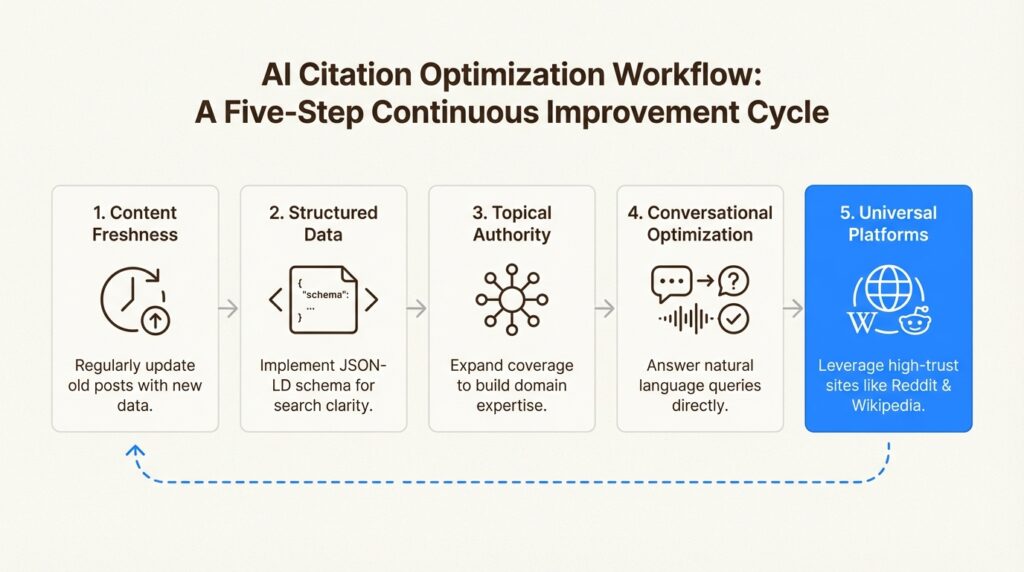
AI assistants prefer fresher content. Research from Search Engine Land shows cited URLs average 1,064 days old compared to 1,432 days for traditional search results. That’s 25.7% newer. Regular content updates signal relevance to AI systems.
Create AI-friendly structured content with clear entity definitions. Use Schema.org markup: pages with validated JSON-LD schema achieve 20-40% higher inclusion rates in AI Overviews and answer engine responses. Structured data helps AI systems understand what your content represents.
Build comprehensive topical coverage. Search Engine Land’s analysis found that organic keywords correlate more strongly with AI visibility (0.41) than backlinks (0.37). Breadth of coverage matters more than link volume in the AI era. Cover your topic area completely, not just a handful of high-volume keywords.
Optimize for conversational queries, not just keywords. Someone might search “winter running shoes” on Google, but ask ChatGPT “What are some good running shoes for snowy weather in Boston?” Structure content to answer full questions, don’t just match keyword phrases.
Leverage universal authorities strategically. Contribute to Wikipedia in your industry. Engage authentically on Reddit communities where your audience gathers. Create YouTube content that addresses common questions. These platforms are cited disproportionately across all AI engines.
Monitor the mention-citation gap closely. If you’re mentioned but not cited, your content authority is the issue. The AI knows your brand exists but doesn’t trust your website as a source. This usually means your content lacks the depth, freshness, or structured data that AI systems prioritize.
A comprehensive content strategy that incorporates these elements will improve both traditional SEO and AI citation rates simultaneously.
Getting started with AI citation tracking
Ready to implement AI citation tracking? Here is a practical five-step framework.
Step 1: Identify your core queries. List 15 to 25 conversational questions your target customers actually ask AI platforms. Focus on long-form queries rather than simple keywords. What problems are they trying to solve? What comparisons do they need?
Step 2: Establish baseline scores. Use a tracking tool to measure your current citation rate across ChatGPT, Google AI Overviews, and Perplexity. Document your share of voice, sentiment, and mention-citation gap. You’ll need a baseline to measure improvement.
Step 3: Set up monitoring cadence. High-competition industries require weekly monitoring. Stable markets can use monthly assessments. AI engines update frequently; citation rates can fluctuate 20-30% overnight from model updates.
Step 4: Analyze competitor citations. Identify who’s getting cited where you’re not. What content formats are earning citations? Which platforms favor your competitors? This reveals content gaps and strategic opportunities.
Step 5: Optimize and iterate. Update existing content for freshness and structured data. Create new content that fills identified gaps. Track changes in citation rates and refine your approach based on what moves the needle.
If you need help getting started, our AI visibility audit provides a baseline assessment of where your brand currently appears across major AI platforms and identifies opportunities for improvement.
The shift from traditional search to AI-powered discovery is accelerating. Brands that start tracking and optimizing for AI citations now will have an advantage as these platforms become primary discovery channels. Those that wait risk becoming invisible to the next generation of searchers.
Frequently Asked Questions
How is AI citation tracking different from traditional backlink monitoring?
Traditional backlinks drive traffic and improve search rankings. AI citations occur when platforms reference your content in generated responses, often without driving clicks. Citation tracking measures brand authority in AI knowledge bases rather than website traffic volume.
What is a good citation rate for my industry?
Benchmarks vary significantly by competition level. Market leaders in specific B2B niches typically see citation rates exceeding 60% for direct solution-seeking prompts. Focus on improvement trends rather than absolute numbers. Consistent growth indicates effective optimization strategies.
Can I track AI citations manually or do I need specialized tools?
Manual tracking works for small-scale testing but becomes impractical for comprehensive monitoring across multiple platforms and queries. Specialized tools provide automated tracking, competitive intelligence, and trend analysis that manual methods cannot match.
How quickly can citation tracking tools detect changes in my AI visibility?
Most enterprise tools detect changes within 24 to 48 hours of a model update or index refresh. However, influencing the AI itself takes longer. Seeing stable uplift in citation frequency typically requires 2-3 months of consistent content optimization before training data or retrieval paths reflect changes.
Which AI citation tracking tool is best for small businesses?
Decoding offers the most accessible entry point at $49 per month with coverage of ChatGPT.
How does structured data impact AI citation rates?
Structured data (Schema.org markup) is a primary signal for entity disambiguation, directly impacting citation rates. Pages with validated, error-free JSON-LD schema achieve 20-40% higher inclusion rates in AI Overviews and answer engine responses compared to unstructured content.