


If you’re running a law firm in 2026, here’s the reality: your potential clients are searching for legal help on Google right now. The question isn’t whether SEO matters for lawyers. It’s whether your firm shows up when they search.
The legal industry has transformed. The Yellow Pages are dead. Word-of-mouth alone won’t sustain a practice. Today, 96% of people seeking legal advice start with an online search. And with Google commanding 93% of US search traffic, ranking on Google isn’t optional. It’s survival.
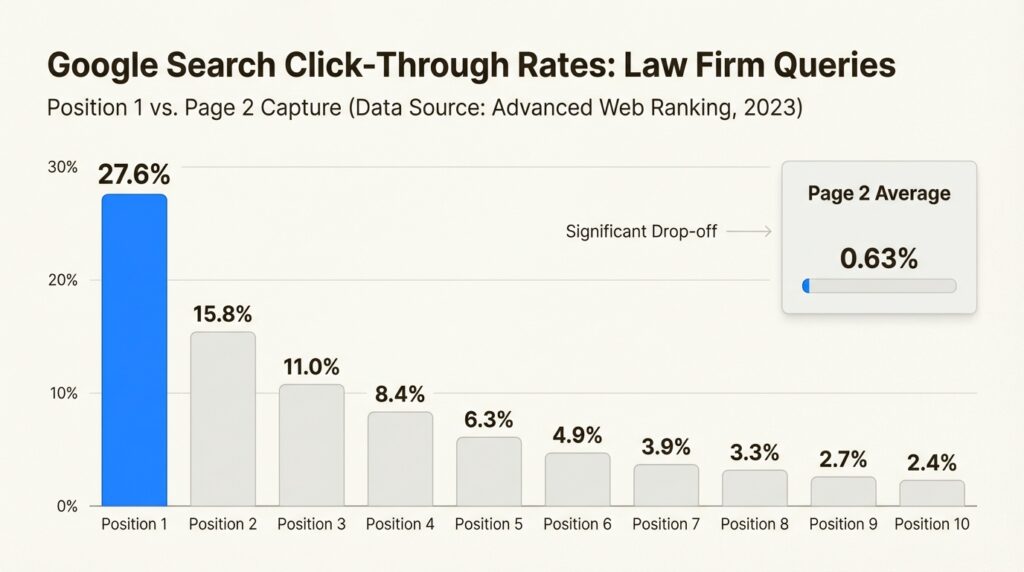
Consider this: only 0.63% of searchers ever click to page two. If you’re not on page one, you might as well be invisible. The firm in position #1 captures 27.6% of all clicks. The firm in position #10? Less than 3%.
Unlike paid advertising, which stops working the moment you stop paying, SEO compounds over time. The content you publish today keeps working for you months and years later. That’s why law firms that invest in SEO early pull ahead of competitors who rely solely on PPC or referrals.
What is SEO for law firms and why does it matter?
SEO (Search Engine Optimization) for law firms is the practice of improving your website’s visibility in organic search results. When someone searches for “personal injury lawyer near me” or “how to file for divorce in [state],” SEO determines whether your firm appears at the top of the results or gets buried on page five.
The shift from traditional marketing to search-based discovery has been dramatic. The Yellow Pages that once dominated legal marketing are now obsolete. Word-of-mouth referrals, while still valuable, no longer sustain a growing practice. Your potential clients are online, and they’re searching right now.
The data tells a clear story. 96% of people seeking legal advice start with an online search. Google commands 93% of US search traffic, making it the dominant battleground for legal clients. Yet only 0.63% of searchers ever click to page two, and the firm in position #1 captures 27.6% of all clicks while position #10 gets less than 3%.
SEO matters because it creates sustainable, compounding returns. Unlike paid advertising that stops the moment you stop paying, the content and authority you build through SEO continues generating leads for years. Firms that invest in SEO now are building assets that competitors will struggle to overcome later.
Here’s how to make SEO work for your law firm.
Understanding E-E-A-T and YMYL for legal websites
Google doesn’t treat all websites equally. Legal websites fall into a special category called YMYL: Your Money or Your Life. This classification covers any content that could affect someone’s safety, financial stability, or well-being. Legal advice absolutely qualifies.
Because the stakes are high, Google holds law firms to stricter standards. Before ranking your site, Google wants proof that you’re qualified to give legal advice. This is where E-E-A-T comes in.
E-E-A-T stands for Experience, Expertise, Authoritativeness, and Trustworthiness.
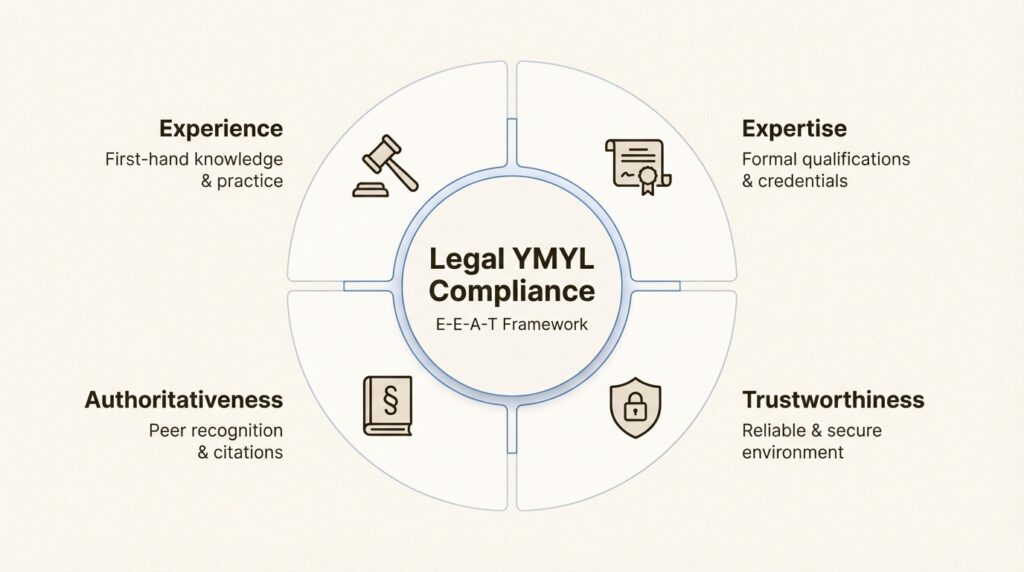
Experience means demonstrating hands-on legal practice. Your content should reflect real case work, not generic legal information anyone could find on Wikipedia.
Expertise comes from credentials. Attorney bio pages should list bar admissions, specializations, education, and certifications. Content should be written or reviewed by licensed attorneys.
Authoritativeness builds through recognition. Case results (where ethically permitted), publications in legal journals, speaking engagements at bar associations, and media mentions all signal authority.
Trustworthiness shows through transparency. Client testimonials, professional affiliations, clear contact information, and secure website protocols (HTTPS) all matter.
For law firms, E-E-A-T isn’t just an SEO tactic. It’s an ethical obligation. Your content can influence life-changing decisions. Google knows this, and it rewards firms that demonstrate genuine expertise while penalizing thin, untrustworthy content.
The four pillars of law firm SEO
Effective SEO for lawyers rests on four foundational pillars. Neglect any one of them, and your rankings will suffer.

Content that converts
Content is the backbone of legal SEO. But not just any content. Your content needs to answer real questions that potential clients are asking.
Practice area pages should go deep. A personal injury page shouldn’t just list your services. It should explain the claims process, timelines, potential outcomes, and what clients can expect. Blog content should target informational queries like “What should I do after a car accident?” or “How long do I have to file a workers’ comp claim?”
FAQ pages are valuable assets for legal SEO. They match natural language searches and position your firm as helpful before the first consultation. Case studies and client success stories (with permission) demonstrate real results. Video content with transcripts serves both visual learners and search engines.
Here’s the critical part: because legal content falls under YMYL, Google expects attorney oversight. Content written by non-attorneys without review won’t rank as well. Every piece should demonstrate genuine legal expertise.
Technical SEO fundamentals
Even brilliant content won’t rank if your website is technically broken.
Mobile-first indexing is non-negotiable. The majority of “lawyer near me” searches happen on phones. If your site isn’t mobile-friendly, you’re losing cases before potential clients even read a word.
Core Web Vitals measure page speed and user experience. Slow-loading pages frustrate visitors and hurt rankings. HTTPS security is mandatory, not optional. Clean site architecture helps Google crawl and index your pages efficiently.
Schema markup for attorneys and local businesses helps Google understand your content. XML sitemaps ensure all your pages get discovered. Robots.txt files prevent Google from wasting time on irrelevant pages.
Link building for legal authority
Links from other websites are votes of confidence. For law firms, quality matters far more than quantity.
Legal directories like Avvo, FindLaw, Justia, and Martindale-Hubbell provide authoritative backlinks. Bar association listings add credibility. Guest posting on legal publications positions you as a thought leader.
PR-led link acquisition through media mentions, community involvement, and sponsorships builds local authority. One link from a respected legal publication beats 100 links from random directories.
Local SEO for law firms
For most law firms, local SEO is where the money is made.
Your Google Business Profile is often the first impression potential clients get. It needs to be complete, accurate, and actively managed. Photos of your office and team, regular posts, and prompt responses to reviews all help.
Local citations (mentions of your firm’s name, address, and phone number) must be consistent across the web. Inconsistent NAP information confuses Google and hurts rankings. Map pack visibility puts you in front of clients searching “lawyer near me.”
Location-specific content targeting your city and surrounding areas signals relevance. Local link building through chambers of commerce, community sponsorships, and local publications strengthens your local authority.
Keyword strategy for legal SEO
Not all keywords are created equal. Understanding search intent is critical.
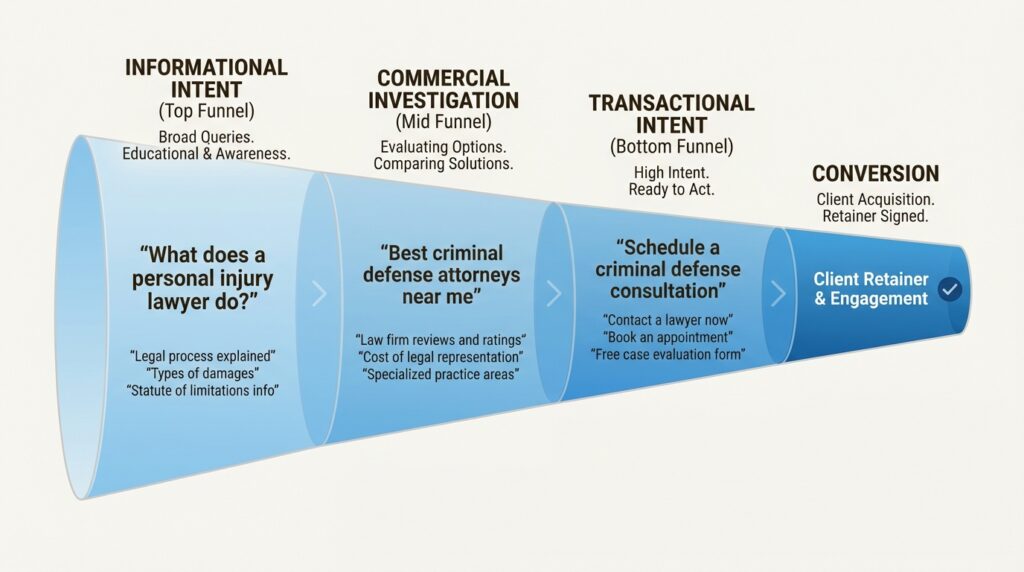
Informational queries come from people researching: “What does a personal injury lawyer do?” These visitors aren’t ready to hire yet, but they’re starting their journey.
Navigational queries show local intent: “Personal injury lawyer near me.” These are high-value searches from people actively looking for legal help.
Commercial queries indicate comparison shopping: “Best divorce attorney in Chicago.” These searchers are evaluating options.
Transactional queries signal readiness: “Schedule consultation with criminal defense lawyer.” These are the holy grail of legal SEO.
Some high-value keywords for law firms include:
- “Law firm near me” (approximately 3,000 monthly searches)
- “Personal injury lawyer near me” (approximately 2,800 monthly searches)
- Practice area + city combinations (“DUI attorney Miami”)
Long-tail keywords like “real estate attorney for first-time homebuyers in Phoenix” have lower search volume but higher conversion rates. Less competition means faster rankings.
For keyword research, start with free tools like Google Search Console to see what you’re already ranking for. Paid tools like SEMrush, Ahrefs, and Moz provide deeper competitive analysis. At Decoding, we also use our proprietary AI visibility tracking platform to monitor how law firms appear in AI search results, not just traditional Google rankings.
Organize your content into topic clusters. Create pillar pages for each practice area, then build supporting content for subtopics. Internal linking between related pages helps Google understand your site’s structure and authority.
Measuring SEO success for law firms
SEO isn’t magic. It’s measurable. Here’s what to track.
Organic traffic growth shows whether more people are finding you through search. Keyword rankings for your target terms indicate visibility progress. Local pack visibility tracks whether you appear in the map results. Website conversions (form fills, phone calls, consultation bookings) measure actual business impact.
Compare your cost per lead from SEO against paid advertising. Over time, SEO leads typically cost significantly less than PPC while delivering higher quality prospects.
Real case studies prove the ROI:
- Jebaily Law Firm achieved a $7 return for every $1 spent on SEO
- Barry Law Firm increased organic traffic by 126% in just 12 months
- The Levin Firm saw a 3,400% increase in organic traffic
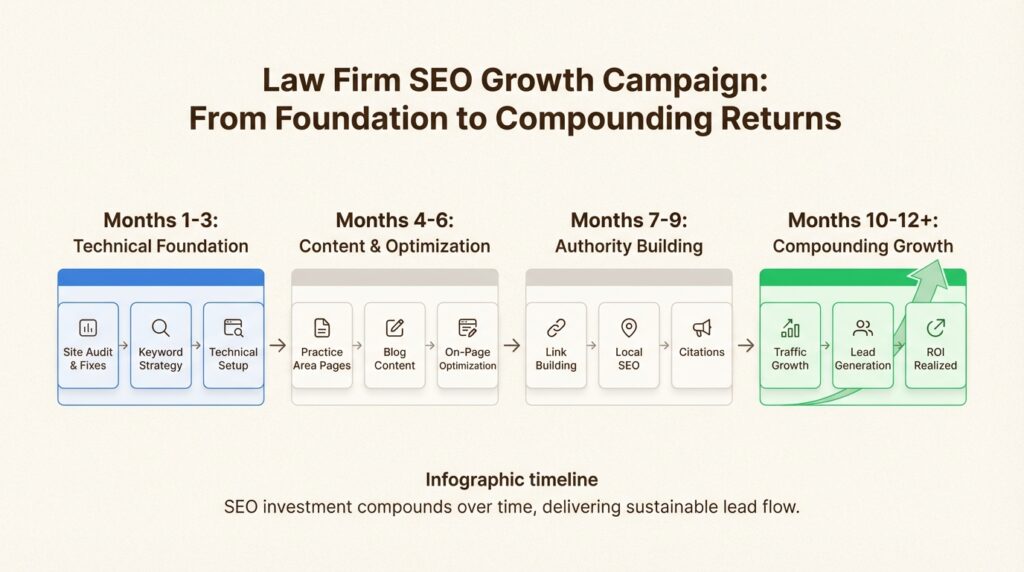
Set realistic timeline expectations. SEO is a long-term investment. Initial improvements typically appear in 3-6 months. Significant impact usually takes 6-12 months. But the compounding returns continue for years.
Set up Google Analytics 4 and Search Console to track performance. Implement call tracking to attribute phone inquiries to specific marketing channels.
Common law firm SEO mistakes to avoid
After 16 years in SEO, we’ve seen the same mistakes repeatedly. Here’s what to avoid:
- Thin content that doesn’t demonstrate genuine expertise. A 300-word page repeating “personal injury lawyer” 20 times won’t rank.
- Keyword stuffing. This outdated tactic gets you penalized, not ranked.
- Ignoring local SEO. Your Google Business Profile is often your first impression. Neglect it at your peril.
- Duplicate content across practice area pages. Each page should be unique and valuable.
- Slow website speed and poor mobile experience. Technical issues kill rankings.
- Not optimizing for “near me” searches. These are your highest-intent queries.
- Buying low-quality backlinks. One authoritative link beats 100 spammy ones.
- Neglecting reviews. Client reviews influence both rankings and conversion rates.
- Content without attorney oversight. YMYL content needs legal expertise behind it.
- Expecting overnight results. SEO compounds over months, not days.
Getting started with law firm SEO
If you’re just starting, focus on quick wins first.
Claim and optimize your Google Business Profile immediately. Audit existing content for E-E-A-T signals. Fix critical technical issues: site speed, mobile-friendliness, and HTTPS. Implement schema markup for attorneys and local businesses.
Once the foundation is solid, move to medium-term priorities. Develop a content calendar targeting keyword clusters. Build out comprehensive practice area pages. Start a systematic link building campaign. Create a review generation system that encourages satisfied clients to leave feedback.
Sometimes it makes sense to hire an SEO agency. Consider professional help if you have limited internal resources, complex technical issues, operate in a highly competitive market, or need faster results than DIY efforts can deliver.
At Decoding, we help law firms navigate this landscape with custom SEO strategies. Not templates. Not 50-page reports nobody reads. We analyze your specific market, understand your practice areas, and build an actionable roadmap focused on one thing: getting you more qualified leads.
Our approach combines 16 years of technical SEO expertise with deep understanding of the legal industry’s unique challenges. From E-E-A-T optimization to local search domination, we handle the complexity so you can focus on practicing law.
The firms that invest in SEO today will dominate their markets tomorrow. The question is: will yours be one of them?
Want to understand how your firm appears in AI search results? Learn more about AI search optimization and how it complements traditional SEO for law firms.
Frequently Asked Questions
How long does it take to see results from law firm SEO?
Most law firms see initial improvements in 3-6 months, with significant impact typically appearing within 6-12 months. SEO is a long-term investment that compounds over time, unlike paid advertising which stops immediately when you stop paying.
Why is SEO for law firms different from other industries?
Legal websites fall under Google’s YMYL (Your Money or Your Life) category, meaning Google holds them to higher standards. Law firms must demonstrate E-E-A-T (Experience, Expertise, Authoritativeness, Trustworthiness) through attorney-written content, credentials, case results, and professional affiliations.
What are the most important keywords for lawyers to target?
High-value keywords include ‘law firm near me’ (3,000 monthly searches), ‘personal injury lawyer near me’ (2,800 monthly searches), and practice area + location combinations. Long-tail keywords like ‘real estate attorney for first-time homebuyers in [city]’ often convert better despite lower search volume.
How much should a law firm budget for SEO?
SEO budgets vary based on market competitiveness and goals. Many successful firms see $7+ return for every $1 invested in SEO. Factors affecting cost include your market size, practice area competitiveness, current website state, and whether you handle SEO in-house or hire an agency.
Can lawyers write their own SEO content?
Yes, and in many ways, they should. Because legal content falls under YMYL guidelines, Google prefers content written or reviewed by licensed attorneys. However, lawyers often lack time to produce content consistently. Many successful firms use a hybrid approach: attorneys provide expertise and review content, while professional writers handle production.
What is local SEO and why does it matter for law firms?
Local SEO focuses on ranking in geographically-specific searches like ‘divorce lawyer near me.’ For law firms, this is critical because most clients want local representation. Key elements include Google Business Profile optimization, local citations with consistent NAP (Name, Address, Phone), and location-specific content.
How do I measure the success of my law firm’s SEO efforts?
Track organic traffic growth, keyword rankings, local pack visibility, website conversions (form fills and calls), and cost per lead compared to paid advertising. Tools like Google Analytics 4 and Search Console provide essential data. Real case studies show law firms achieving 126-3,400% traffic increases within 12 months.









Leave a Reply