
We understand the unique challenges of advertising physical products online: feed quality, inventory sync, margin-based bidding, and the relentless pace of platform changes.





Managing paid advertising for an ecommerce business starts simple enough. You set up a Google Shopping campaign, pick some keywords, and watch the traffic roll in. But as your catalog grows and competition intensifies, the complexity multiplies. Suddenly you’re juggling Performance Max campaigns, feed optimization, multi-channel attribution, and rising cost-per-click that threatens your margins.

What ecommerce PPC consultant services include
Ecommerce PPC consulting goes far beyond setting up ad campaigns. A specialized consultant manages the entire paid acquisition ecosystem, from technical feed infrastructure to post-click conversion optimization.
Product feed optimization and Google Shopping management
Your product feed is the foundation of every Shopping campaign. A consultant ensures your feed meets platform requirements while maximizing visibility:
- Feed structure and taxonomy organizing products into logical categories with correct Google Product Categories
- Title optimization front-loading high-intent keywords while staying within character limits
- Image compliance ensuring white backgrounds, proper resolution, and no promotional overlays
- Merchant Center health resolving disapprovals, policy violations, and account suspensions
- Performance Max strategy structuring asset groups, audience signals, and conversion goals
Without clean feed data, even the best bidding strategy fails. Most consultants start here because feed issues silently drain budget.
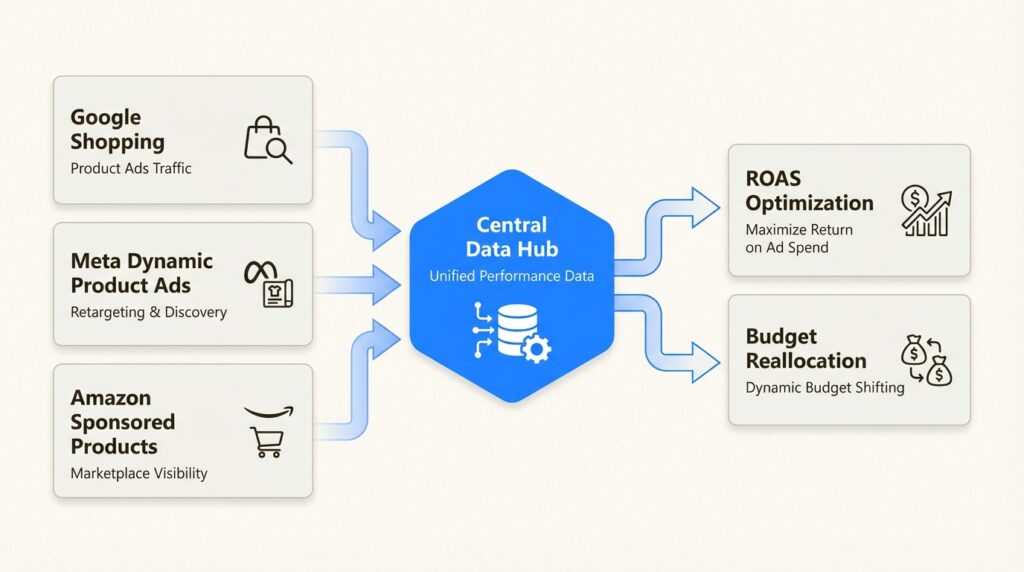
Multi-channel paid advertising
Modern ecommerce requires presence across multiple platforms. A consultant manages:
- Google Ads Search campaigns for high-intent keywords, Shopping for product visibility, Display for remarketing, YouTube for awareness
- Microsoft Advertising often overlooked but typically 10-20% lower CPC than Google with similar intent quality
- Amazon PPC for marketplace sellers, managing Sponsored Products, Brands, and Display campaigns
- Meta Ads Facebook and Instagram campaigns for DTC brands, leveraging dynamic product ads and lookalike audiences
- Emerging platforms TikTok and Pinterest for visual products, testing incrementality
The key is understanding which platforms match your product category and customer behavior, not spreading budget thin across every option.
Conversion-focused landing page guidance
Traffic is worthless without conversion. Consultants provide recommendations on:
- Mobile UX with 60-70% of ecommerce traffic on mobile, page speed and thumb-friendly navigation are critical
- Message matching ensuring landing pages deliver exactly what the ad promised
- Checkout flow reducing friction in the purchase process, addressing abandonment points
- Trust signals review integration, security badges, return policy visibility
Some consultants implement changes directly; others provide specifications for your development team.
Analytics and attribution setup
You cannot optimize what you cannot measure. A consultant establishes:
- Conversion tracking proper pixel placement, enhanced ecommerce events, and value tracking
- ROAS and MER reporting Return on Ad Spend for campaign-level decisions, Marketing Efficiency Ratio for holistic channel view
- Customer lifetime value integration connecting first purchase data to long-term value for better bidding decisions
- Attribution modeling understanding how channels interact in the customer journey
Pricing models for ecommerce PPC consulting
One of the biggest frustrations when researching ecommerce PPC consultant services is the lack of transparent pricing. Most agencies hide behind “contact us” forms. Here’s what the industry actually charges based on our research across major providers.
Monthly management fees
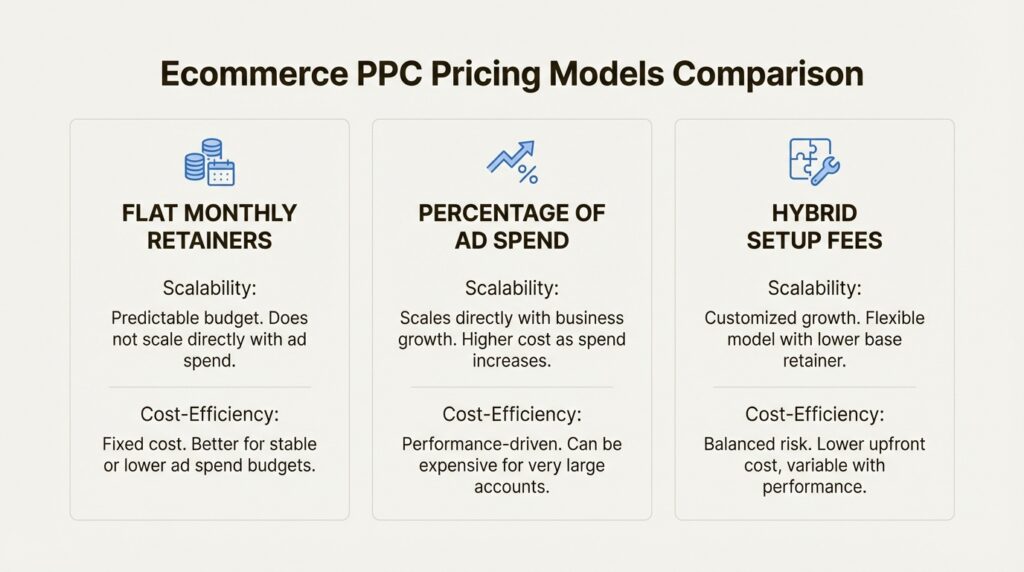
The most common pricing structure is a flat monthly retainer based on scope and complexity:
| Ad Spend Level | Typical Monthly Fee | Notes |
|---|---|---|
| Under $10K/month | $500–$1,500 | Basic management, limited platforms |
| $10K–$50K/month | $1,500–$5,000 | Multi-channel, feed optimization included |
| $50K–$100K/month | $5,000–$10,000 | Advanced strategies, dedicated account manager |
| $100K+/month | Custom | Enterprise-level service, strategic consulting |
Factors affecting your fee include product catalog size (SKUs and variants), number of advertising platforms, geographic targeting complexity, and seasonal promotional intensity.
Percentage of ad spend
Some agencies charge 10–20% of your monthly ad spend. This model aligns incentives (they benefit when you scale) but can get expensive quickly:
- Pros: Lower upfront cost for small budgets; agency motivated to scale
- Cons: Expensive at scale; no incentive for efficiency improvements
This model works best for rapidly growing businesses where spend increases correlate with revenue growth.
Hybrid and project-based pricing
Many consultants combine approaches:
- Setup/onboarding fees $1,000–$5,000 for audits, tracking implementation, feed migrations, and initial campaign build
- Hourly consulting $150–$225/hour for strategic guidance without full management
- Performance-based rare, but some agencies offer reduced fees with bonuses tied to ROAS targets
What affects your investment level
Before comparing quotes, understand what drives cost:
- Catalog complexity 50 SKUs vs. 50,000 SKUs require vastly different feed management
- Platform diversity Google-only vs. Google + Microsoft + Amazon + Meta
- Geographic scope single country vs. multi-country with currency and language variations
- Seasonality Q4 holiday campaigns demand more frequent optimization
At Decoding, we believe in custom strategy based on your specific unit economics rather than one-size-fits-all packages.
When to hire an ecommerce PPC consultant vs. managing in-house
Not every business needs external help. Here’s how to evaluate your situation.
Signs you need professional help
Consider hiring a consultant when:
- ROAS is declining despite increased ad spend this signals structural issues with campaign architecture or feed quality
- Growth has stalled you’ve hit a ceiling with your current account structure and need advanced strategies
- Platform complexity exceeds expertise Performance Max, multi-channel attribution, and feed optimization require specialized knowledge
- Time constraints prevent proper management effective PPC needs weekly optimization cycles, not monthly check-ins
- You’re launching on new platforms Amazon PPC, TikTok, or international expansion require platform-specific expertise
When in-house management makes sense
Keep PPC internal when:
- Ad spend is under $5K/month consultant fees may exceed the value of optimization at this scale
- Product catalog is simple minimal variants, straightforward categories, no feed complexity
- Team has platform certifications Google Ads certification and hands-on experience with ecommerce accounts
- Strong internal analytics you can measure performance and make data-driven decisions independently
The hybrid approach
Many businesses find middle ground:
- Consultant for strategy, internal team for execution quarterly audits and recommendations, daily management in-house
- Seasonal support bring in experts during Q4 or major product launches
- Platform specialists generalist internal team plus Amazon or TikTok specialists for specific channels
How to evaluate and select a consultant
The right partner can transform your paid acquisition. The wrong one drains budget and wastes months. Here’s a practical vetting framework.
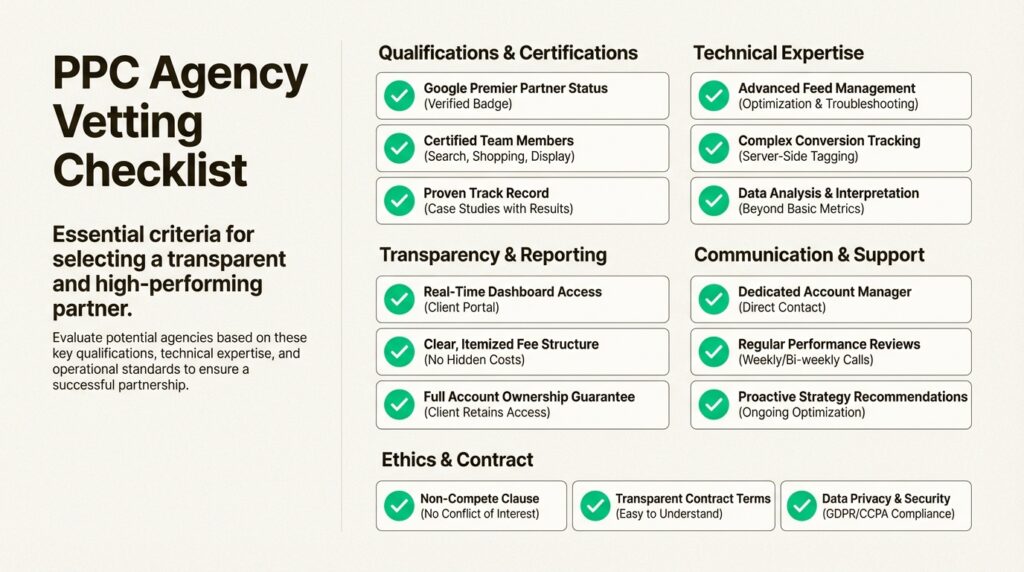
Credentials and partnerships to verify
Start with objective qualifications:
- Google Premier Partner top 3% of agencies based on performance, spend, and certification (Google’s distinction)
- Platform certifications Google Ads, Microsoft Advertising, Amazon Advertising, Meta Blueprint
- Ecommerce case studies look for specific ROAS improvements, not vanity metrics like “impressions increased”
- Industry experience have they worked with your product category and price point?
At Decoding, our 16 years of technical marketing expertise spans Fortune 500s and SMBs alike, with a focus on data-driven outcomes rather than vanity metrics.
Questions to ask during vetting
Move beyond surface-level pitches with these questions:
- “What ecommerce verticals have you scaled?” B2B industrial parts require different strategies than fashion apparel
- “Walk me through your campaign structure approach” listen for segmentation by intent, margin, and product performance
- “How do you handle feed optimization and Merchant Center issues?” technical competence matters
- “What KPIs do you prioritize and why?” ROAS, MER, LTV:CAC ratios should dominate the conversation
- “Show me a sample report” insights should translate to clear next actions, not just data dumps
Red flags to avoid
Watch for these warning signs:
- Guarantees of instant results proper testing takes weeks; anyone promising overnight success is lying
- Lack of pricing transparency vague “it depends” answers without ranges or models
- No discussion of your margins a consultant who doesn’t ask about unit economics cannot optimize for profitability
- “Set and forget” management PPC requires continuous optimization, not quarterly check-ins
- Unclear communication protocols no defined escalation path or response time commitments
Contract and terms considerations
Protect yourself with clear agreements:
- Account ownership you must retain full access to all accounts, data, and creative assets
- Minimum commitments avoid long-term contracts until you’ve validated performance (3-month minimum is reasonable)
- Scope boundaries what’s included in management fees vs. billed separately (creative, landing pages, feed tools)
- Performance review cadence weekly check-ins during launch, monthly strategic reviews ongoing
Timeline expectations: When will you see results?
PPC can drive traffic within hours, but sustainable performance improvement follows a predictable timeline:
| Phase | Timeline | What Happens |
|---|---|---|
| Discovery | Weeks 1–2 | Account audit, tracking setup, feed analysis, competitive research, campaign architecture planning |
| Launch | Weeks 3–6 | Campaign activation, data gathering, quick optimizations (negative keywords, bid adjustments), early performance signals |
| Optimization | Months 2–3 | Structured testing (creatives, audiences, landing pages), steadier performance gains, initial scale of winners |
| Scale | Months 3–6 | Channel expansion, seasonality preparation, advanced strategies (LTV-based bidding, audience layering) |
| Compounding | 6+ months | Mature account with predictable performance, continuous testing, strategic growth initiatives |
Factors that accelerate results: clean existing account structure, strong product-market fit, flexible margins for aggressive bidding, and minimal technical debt in tracking.
Factors that delay results: disapproved products in Merchant Center, broken conversion tracking, highly competitive auctions, and restrictive budget constraints.
Key metrics ecommerce PPC consultants should track
Focus on business outcomes, not vanity metrics. Here’s what matters:
| Metric | What It Tells You | Target Benchmark |
|---|---|---|
| ROAS (Return on Ad Spend) | Revenue per dollar spent core profitability indicator | 2.0–4.0x depending on margins |
| CPA (Cost Per Acquisition) | Cost to acquire a customer | Should align with LTV ratios (typically 20-30% of first order value) |
| Conversion Rate | Percentage of clicks that purchase | 2–5% for ecommerce (varies significantly by vertical) |
| MER (Marketing Efficiency Ratio) | Total revenue divided by total ad spend | Holistic view including organic impact |
| AOV (Average Order Value) | Revenue per transaction | Higher AOV allows more aggressive CPC bidding |
| LTV:CAC Ratio | Lifetime value to customer acquisition cost | 3:1 or higher for sustainable growth |
Your consultant should report on these weekly, with context on what’s driving changes and specific optimization actions taken. For more on tracking your marketing performance across channels, see our guide on how to track AI visibility alongside traditional PPC metrics.
Getting started with ecommerce PPC consulting
If you’re considering professional help, here’s how to move forward:
Audit your current performance Pull 90 days of data. What’s your trendline for ROAS? Where is budget being wasted? What’s your growth ceiling with current structure?
Define your goals and constraints What’s your target ROAS? Monthly budget range? Internal resource availability? Timeline expectations?
Prepare your data Product feed export, margin structure by category, historical performance data, competitive landscape overview.
Schedule consultations Talk to 2–3 specialized consultants. Ask the vetting questions above. Compare their approaches, not just their prices.
Why Decoding for ecommerce PPC
At Decoding, we approach ecommerce PPC differently:
- Custom strategy We learn your business, margins, and goals before building campaigns. No templates.
- Data-driven optimization Decisions based on your conversion data, not industry averages or gut feeling.
- Transparent reporting Clear communication, no jargon, actionable recommendations tied to revenue outcomes.
- Technical depth 16 years of hands-on experience with feed optimization, tracking implementation, and platform APIs.
We focus on the metrics that matter: revenue growth, ROAS improvement, and sustainable scale. Not impressions, clicks, or other vanity metrics that pad reports without driving business results.
Ready to transform your paid acquisition? Contact us for a no-obligation discussion of your current challenges and opportunities. We’ll give you an honest assessment of whether our ecommerce PPC services are the right fit for your business. You can also explore our AI SEO services for a comprehensive approach to search visibility.
Frequently Asked Questions
How much should I expect to pay for ecommerce PPC consultant services?
Monthly management fees typically range from $500–$10,000 depending on your ad spend level and catalog complexity. Most agencies charge either a flat monthly retainer or 10–20% of ad spend.
What should ecommerce PPC consultant services include beyond just running ads?
Comprehensive services include product feed optimization, Google Merchant Center management, multi-channel campaign strategy, landing page recommendations, conversion tracking setup, and regular performance reporting.
How long does it take to see results from ecommerce PPC consultant services?
You’ll see traffic immediately upon campaign launch, but meaningful performance optimization typically takes 30–90 days. By month 6, you should see compounding results from optimized campaign structure.
When is the right time to hire an ecommerce PPC consultant instead of managing in-house?
Consider hiring a consultant when ROAS is declining despite increased spend, you’ve hit a growth ceiling, platform complexity exceeds internal capabilities, or time constraints prevent proper weekly optimization.
What red flags should I watch for when evaluating ecommerce PPC consultant services?
Avoid consultants who guarantee instant results, refuse to discuss pricing transparently, don’t ask about your margins, promote a ‘set and forget’ approach, or lack clear communication protocols.
Which metrics should I expect my ecommerce PPC consultant to report on?
Focus on business-outcome metrics: ROAS, CPA, conversion rate, MER, AOV, and LTV:CAC ratio. Avoid consultants who emphasize vanity metrics like impressions or clicks without connecting them to revenue.
Do I need different ecommerce PPC consultant services for different advertising platforms?
Most specialized ecommerce PPC consultants manage multiple platforms as part of their service. However, some businesses use platform-specific specialists for complex channels while maintaining a generalist for primary campaigns.