

If you’re still using 2020 CTR benchmarks to project organic traffic, your forecasts are wrong. The search landscape has shifted dramatically, and the data proves it.
New research reveals that ranking #1 on Google doesn’t deliver what it used to. Position 1 organic CTR has dropped 32% year-over-year. Meanwhile, positions 6-10 are getting 30% more clicks than before. The culprit? AI Overviews and an increasingly complex SERP.
Let’s break down what the latest data actually shows, and what it means for your SEO strategy.
What is organic CTR and why it matters
Organic click-through rate (CTR) is simple math: clicks divided by impressions. If your page appears in 100 searches and gets 5 clicks, your CTR is 5%.
But this simple metric carries serious weight. CTR directly impacts:
- Traffic projections A 20% CTR at position 1 versus 5% at position 9 is the difference between 2,000 visitors and 500 visitors for the same 10,000 impressions
- Revenue forecasting Lower CTR means fewer conversions, even with stable rankings
- SEO prioritization Understanding CTR curves helps you decide which ranking improvements deliver the highest ROI
Here’s the short version: CTR isn’t just a vanity metric. It’s how you translate rankings into actual business results. And the benchmarks most SEOs are using are outdated.
The traditional CTR curve: What we used to know
For years, the SEO industry relied on a fairly consistent CTR curve, like this:
| Position | Traditional CTR |
|---|---|
| 1 | 28-40% |
| 2 | 15-20% |
| 3 | 10-13% |
| 4 | 6-9% |
| 5 | 4-6% |
| 6-10 | 2-4% |
The pattern was predictable and steep. The top 3 positions captured roughly 68.7% of all clicks. Position 1 alone often pulled more clicks than positions 4-10 combined.
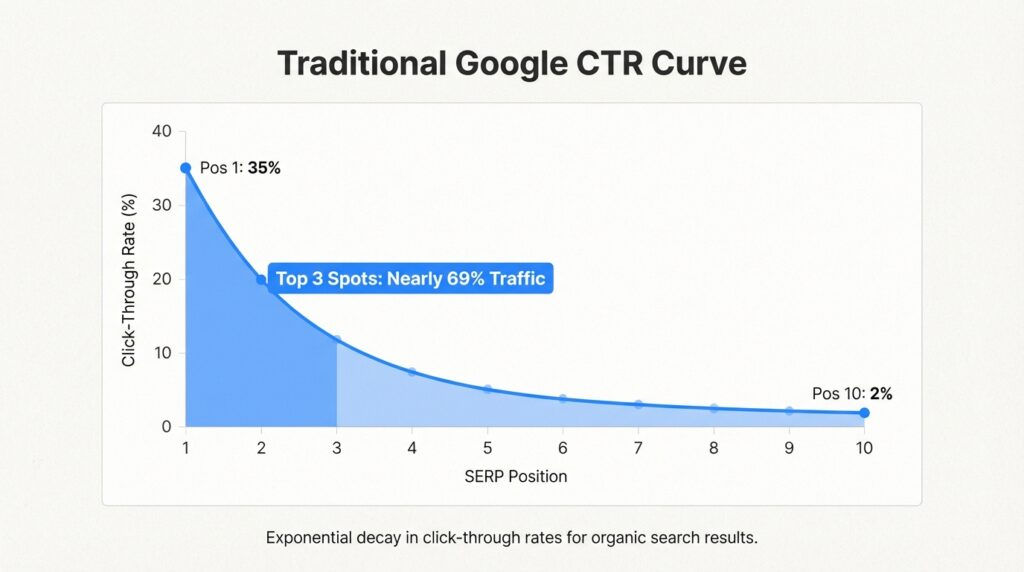
This curve shaped how we thought about SEO. Moving from position 5 to position 3 could double your traffic. Moving from position 3 to position 1 could double it again. The math made prioritization easy.
But that was before AI Overviews.
How AI Overviews are disrupting organic CTR
Google’s AI Overviews now appear on approximately 31% of search result pages. That number grew from just 10,000 keywords in August 2024 to 172,855 keywords by May 2025, according to GrowthSRC’s analysis.
The impact on organic CTR has been dramatic:
| Position | 2024 CTR | 2025 CTR | Change |
|---|---|---|---|
| 1 | 28% | 19% | -32% |
| 2 | 20.8% | 12.6% | -39% |
| 3 | ~13% | ~10% | -23% |
| 4 | ~8% | ~7% | -12% |
| 5 | ~6% | ~5% | -17% |
| 6-10 | ~2-5% | ~2-6% | +30% avg |
Position 1 lost nearly one-third of its click-through rate. Position 2 lost almost 40%. These aren’t minor fluctuations. They’re fundamental shifts in how search traffic flows.
Why is this happening?
AI Overviews push organic results down the page. When an AI-generated answer appears at the top, the traditional #1 organic result drops below the fold. Users who previously clicked the first blue link now get their answer directly from Google’s AI.
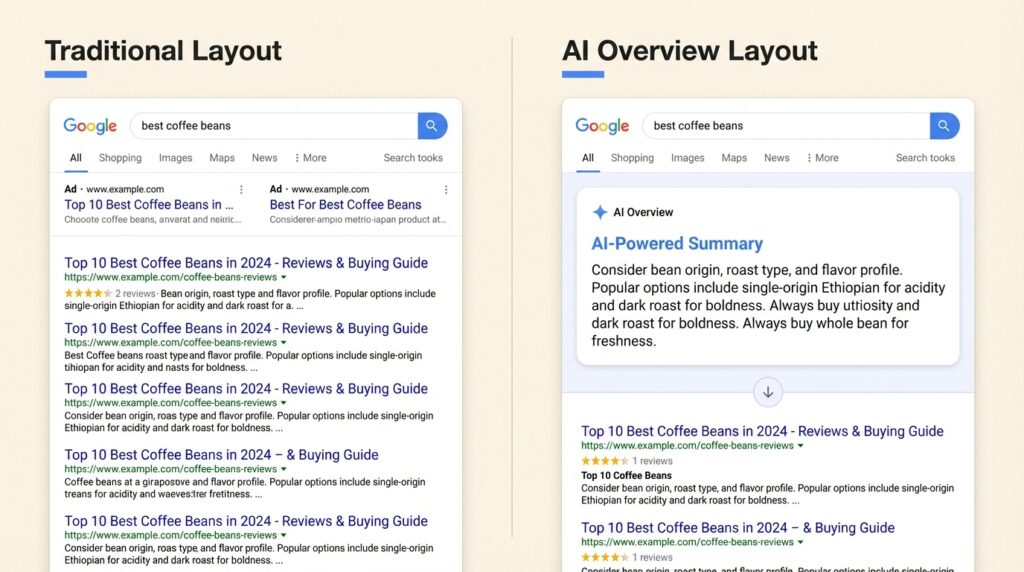
But there’s a counterintuitive twist: positions 6-10 are actually getting more clicks. As users scroll past the AI Overview to verify or expand on the information, they’re clicking lower results at higher rates than before.
Real-world data confirms this. MailOnline reported that when AI Overviews appear for their keywords, average CTR drops 56.1% on desktop and 48.2% on mobile. Their SEO director called the change “pretty shocking.”
This shift demands a complete rethinking of how we approach AI search optimization. The old playbook assumed position 1 was the ultimate goal. Now, visibility within AI-generated answers may matter just as much as traditional rankings.
Current organic CTR by search position
Here’s what the latest data from multiple sources shows for organic CTR by position in 2026:
| Position | 2026 CTR | With Featured Snippet | With Local Pack | With AI Overview |
|---|---|---|---|---|
| 1 | 19-39.8% | 23.7% | 23.7% | 13-20% |
| 2 | 12.6-18.7% | 15.1% | 15.1% | 7-12% |
| 3 | 10.2% | 10.2% | 10.2% | 8-10% |
| 4 | 7.2% | 7.2% | 7.2% | 6-7% |
| 5 | 5.1% | 5.1% | 5.1% | 4-5% |
| 6 | 4.4% | 4.4% | 4.4% | 4-5% |
| 7 | 3.0% | 3.0% | 3.0% | 3-4% |
| 8 | 2.1% | 2.1% | 2.1% | 2-3% |
| 9 | 1.9% | 1.9% | 1.9% | 2-3% |
| 10 | 1.6% | 1.6% | 1.6% | 2-3% |
Data sources: First Page Sage report, GrowthSRC study
The variance in position 1 CTR (19% to 39.8%) reflects different methodologies and SERP contexts. First Page Sage’s higher figures represent “clean” SERPs without AI Overviews, while GrowthSRC’s lower numbers reflect the new reality where AI Overviews appear on nearly a third of searches.
Key insight: SERP features dramatically alter CTR curves. A featured snippet or local pack can cut position 1 CTR nearly in half. An AI Overview can reduce it by 50% or more.
For more context on how search is evolving, see our SEO statistics for AI search.
What this means for your SEO strategy
The shifting CTR landscape changes how you should prioritize SEO efforts:
1. Recalibrate traffic projections
If you’re forecasting based on 2020 CTR data, you’re overestimating traffic from top positions by 30-40%. Update your models with benchmarks or risk missed targets and disappointed stakeholders.
2. Rethink position targets
Position 1 still matters, but the gap between position 1 and positions 6-10 has narrowed. A page ranking at position 8 in 2025 may get comparable traffic to what position 5 delivered in 2020.
3. Prioritize featured snippets
Featured snippets achieve 42.9% CTR according to First Page Sage. That’s higher than traditional position 1. Structure content to win snippets: direct answers, numbered lists, and clear definitions.
4. Optimize for AI Overview citations
Google’s AI Overviews cite sources. Sundar Pichai claimed that links within AI Overviews get higher CTR than traditional results. Whether or not that’s fully accurate, appearing as a cited source in AI-generated answers is becoming a new form of search visibility.
5. Focus on long-tail keywords
AI Overviews appear most frequently on broad, informational queries. Long-tail keywords with specific intent show fewer AI Overviews, meaning traditional CTR curves still apply. Targeting these can deliver more predictable traffic.
The zero-click search trend is accelerating. Google wants to answer queries without sending users elsewhere. Your strategy needs to account for visibility that doesn’t always convert to clicks.
If you need help adapting to this new landscape, our GEO services focus specifically on AI search visibility. Or start with an AI visibility audit to understand where you stand.
How to improve your organic CTR
Even with declining benchmarks, you can outperform averages. Here’s what the data shows works:
Optimize title tags
- Keep them between 40-60 characters (6-9 words)
- Front-load important keywords
- Use numbers and brackets when relevant: “[2026 Guide]” or “(7 Tips)”
- Include your brand name at the end for recognition
Write compelling meta descriptions
- Use evocative words: “best,” “complete,” “proven,” “step-by-step”
- Include a clear value proposition
- Add a subtle call-to-action
- Keep it under 160 characters
Implement structured data
Rich snippets (star ratings, pricing, availability) take up more SERP real estate and attract more attention. Use Schema.org markup and test with Google’s rich results test.
Align with search intent
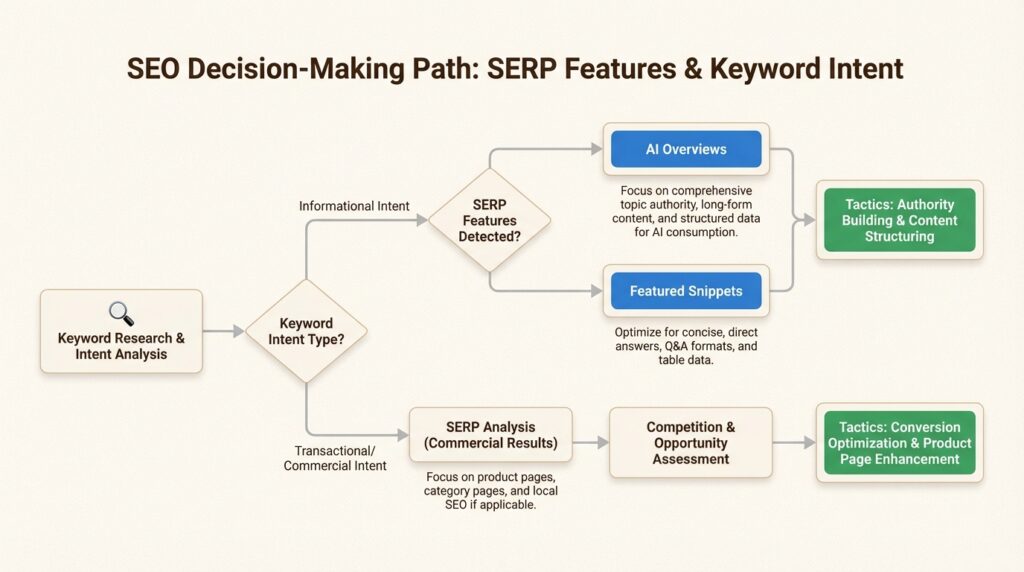
Informational queries need comprehensive answers. Commercial queries need comparison data. Transactional queries need clear next steps. Match your content format to what the searcher actually wants.
Target featured snippets strategically
- Answer questions directly in the first paragraph
- Use numbered lists for “how to” queries
- Use tables for comparison queries
- Include definitions for “what is” queries
Monitor and act on underperformers
Google Search Console shows CTR for every query. Look for high-impression, low-CTR opportunities. A page ranking at position 3 with 5% CTR is underperforming and needs title/description optimization.
For technical implementation, our technical SEO services can handle structured data and on-page optimization. For content strategy, our content team focuses on search intent alignment.
Preparing for the future of organic CTR
AI search isn’t a temporary disruption. It’s the new normal. Here’s how to adapt:
Build brand authority beyond rankings
As traditional CTR declines, brand recognition becomes more valuable. Users who know your brand are more likely to click even when you’re not in position 1. Invest in brand building across channels, not just SEO.
Embrace GEO alongside SEO
Generative Engine Optimization (GEO) focuses on appearing in AI-generated answers, not just traditional rankings. This means structuring content for AI citation, building authority signals that LLMs trust, and tracking visibility inside AI responses.
Diversify your search presence
The search ecosystem is fragmenting. ChatGPT, Perplexity, and Claude are becoming search destinations. Users are asking AI assistants instead of typing queries into Google. Your visibility strategy needs to account for this broader landscape.
At Decoding, we’ve always believed that custom strategy beats templates. The current CTR disruption proves why. Standard SEO playbooks assume stable CTR curves. They don’t account for AI Overviews, shifting user behavior, or the fragmentation of search itself.
The agencies and in-house teams that adapt their measurement frameworks, traffic projections, and optimization tactics will capture market share from those still playing by 2020 rules.
Track your brand’s visibility across AI search engines with our AI brand visibility tracker or monitor your ChatGPT presence specifically with our ChatGPT visibility tracker. Understanding where you appear in AI responses, not just Google rankings, is becoming essential for accurate traffic forecasting.
Bottom line: The organic CTR curve has fundamentally changed. Position 1 delivers 32% fewer clicks than it did a year ago. Positions 6-10 are more valuable than ever. AI Overviews are reshaping how users interact with search results. Update your benchmarks, recalibrate your projections, and expand your visibility strategy beyond traditional rankings. The search landscape isn’t going back to the old normal.
Frequently Asked Questions
What is a good organic click-through rate by search position?
In 2026, a ‘good’ CTR depends heavily on SERP features. For position 1 without AI Overviews, 35-40% is strong. With AI Overviews present, 15-20% is more realistic. Position 2 typically sees 12-18%, while positions 3-5 range from 5-10%. The key is benchmarking against your specific SERP context, not generic averages.
How much has organic click-through rate by search position changed with AI Overviews?
According to GrowthSRC’s study of 200,000+ keywords, position 1 CTR dropped 32% (from 28% to 19%) and position 2 dropped 39% (from 20.83% to 12.60%). Surprisingly, positions 6-10 increased 30% as users scroll past AI Overviews to find alternative sources.
Why does organic click-through rate by search position matter for SEO strategy?
CTR translates rankings into actual traffic and revenue. If you’re projecting traffic based on outdated CTR data, you’ll miss targets. Understanding current CTR curves helps prioritize which ranking improvements deliver ROI and whether investing in featured snippets or AI Overview optimization might outperform traditional ranking improvements.
How can I track my organic click-through rate by search position?
Google Search Console provides CTR data for every query and page. Use the Performance report to see average position, impressions, and CTR. Segment by query to identify high-impression, low-CTR opportunities. Third-party tools like STAT and Advanced Web Ranking offer more granular CTR analysis by SERP feature.
What SERP features have the biggest impact on organic click-through rate by search position?
AI Overviews have the largest negative impact, reducing position 1 CTR by 50% or more. Featured snippets and local packs also significantly reduce top-position CTR (cutting position 1 from ~40% to ~24%). Rich snippets generally improve CTR for the results that display them.
Should I still aim for position 1 given the declining organic click-through rate?
Yes, but with adjusted expectations. Position 1 still delivers the most clicks in most scenarios. However, the gap between position 1 and lower positions has narrowed. A strategic approach targets position 1 while also optimizing for featured snippets, AI Overview citations, and long-tail keywords where AI Overviews appear less frequently.





Leave a Reply