

Nearly half of all Google searches are looking for something nearby. If your business doesn’t show up when local customers are searching, you’re essentially invisible to the people most likely to buy from you.
But here’s what’s changing: it’s no longer just about ranking on Google. With AI search tools like ChatGPT, Perplexity, and Google AI Overviews becoming part of how people find businesses, local visibility now means showing up in both traditional search AND AI-generated answers.
At Decoding, we’ve spent 16 years helping SMBs dominate Google search. Now we’re helping businesses navigate this shift to AI-first discovery. Our AI Visibility Tracking Platform shows how your brand appears inside ChatGPT and AI Search. The statistics below reveal exactly how consumers find local businesses today, what drives them to convert, and where you should focus your optimization efforts in 2026.
How consumers search for local businesses: Key local SEO stats
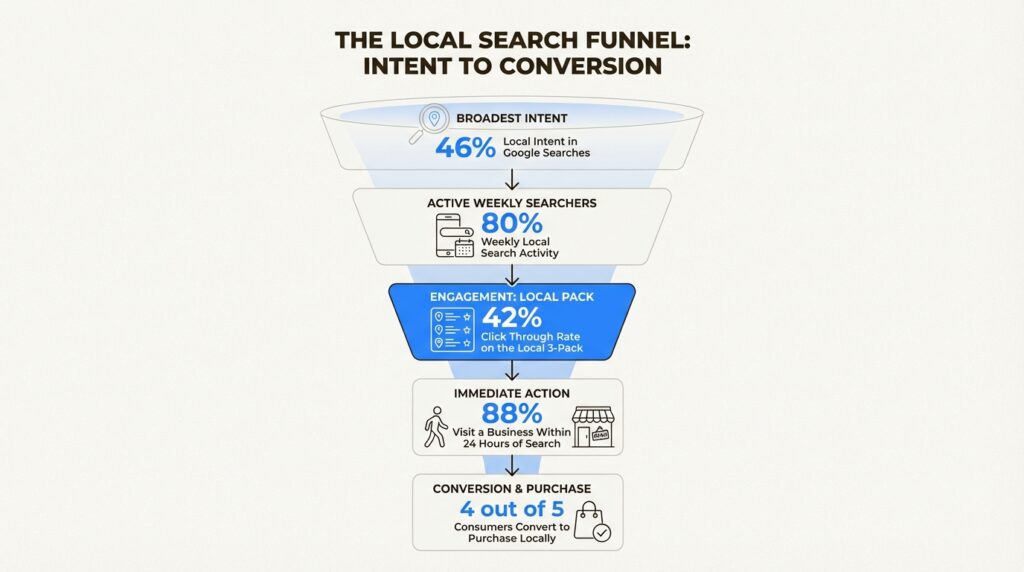
Let’s start with the big number: 46% of Google searches have local intent. That means nearly 1 in 2 searches are from people looking for products, services, or businesses near them. Source
This isn’t occasional behavior. According to SOCi’s Consumer Behavior Index, 80% of US consumers search for local businesses online at least once per week. Nearly a third (32%) search daily.
Mobile dominates local search. ReviewTrackers data shows that 57% of local searches happen on mobile devices. This makes sense. When someone needs a plumber at 2 AM or wants to find lunch nearby, they reach for their phone.
The “near me” phenomenon continues to grow. Think with Google reports that searches containing “near me” or “close by” grew more than 900% in just two years.
Here’s the key insight: 76% of consumers who search for something nearby visit a business within a day. Local search isn’t just about research. It’s about immediate action.
What this means for you: Your business needs to be visible when and where local customers are searching. This requires optimizing for mobile, claiming your Google Business Profile, and ensuring your NAP (name, address, phone) information is consistent everywhere it appears online.
The revenue impact of local pack rankings: Local SEO statistics that matter
Ranking in Google’s Local Pack (the map with three business listings that appears at the top of local searches) isn’t just nice to have. It’s a revenue driver.
SOCi’s research found that businesses in the local pack get 126% more traffic than those ranked 4-10. The difference between position 3 and position 4 is massive.
According to Backlinko’s user behavior study, 42% of local searchers click on results inside the Google Map Pack. That means nearly half of all local search clicks go to just three businesses.
What does it take to get there? Semrush data shows that the top 3 local results average 561 Google reviews and maintain a 4.8 star rating. Reviews matter for rankings, not just conversions.
The conversion numbers are striking. SynUp research found that 88% of mobile local searchers either visit or call a store within a day. Search Engine Watch reports that 4 out of 5 mobile local searches lead to a purchase.
The cost of not ranking: If you’re not in the local pack, you’re competing for the remaining 58% of clicks. And if you’re not on page 1 at all, you might as well be invisible. First Page Sage found that the average ROI for a local SEO campaign after three years is over 300%. The businesses that invest in local SEO see returns. Those that don’t are leaving money on the table.
Google Business Profile: Local SEO stats for your digital storefront
Your Google Business Profile (GBP) is often the first impression potential customers have of your business. And the data shows that a complete, optimized profile directly impacts revenue.
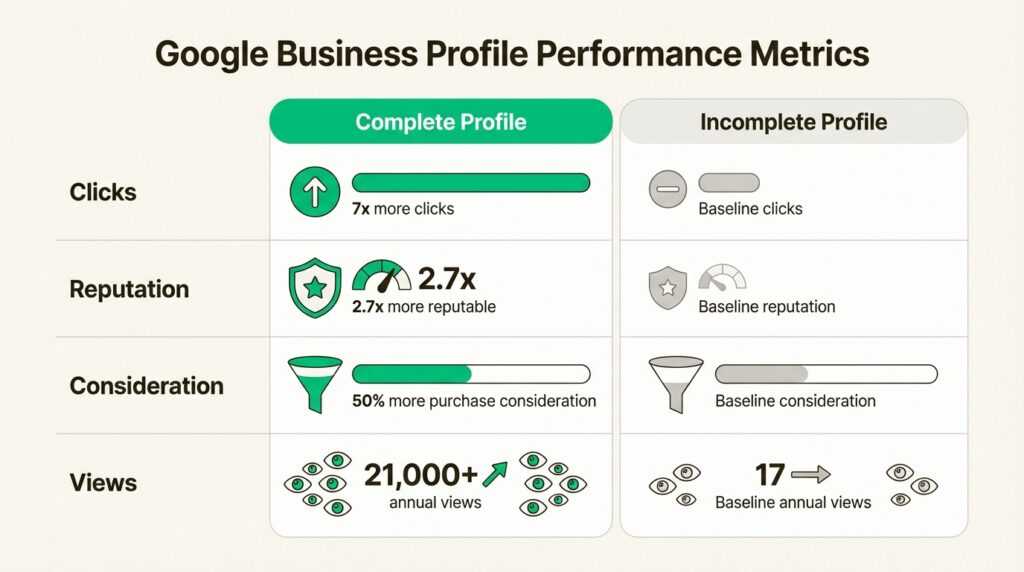
According to Google’s own research, customers are 2.7 times more likely to view a business as reputable if it has a complete GBP. They’re also 50% more likely to consider making a purchase from businesses with complete profiles.
The click-through numbers are even more dramatic. Google states that complete GBP listings get 7 times more clicks than incomplete ones do.
Birdeye’s analysis of millions of GBP listings found that verified businesses receive over 21,000 views annually in Google searches and Maps. That’s 21,000 opportunities to attract customers.
Photos make a measurable difference. Google’s data shows that businesses with photos on their GBP receive 42% more requests for directions and 35% more website clicks than businesses without photos do.
Here’s a surprising stat: Publer’s research found that 40% of companies receive appointment requests directly through their Google Business Profile. For service businesses, GBP is not just a directory listing. It’s a lead generation tool.
But there’s a flip side. BrightLocal’s research found that 62% of consumers would avoid a business if they found incorrect information online. Wrong hours, outdated phone numbers, or inconsistent addresses do not just confuse customers. They cost you business.
Your GBP optimization checklist:
- Claim and verify your profile
- Fill out every field (business description, hours, services, attributes)
- Add high-quality photos of your business, products, and team
- Post updates regularly (Google posts)
- Respond to all reviews (more on this below)
- Keep your information accurate and consistent across all platforms
Reviews as a ranking factor: Local SEO statistics
Reviews are not just social proof. They’re a critical ranking factor and conversion driver.
BrightLocal’s Local Consumer Review Survey found that 75% of consumers “always” or “regularly” read online reviews when browsing for local businesses. And 83% use Google to find those reviews.
The bar for trust keeps rising. BrightLocal’s 2026 survey found that 68% of consumers will only consider using a business if it has a 4-star rating or higher. A few bad reviews can disqualify you before potential customers even visit your website.
Responding to reviews matters more than most businesses realize. BrightLocal found that 89% of consumers are more likely to choose a business that responds to all reviews (positive and negative) versus one that doesn’t respond at all.
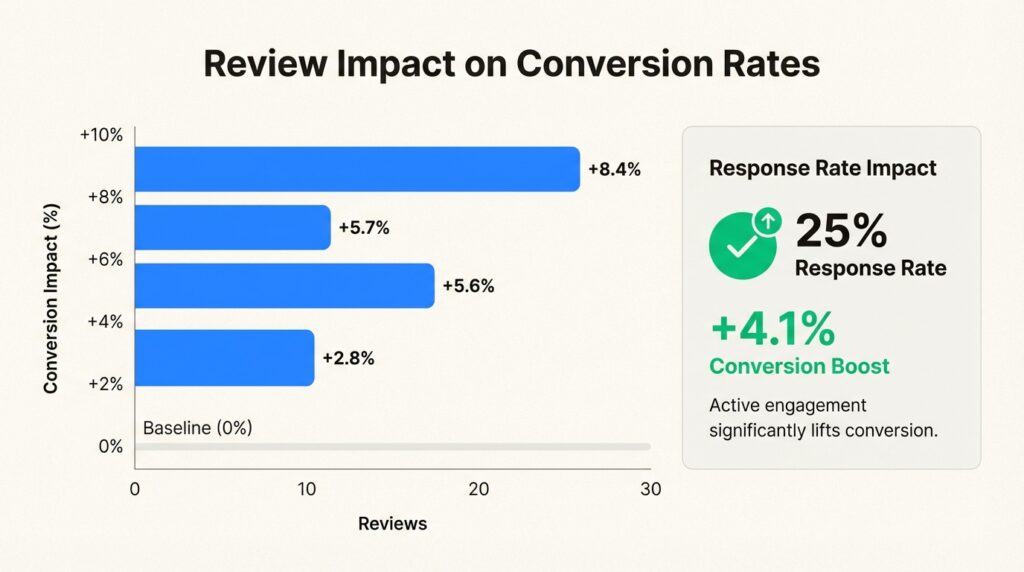
The conversion impact is measurable. SOCi’s research found that every 10 new reviews increases conversion by 2.8%. And responding to just 25% of reviews improves conversion by 4.1%.
Yet most businesses ignore this opportunity. SOCi’s Local Visibility Index found that 54% of Google reviews never receive a response. When you respond to reviews, you’re not just engaging with the reviewer. You’re signaling to every future customer that you care about feedback.
Your review strategy:
- Actively request reviews from satisfied customers (email, SMS, in-person)
- Respond to every review within 24-48 hours
- Thank positive reviewers by name and mention specific details
- Address negative reviews professionally and take the conversation offline when appropriate
- Never buy fake reviews or incentivize reviews (violates Google’s policies)
The AI search disruption: New local SEO stats for 2026
The local search landscape is shifting beneath our feet. AI search tools are changing how consumers find businesses, and the data shows this trend is accelerating.
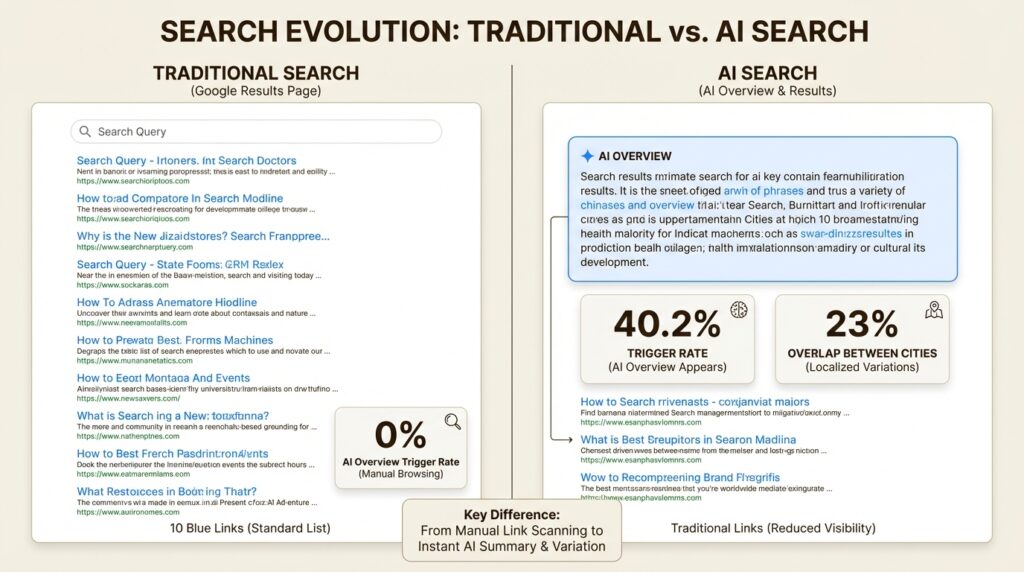
LocalFalcon’s research found that 40.2% of local business queries now trigger Google’s AI Overviews. These AI-generated summaries appear at the top of search results, often pushing traditional organic listings below the fold.
Consumer adoption of AI search is growing. Uberall’s Consumer Search Behavior Report found that 19% of consumers already use AI tools like ChatGPT to find local businesses. In the US, that number is even higher: nearly 1 in 4 American consumers prefer AI tools for local business discovery.
Marketers are taking notice. BrightLocal’s Brand Beacon Report found that 88% of multi-location marketers are already using generative AI in their local marketing strategies.
Here’s what makes AI search different: SE Ranking’s study found that when two users in different cities search the same local “near me” keyword, Google’s AI Mode delivers almost completely different results. Only about 23% of the websites overlap. This means local SEO is becoming even more hyper-local.
What this means for your strategy:
- Optimize for AI visibility (Generative Engine Optimization or GEO)
- Ensure your business information is structured and machine-readable
- Build citations and mentions across authoritative sources that AI tools reference
- Monitor how your business appears in AI-generated responses
- Consider our GEO SEO audit to identify AI visibility gaps
At Decoding, we’ve developed an AI Visibility Tracking Platform that shows how your brand appears inside ChatGPT and AI Search, not just Google rankings. You can track your competitors and monitor which websites AI references in its responses for content and link building opportunities. Learn more about how to track your AI visibility.
Local SEO adoption gaps: Statistics reveal your opportunity
Here is the surprising truth: most of your competitors are not doing local SEO well. Or at all.
ReviewTrackers’ Local Search Report found that 58% of businesses don’t optimize for local search. Only 30% actually have a local SEO plan in place.
This creates a massive opportunity. While your competitors are ignoring local search, you can capture the customers they’re missing.
The data backs this up. BrightLocal’s Brand Beacon Report found that 94% of high-performing brands have a local marketing strategy. Success correlates with intentional effort.
The ROI is there for businesses that commit. First Page Sage found that the average ROI for a local SEO campaign after three years is over 300%. Local SEO isn’t a quick fix. It’s a long-term investment that compounds over time.
Your competitive advantage:
- Claim and optimize your Google Business Profile (most businesses don’t)
- Build a review generation and response system (most businesses ignore this)
- Create location-specific content (most businesses use generic copy)
- Build local citations and backlinks (most businesses skip this)
- Optimize for AI search visibility (almost no one is doing this yet)
Turn these local SEO stats into your strategy
Let us recap the highest-impact statistics:
- 46% of Google searches have local intent
- 80% of consumers search for local businesses weekly
- Businesses in the local pack get 126% more traffic
- Complete GBP listings get 7x more clicks
- 75% of consumers regularly read online reviews
- Every 10 new reviews increases conversion by 2.8%
- 40% of local queries trigger AI Overviews
- 58% of businesses don’t optimize for local search
Your prioritized action plan:
- Claim and optimize your Google Business Profile (highest impact, lowest effort)
- Build a review generation system (high impact on both rankings and conversions)
- Ensure NAP consistency across all directories and platforms
- Create location-specific content on your website
- Build local citations and backlinks
- Optimize for AI search visibility (emerging opportunity)
At Decoding, we help SMBs and agencies dominate Google and AI search. Our approach is simple: custom SEO strategy, not templates. Data-driven optimization, not guessing. Actionable roadmap, not 50-page reports.
We’ve helped businesses outrank Fortune 500s and capture local markets. Whether you need professional SEO consulting, GEO/AEO services for AI visibility, or our AI Visibility Tracking Platform, we can help you turn these statistics into revenue.
For businesses looking to optimize their local presence specifically for AI search, check out our guide on SEO local for ChatGPT.
Ready to dominate local search? Get a custom local SEO audit and discover exactly where your business stands and what opportunities you’re missing.
Frequently Asked Questions
How often should I update my Google Business Profile to see results from these local SEO stats?
Update your GBP at least weekly with Google Posts, photos, or offers. Businesses that post regularly see 5x more views according to Google’s data. At minimum, review and update your profile monthly to ensure hours, services, and contact information are current.
Do these local SEO statistics apply to service-area businesses without a physical storefront?
Yes, most of these statistics apply to service-area businesses too. While you may not get foot traffic, the search behavior, review importance, and GBP optimization principles remain the same. The key difference is you’ll set a service area rather than a specific address in your GBP.
How long does it take to see results from local SEO efforts based on these stats?
Initial improvements (GBP optimization, review responses) can show results within weeks. Ranking improvements typically take 3-6 months of consistent effort. The 300%+ ROI statistic from First Page Sage is measured over 3 years, showing that local SEO is a long-term investment that compounds.
Are online reviews really that important for local SEO rankings?
Yes. Reviews are a confirmed ranking factor for Google’s local pack. Beyond rankings, 75% of consumers regularly read reviews and 68% won’t consider businesses under 4 stars. Reviews impact both visibility AND conversion.
How is AI search changing these local SEO statistics?
AI search is making local results more personalized and fragmented. With only 23% website overlap for the same query in different cities, hyper-local optimization is becoming critical. The 40% of queries triggering AI Overviews means businesses need to optimize for AI visibility (GEO) in addition to traditional SEO.
What’s the most important local SEO stat for small businesses to focus on?
The 46% local intent statistic combined with 58% of businesses not optimizing for local search. Nearly half of all searches are local, yet most of your competitors are ignoring this. The opportunity is massive for businesses that take local SEO seriously.

Leave a Reply