


Here’s a striking statistic: 81% of consumers begin their search for products and services on Google. Yet according to Kitces Research, only 22% of financial advisors actually use SEO as part of their marketing strategy. That’s a massive opportunity gap.
The advisors who do invest in SEO see impressive results. The same Kitces study found that SEO has the lowest Client Acquisition Cost (CAC) of any marketing tactic evaluated. We’re talking about a fraction of the cost per client compared to paid ads, podcasting, or social media.
But here’s what’s changing: traditional Google SEO isn’t enough anymore. In 2026, your prospects aren’t just searching Google. They’re asking ChatGPT for advisor recommendations. They’re using Perplexity to research fee structures. They’re seeing Google AI Overviews before they ever click a website link.
This guide covers what actually works for financial advisor SEO today. We’ll walk through local search fundamentals, content strategy, the emerging field of AI search optimization, and the compliance considerations that make financial services unique.
For context on how search is evolving, see our analysis of SEO statistics in the AI search era.
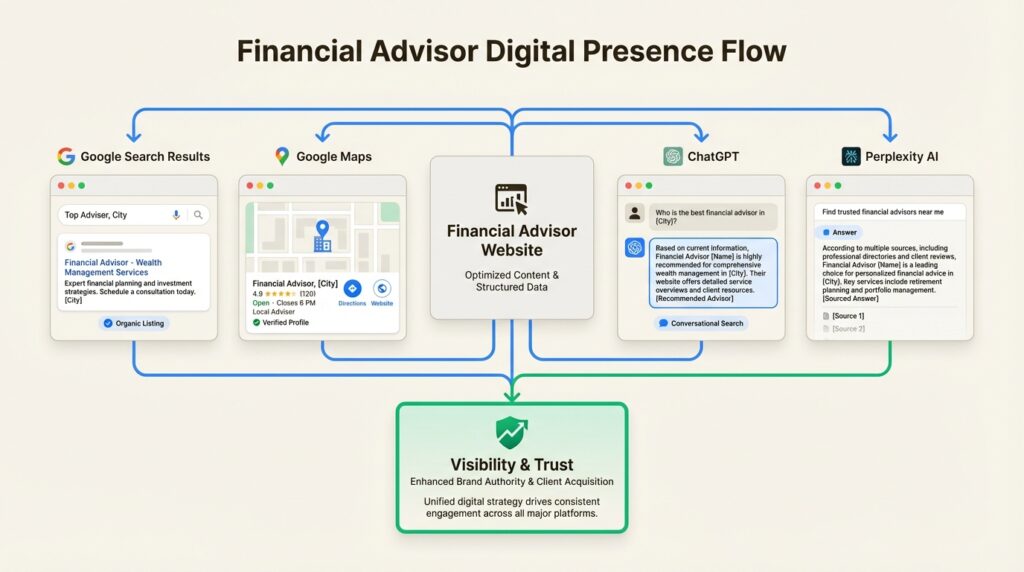
What is SEO for financial advisors?
SEO (Search Engine Optimization) is the practice of improving your website so it ranks higher when prospects search for financial advice. When someone types “financial advisor near me” or “retirement planning help,” you want your firm to appear at the top of those results.
For financial advisors, SEO works in three main areas:
- Technical SEO how your site is built, how fast it loads, whether it works on mobile
- On-page SEO the content on your site, the keywords you use, how pages are structured
- Off-page SEO backlinks from other sites, directory listings, your overall online reputation
Financial services has a unique challenge here. Google classifies financial content as “Your Money or Your Life” (YMYL). This means the search engine holds advisor websites to higher standards. You need stronger signals of Experience, Expertise, Authority, and Trust (E-E-A-T) than a typical business website.
SEO differs fundamentally from paid advertising. With paid ads, you buy visibility. When you stop paying, the traffic stops. SEO is earned visibility. It takes longer to build (typically 6-12 months to see meaningful results), but it compounds over time. A blog post you publish today can still attract clients three years from now.
The shift toward AI search optimization is changing how advisors need to think about visibility. It’s not just about ranking #1 on Google anymore. It’s about being discoverable across multiple search experiences.
Local SEO: Your fastest path to visibility
For most financial advisors, local SEO is the highest-impact place to start. Here’s why: 46% of all Google searches have local intent. When someone searches “financial advisor,” Google knows they probably want someone nearby and adjusts results accordingly.
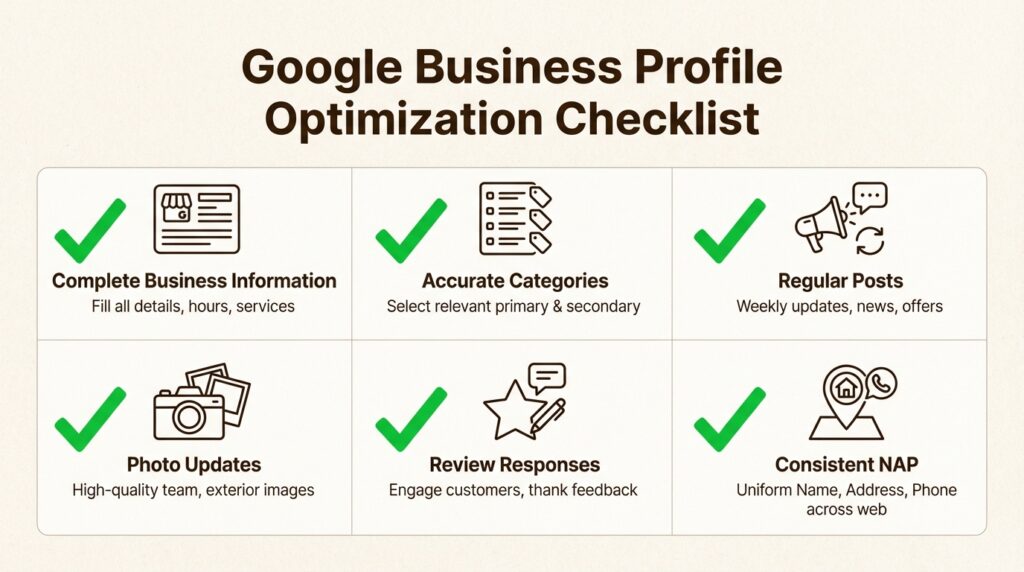
Google Business Profile optimization
Your Google Business Profile (formerly Google My Business) is often the first thing prospects see. It appears in the Map Pack, those three business listings that show up at the top of local searches.
To optimize your profile:
- Complete every field hours, services, business description, photos of your office and team
- Choose accurate categories “Financial Consultant,” “Investment Service,” “Financial Planner” (select all that apply)
- Post regular updates share market insights, firm news, or educational content weekly
- Add photos quarterly fresh signals tell Google your business is active
NAP consistency
NAP stands for Name, Address, Phone. This information must be identical across every platform where your firm appears. If your website lists “Suite 200” but Yelp says “Ste. 200,” that’s a consistency issue that can hurt your rankings.
Audit your listings on:
- Google Business Profile
- NAPFA (National Association of Personal Financial Advisors)
- CFP Board directory
- Yelp
- Bing Places for Business
- LinkedIn Company Page
Location-specific keywords
Generic terms like “financial planning” are nearly impossible to rank for. Instead, target location-specific phrases: “financial advisor in Denver,” “wealth management Scottsdale,” “retirement planner Austin.”
These long-tail keywords have lower search volume but much higher intent. Someone searching “financial advisor in Denver” is actively looking to hire. Someone searching “financial planning” might just be researching concepts.
Reviews within SEC guidelines
The SEC now allows investment advisors to use testimonials and reviews, with restrictions. You cannot selectively display only positive reviews. You must show a balanced representation. You cannot compensate clients for reviews.
Focus on generating reviews through third-party platforms like Google Business Profile where clients voluntarily leave feedback. Respond professionally to all reviews, including neutral or negative ones. This engagement signals to both prospects and search engines that you’re actively managing your reputation.
For more on local search in the AI era, read our guide on local SEO for ChatGPT. If you need help implementing these strategies, our local SEO services are designed specifically for professional services firms.
Content strategy that attracts ideal clients
The most effective advisor content answers questions your best clients already ask you. Think about your last five client meetings. What did they want to know? Those’re your keywords.

Long-tail keyword strategy
Broad terms like “retirement planning” are dominated by major financial publications. You won’t outrank Fidelity or Vanguard for those terms. But you can rank for specific, niche phrases:
- “Retirement planning for physicians”
- “RSU tax strategies for tech employees”
- “Small business succession planning”
- “Financial planning for widows”
These long-tail keywords have three advantages: lower competition, higher intent, and better client fit. Someone searching “RSU tax strategies” has a specific, complex need that justifies professional advice.
Service pages vs. blog content
Your website needs both. Service pages are static pages describing what you do: “Retirement Planning,” “Tax-Efficient Investing,” “Estate Planning.” These target high-intent searches from people ready to hire.
Blog content targets research-phase searches. Someone reading “When should I claim Social Security?” isn’t ready to hire yet, but they’re in your target market. Consistent, helpful blog content builds authority and keeps your site fresh. Google rewards updated content.
Topic clusters
Instead of writing isolated blog posts, build topic clusters. Start with a comprehensive pillar page on a broad topic like “Retirement Planning.” Then create supporting articles on specific aspects: Social Security timing, Medicare enrollment, 401(k) rollover strategies, Roth conversion rules.
Link all supporting articles to the pillar page and vice versa. This structure signals to search engines that you have comprehensive expertise on the topic, not just a surface-level understanding.
Content formats that work
FAQ pages are particularly valuable in 2026. They match how people search (questions) and they’re easily digestible by AI systems. Structure them clearly with question headings and concise answers.
Case studies build credibility, though you’ll need to anonymize client details for compliance. Educational guides position you as a resource. Video content (properly transcribed) can rank in both regular search and video results.
The key is consistency. One excellent article per month beats ten rushed posts. Quality, depth, and relevance matter more than volume.
Our content strategy services help advisors develop sustainable content calendars that attract the right prospects. For guidance on structuring content that gets cited by AI systems, see our article on how to get cited by LLMs.
Optimizing for AI search and LLMs
Search is fragmenting. Your prospects now discover advisors through Google, Maps, ChatGPT, Perplexity, and other AI tools. The firms that adapt to this shift will have a significant advantage.
The new landscape
Google AI Overviews now appear at the top of many search results, answering questions directly without requiring a click. ChatGPT has over 800 million weekly users. Perplexity is gaining traction as a research tool. Nearly 60% of Google searches now end without a click to any website.
This doesn’t mean SEO is dead. It means visibility is changing. Being cited in an AI Overview or recommended by ChatGPT is valuable exposure, even if it doesn’t drive immediate traffic.
AEO and GEO explained
Answer Engine Optimization (AEO) and Generative Engine Optimization (GEO) are emerging disciplines focused on AI-driven search. The principles overlap with traditional SEO but with added emphasis on:
- Structured, question-based content clear questions as headings, direct answers in the first paragraph
- FAQ schema markup code that helps search engines understand your Q&A content
- Concise summaries key takeaways at the beginning of articles
- Comprehensive coverage AI systems favor sources that thoroughly cover a topic
Getting cited by LLMs
Large Language Models like ChatGPT are trained on web content. They tend to cite sources that demonstrate clear expertise on a topic. To increase your chances of being referenced:
- Build topical authority through content clusters
- Earn mentions and links from reputable financial publications
- Maintain consistent, accurate information across the web
- Structure content so AI systems can easily extract key facts
The opportunity here is timing. Most advisors haven’t adapted to AI search yet. Early movers can establish themselves as the go-to sources in their niches before competition gets intense.
Our AI brand visibility tracker helps you monitor how your firm appears across AI search platforms. For a comprehensive approach to this new landscape, see our guide to AI search optimization.
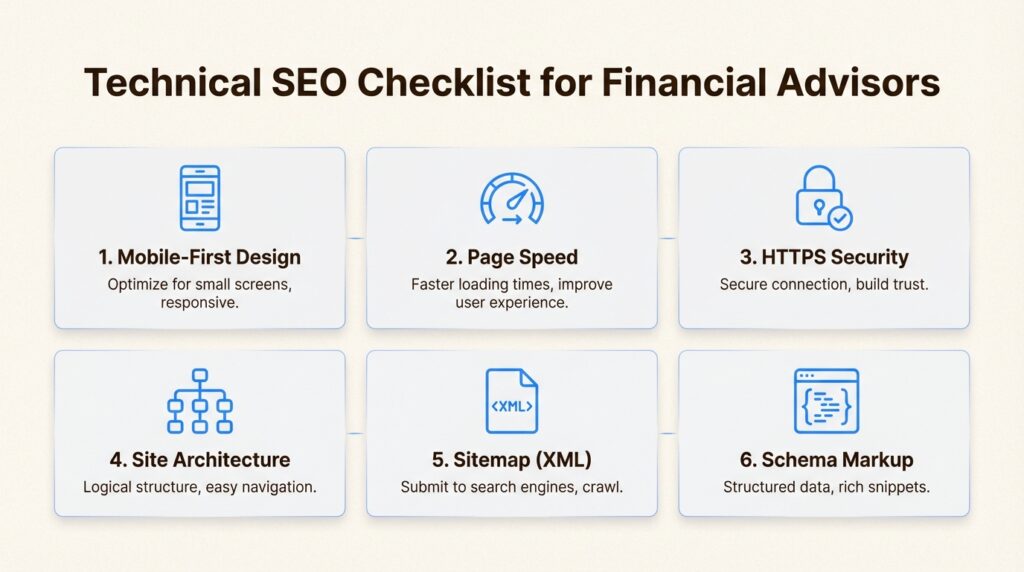
Technical SEO essentials
Even the best content won’t rank if your website has technical issues. Here’re the fundamentals every advisor site needs.
Mobile-first design
Over 70% of online searches happen on mobile devices. Google uses mobile-first indexing, meaning it evaluates your site based on the mobile version. Your site must load quickly, display properly, and be easy to navigate on smartphones.
Test your site with Google’s free PageSpeed Insights and Lighthouse tools. Address any issues they flag.
Page speed
Site speed affects both rankings and conversions. A one-second delay in page load time can reduce conversions by 7%. For financial advisors, where trust is paramount, a slow site suggests technical incompetence.
Key speed factors include image optimization, server response time, and minimizing unnecessary code. Your web developer should address these, or consider switching to a faster platform if issues persist.
HTTPS security
Non-negotiable. If your site doesn’t use HTTPS (the padlock icon in the browser), you’re losing both rankings and trust. Financial services especially requires security signals. Most modern website platforms include HTTPS by default.
Site architecture
Your site should have a logical structure that’s easy to navigate. Important pages (services, about, contact) should be accessible within one or two clicks from any page. Use descriptive URLs like /retirement-planning/ instead of /page-123/.
XML sitemap
An XML sitemap is a file that tells search engines about all the pages on your site. Submit yours through Google Search Console to ensure Google can find and index all your content.
Schema markup
Schema is structured data that helps search engines understand your content. For advisors, useful schema types include:
- LocalBusiness tells Google you’re a local service provider
- Person for advisor bios with credentials
- FAQPage for FAQ sections
- Service for specific service offerings
Schema can help you appear in rich results and improve how your listings display in search.
If technical SEO feels overwhelming, our technical SEO services can handle the heavy lifting while you focus on client relationships.
Compliance and credibility considerations
Financial services operates under strict regulatory oversight. Your SEO strategy has to work within these constraints.
SEC and FINRA guidelines
Content must be accurate, not misleading, and include required disclosures. You cannot guarantee returns or make unsubstantiated claims about performance. Past performance disclaimers are required where applicable.
The SEC’s marketing rule now allows testimonials, but with important restrictions:
- Reviews must be balanced (not cherry-picked)
- You cannot compensate clients for testimonials
- Disclaimers may be required
- Check with your compliance department for firm-specific policies
E-E-A-T signals for advisors
Google’s E-E-A-T framework (Experience, Expertise, Authority, Trust) is especially important for YMYL content. Strengthen your signals by:
- Displaying professional credentials prominently (CFP®, CFA, ChFC, etc.)
- Including detailed author bios on content
- Maintaining transparent fee disclosures
- Publishing a comprehensive privacy policy
- Showing professional affiliations (NAPFA, FPA, etc.)
Building trust through education
The most effective advisor content educates without selling. Explain complex topics clearly. Acknowledge when multiple approaches exist. Cite reputable sources. This educational approach builds the trust that converts searchers into clients.
Our GEO services include compliance review to ensure your AI optimization efforts meet regulatory standards.
Measuring SEO success
SEO requires patience, but you should track progress from day one. Here’s what matters.
Key metrics to track
- Organic traffic growth total visitors from search engines
- Keyword rankings where you rank for target terms (use Ahrefs, SEMrush, or Google Search Console)
- Local map pack visibility appearing in the top three local results
- Lead form submissions actual consultation requests from organic traffic
- Client acquisition new clients who found you through search
Tools to use
Google Search Console (free) shows what queries bring people to your site and your average position for each. Google Analytics (free) tracks traffic and conversions. For more advanced tracking, tools like Ahrefs or SEMrush provide comprehensive keyword and competitor data.
Attribution challenges
SEO often assists conversions rather than driving direct last-click attribution. A prospect might find you through search, follow you on LinkedIn for six months, then finally book a consultation after receiving your newsletter. The SEO touchpoint was crucial but may not get credit in simple attribution models.
The ultimate measure of SEO success isn’t traffic. It’s new client acquisition from organic sources. Track this metric religiously.
Our AI visibility audit provides a comprehensive assessment of your current search presence, including how you appear in AI-driven search. For ongoing monitoring, learn how to track AI visibility across different platforms.
When to DIY vs. hire an SEO agency
Should you handle SEO yourself or bring in experts? That depends on your situation.
When DIY makes sense
- You’re a solo advisor in a small market with limited competition
- You have marketing experience and enjoy the technical work
- Your budget is constrained and you have more time than money
- You’re just starting out and want to learn the basics before investing
When to hire an agency
- You’re in a competitive market (major metro area)
- You’re an RIA looking to scale beyond referrals
- You value your time and want to focus on client relationships
- You need expertise in both traditional SEO and AI optimization
What to look for in an agency
- Financial services experience they should understand advisor compliance requirements
- Clear reporting you should know exactly what work is being done and what results it’s producing
- Non-compete agreements reputable agencies won’t work with competing firms in your market
- Realistic expectations anyone promising #1 rankings in 30 days is either lying or using risky tactics
Red flags
- Guarantees of specific rankings
- Reluctance to explain their methods
- No reporting or vague metrics
- Suggesting tactics that feel deceptive
At Decoding, we specialize in SEO and AI visibility for professional services firms. Our AI SEO services combine traditional search optimization with the emerging field of generative engine optimization. We work with a limited number of advisory firms per market to avoid conflicts. If you’re looking for an agency partner, our partnership network can connect you with vetted specialists.
Start building your organic presence today
SEO for financial advisors comes down to four fundamentals: local optimization, strategic content, technical excellence, and compliance awareness. The advisors who master these elements build sustainable, compounding visibility that generates qualified leads year after year.
The urgency is real. Every month you wait, competitors strengthen their positions. The firms that adapted to AI search early’re already capturing visibility that’ll be harder to displace later.
Your next steps:
- Claim and optimize your Google Business Profile this week
- Audit your website’s mobile performance and page speed
- Identify your first ten target keywords based on client questions
- Create a content calendar with one quality piece per month
- Set up tracking in Google Search Console and Analytics
If you want expert guidance, contact us for a consultation. We’ll assess your current visibility, analyze your competitive landscape, and recommend a strategy tailored to your firm’s goals and market.
The advisors who invest in SEO today’ll be the ones prospects find tomorrow. The question is whether that advisor’ll be you.
Frequently Asked Questions
How long does it typically take to see results from SEO for financial advisors?
Most advisory firms begin seeing meaningful traction within 6-12 months. Local SEO improvements can show results faster (2-3 months), while competitive national keywords may take 12-18 months.
Can I do SEO for my financial advisory firm myself, or do I need to hire an agency?
You can handle SEO yourself if you’re in a small market with limited competition. However, if you’re in a competitive metro area or want to scale quickly, an agency with financial services expertise will likely deliver better ROI.
How do SEC regulations affect SEO and online reviews for financial advisors?
The SEC’s marketing rule now allows testimonials and reviews, but with restrictions. You cannot selectively display only positive reviews, compensate clients for reviews, or make misleading claims.
What are the most important SEO strategies for financial advisors just getting started?
Start with local SEO: claim and optimize your Google Business Profile, ensure NAP consistency across directories, and target location-specific keywords. Then focus on creating content that answers your clients’ actual questions.
How is AI search changing SEO for financial advisors?
AI search is fragmenting how prospects find advisors. Fewer searches result in website clicks, but the value of each visit is rising. Advisors need to optimize for being cited in AI-generated answers, not just ranking #1 on Google.
What metrics should financial advisors track to measure SEO success?
Track organic traffic growth, keyword rankings for target terms, local map pack visibility, and most importantly, lead form submissions and new client acquisition from organic sources.
How much should a financial advisory firm budget for SEO?
DIY SEO requires minimal hard costs (tools like Ahrefs at $100-300/month). Agency services typically range from $2,000-5,000/month depending on market competitiveness and scope.








Leave a Reply