
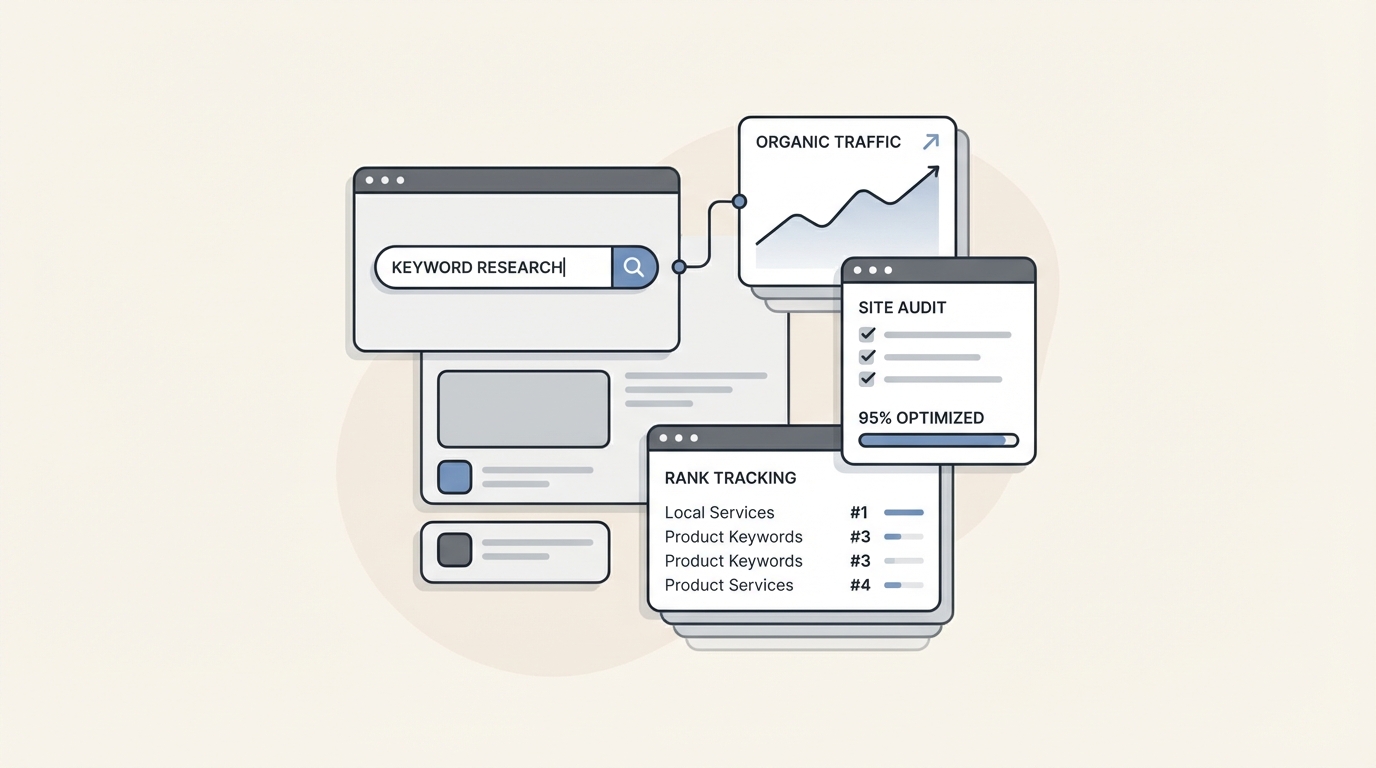
Small businesses don’t need enterprise budgets to compete in search. But with over 100 SEO tools on the market, finding the right one feels like searching for a needle in a haystack. Some tools promise the world but deliver bloated dashboards you’ll never use. Others are free but leave you guessing at critical data.
Here’s the reality: the best SEO software for your small business depends on what you’re actually trying to accomplish. A local plumber has different needs than an e-commerce store or a content publisher.
This guide cuts through the noise. We’ve tested features, verified pricing, and matched each tool to real small business use cases. By the end, you’ll know exactly which tool fits your budget and goals.
What makes great SEO software for small business?
Before diving into the list, let’s establish what separates useful tools from expensive distractions. Small businesses need software that delivers ROI without requiring a dedicated SEO team.
Here’s what we evaluated:
- Ease of use: Minimal learning curve with clear, actionable data
- Pricing transparency: No hidden costs or forced upgrades
- Core functionality: Keyword research, rank tracking, and site audits
- AI/GEO capabilities: Optimization for both Google and AI search (ChatGPT, Perplexity, Claude)
- Support quality: Resources that actually help non-technical users
The free tools on this list handle the basics. The paid options scale with you. Let’s get into it.
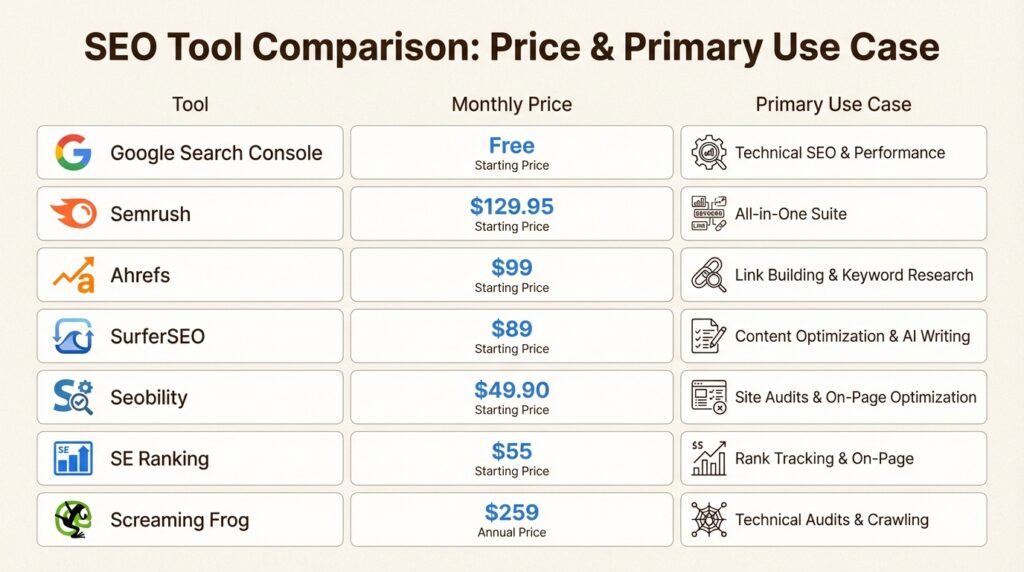
Quick comparison: 7 best SEO software for small business
| Tool | Starting Price | Free Option | Best For | AI/GEO Features |
|---|---|---|---|---|
| Google Search Console | Free | Yes | Every small business | None |
| Semrush | $117.33/mo (annual) | No | Comprehensive SEO | AI Visibility, AI PR |
| Ahrefs | $29/mo (Starter) | Webmaster Tools | Backlink analysis | Brand Radar AI |
| SurferSEO | $49/mo | No | Content optimization | AI visibility tracking |
| Seobility | Free | Yes (limited) | Beginners | AI Overview tracking |
| SE Ranking | $103.20/mo (annual) | 14-day trial | Local SEO | SE Visible dashboard |
| Screaming Frog | $259/year | Yes (500 URLs) | Technical SEO | OpenAI integration |
The 7 best SEO software for small business
1. Google Search Console
What it is: The free, official Google tool for monitoring how your site performs in Google search.
Best for: Every small business (this is your essential foundation)
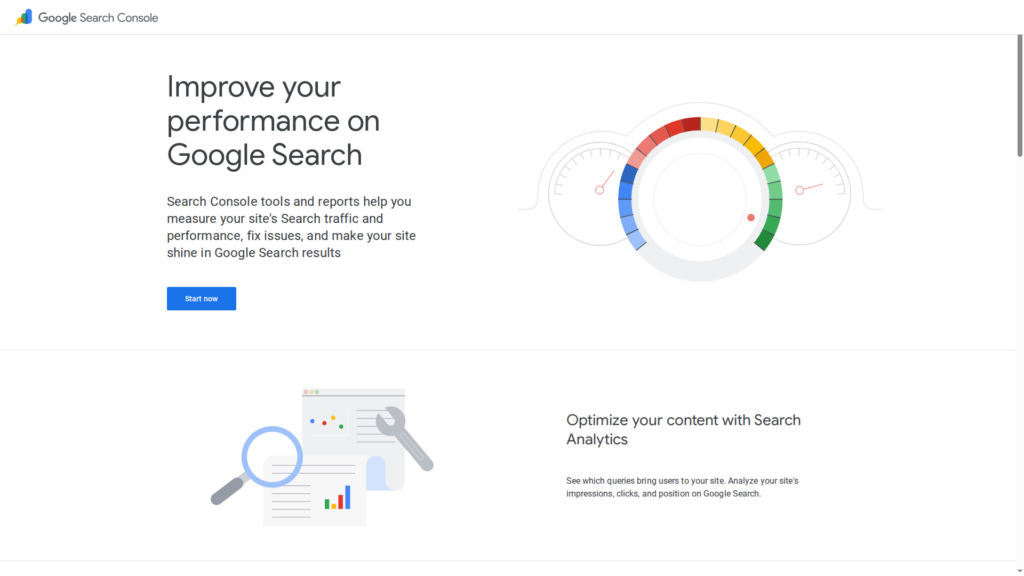
Google Search Console is where every small business should start. It’s completely free, comes directly from Google, and shows you exactly how Google sees your website.
Key features:
- Performance monitoring: Track which keywords and pages drive traffic
- Indexing status: See which pages Google has indexed
- Mobile usability: Identify mobile-friendly issues
- Backlink insights: View sites linking to yours
- Core Web Vitals: Page speed and user experience metrics
Pricing: Completely free
Pros:
- Direct data from Google
- No cost whatsoever
- Essential baseline metrics
Cons:
- Limited keyword data (shows impressions, not full research)
- No competitor analysis
- Historical data limited to 16 months
When to upgrade: When you need competitor insights, advanced keyword research, or automated reporting. But even then, keep GSC connected as your source of truth.
2. Semrush
What it is: The most comprehensive all-in-one SEO and marketing platform available.
Best for: Small businesses ready to invest in serious SEO growth
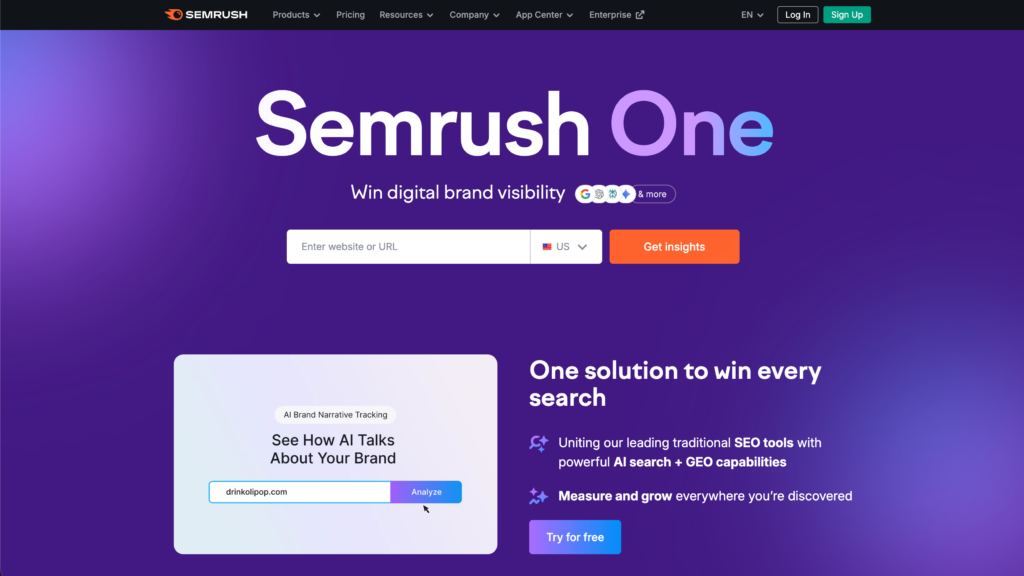
Semrush is the industry standard for a reason. With over 10 million users and 35% of Fortune 500 companies on board, it offers unmatched data depth across every aspect of digital marketing.
Key features:
- Keyword research across 6 specialized tools
- Competitor analysis with traffic insights
- Site audits with AI-powered recommendations
- Position tracking across 170+ search engines
- Content marketing suite with AI writing assistance
- Local SEO tools for multi-location businesses
Pricing:
- Pro: $117.33/mo (annual) or $139.95/mo monthly
- Guru: $208.33/mo (annual) or $249.95/mo monthly
- Business: $416.66/mo (annual) or $499/mo monthly
AI/GEO angle: Semrush’s AI Visibility feature tracks how your brand appears in ChatGPT, Google AI Mode, and other LLMs. This is critical as AI search becomes mainstream.
Pros:
- Most comprehensive data in the industry
- 22 international awards for usability and results
- Covers SEO, PPC, content, and social media
Cons:
- Expensive for beginners
- Steep learning curve
- Can feel overwhelming with so many features
Small business use case: E-commerce sites needing comprehensive competitor analysis, agencies managing multiple clients, or businesses where SEO is a primary growth channel.
3. Ahrefs
What it is: Industry-leading backlink analysis and competitor research tool powered by the world’s second-most active web crawler.
Best for: Businesses focused on link building and competitor analysis
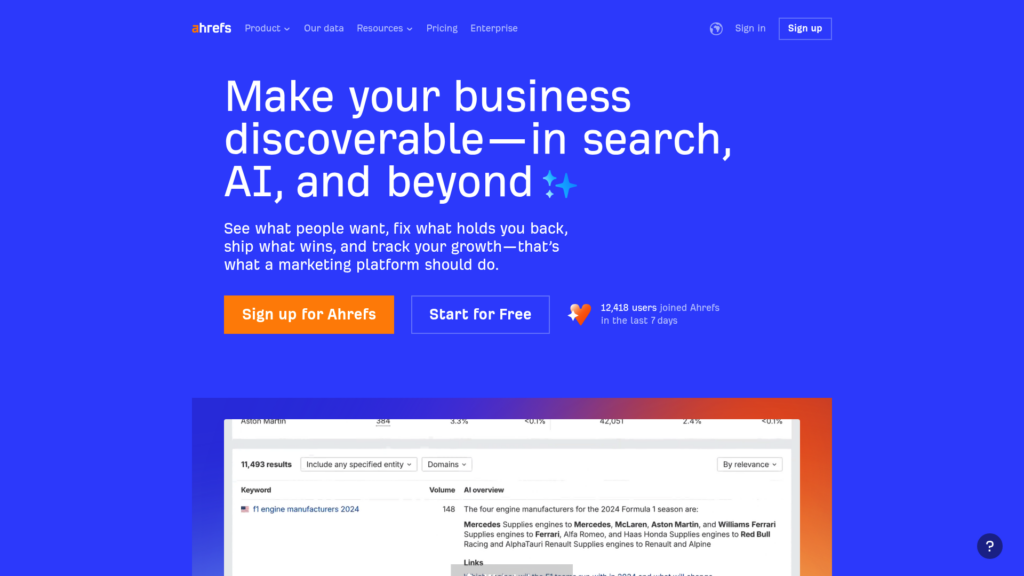
If backlinks are your priority, Ahrefs is unmatched. Their database is the gold standard for understanding who’s linking to you (and your competitors).
Key features:
- Site Explorer: Comprehensive backlink and traffic analysis
- Keywords Explorer: Research across multiple search engines
- Content Gap tool: Find keywords competitors rank for that you don’t
- Site Audit: Technical SEO crawling
- Rank Tracker: Monitor keyword positions
- Broken link checker: Find and fix broken links
Pricing:
- Starter: $29/mo
- Lite: $129/mo ($108/mo annual)
- Standard: $249/mo ($207/mo annual)
- Advanced: $449/mo ($373/mo annual)
AI/GEO capabilities: Brand Radar AI researches brand mentions across 213M+ organic prompts. Custom prompt packages let you track specific AI search queries.
Pros:
- Best backlink database in the industry
- Powerful competitor insights
- Frequent data updates
Cons:
- Expensive for full features
- Complex interface for beginners
- Keyword data not as extensive as Semrush
Small business use case: B2B companies analyzing competitor content strategies, businesses investing in link building, or SEO professionals needing deep backlink data.
4. SurferSEO
What it is: AI-powered content optimization platform that analyzes 500+ web signals to provide real-time SEO recommendations.
Best for: Content creators and businesses publishing regularly
SurferSEO takes the guesswork out of on-page optimization. Instead of wondering what Google wants, you get data-driven recommendations based on what’s actually ranking.
Key features:
- Content Editor: Real-time SEO guidelines while writing
- SERP Analyzer: Compare your content to top-ranking pages
- Content Planner: Organize content clusters
- Grow Flow: Weekly optimization tasks
- AI Writing Assistant (Surfy): AI-powered content creation
- Plagiarism Checker: Ensure content uniqueness
Pricing:
- Discovery: $49/mo (120 documents, 10 pages tracked)
- Standard: $99/mo (360 documents, 50 pages, 25 AI prompts weekly)
- Pro: $182/mo (360 documents, 200 pages, 50 AI prompts daily)
- Peace of Mind: $299/mo (unlimited documents, 500 pages, 100 AI prompts daily)
AI/GEO capabilities: Surfer tracks AI visibility across ChatGPT, Perplexity, Google AI Mode, Google AI Overview, and Google Gemini. Their AI Tracker shows your Visibility Score, mention gaps, and competitor share of voice in AI search.
Pros:
- Data-driven content recommendations
- Excellent for on-page optimization
- Strong AI visibility tracking
Cons:
- Focused mainly on content (not comprehensive SEO)
- Can get expensive at higher tiers
- Requires regular content production to justify cost
Small business use case: Bloggers, content marketing teams, affiliate sites, or businesses publishing weekly content.
5. Seobility
What it is: User-friendly all-in-one SEO software with a focus on simplicity and affordability.
Best for: Beginners and small businesses wanting simplicity without sacrificing features
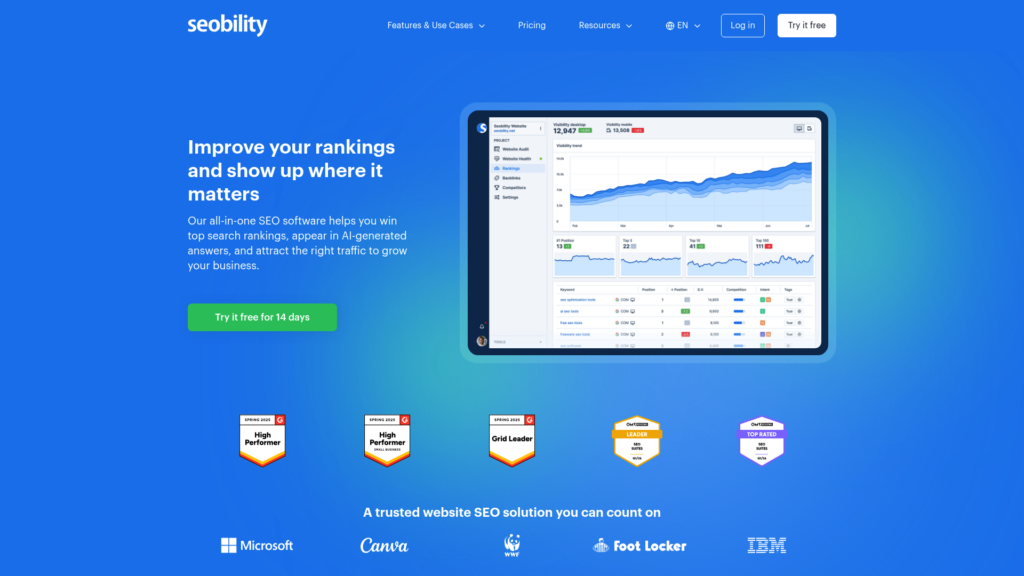
Seobility proves that comprehensive SEO tools don’t need to be complicated or expensive. With over 600,000 users, it’s become a favorite for small businesses across Europe and beyond.
Key features:
- Website Audit: Automatic crawling for technical issues
- Ranking Monitoring: Daily desktop and mobile tracking
- Backlink Monitoring: Weekly backlink analysis
- Keyword Research Tool: Find high-potential keywords
- TF*IDF Content Optimization: Optimize based on top-ranking pages
- White Label Reporting: PDF reports with your branding
Pricing:
- Basic: Free (1 project, 1,000 pages, 10 keywords)
- Premium: ~$54/mo or ~$520/year (3 projects, 25,000 pages, 300 keywords)
- Agency: ~$195/mo or ~$1,870/year (15 projects, 100,000 pages, 1,500 keywords)
AI/GEO capabilities: AI Overview tracking shows when Google displays AI Overviews for your keywords. Premium plans include full AI answer text, cited sources, and source positions.
Pros:
- Clean, intuitive interface
- Affordable pricing
- Manageable data presentation (not overwhelming)
- 14-day free trial on Premium
Cons:
- Smaller database than Semrush/Ahrefs
- Fewer integrations
- Less brand recognition in US market
Small business use case: Local businesses, freelancers, small agencies, or anyone overwhelmed by complex SEO tools.
6. SE Ranking
What it is: Affordable all-in-one SEO platform with strong local SEO and white-label capabilities.
Best for: Local SEO and budget-conscious businesses needing agency features
SE Ranking offers an impressive feature set at a price point that undercuts most competitors. Their recent addition of GEO (Generative Engine Optimization) tools makes them particularly relevant for 2026.
Key features:
- Rank Tracking: Daily updates across major search engines
- Competitor Research: Unlimited keyword and backlink research
- Website Audit: 250K-2M pages per month
- Local Marketing: Google Business Profile management
- Content Marketing: 25-50 articles included
- White-label Reporting: Client-ready reports
Pricing:
- Core: $103.20/mo (annual) or $129/mo (10 projects, 2,000 keywords)
- Growth: $223.20/mo (annual) or $279/mo (30 projects, 5,000 keywords)
- Enterprise: Custom pricing
Add-ons:
- Agency Pack: +$69/mo (white-label, client seats)
- AI Search: From +$71.20/mo (AI visibility tracking)
AI/GEO capabilities: SE Visible dashboard tracks brand mentions, citations, and sentiment across AI search. AI Results Tracker monitors AI Overviews, AI Mode, Perplexity, and ChatGPT. Track 100-250 AI prompts daily depending on your plan.
Pros:
- Excellent value for money
- Strong local SEO features
- Intuitive interface
- Comprehensive GEO features
Cons:
- Smaller feature set than Semrush
- Less historical data
- Fewer third-party integrations
Small business use case: Local service businesses, multi-location brands, agencies needing white-label capabilities, or businesses wanting integrated GEO features.
7. Screaming Frog
What it is: Desktop-based technical SEO crawling tool and industry standard for site audits.
Best for: Technical SEO audits and site health monitoring
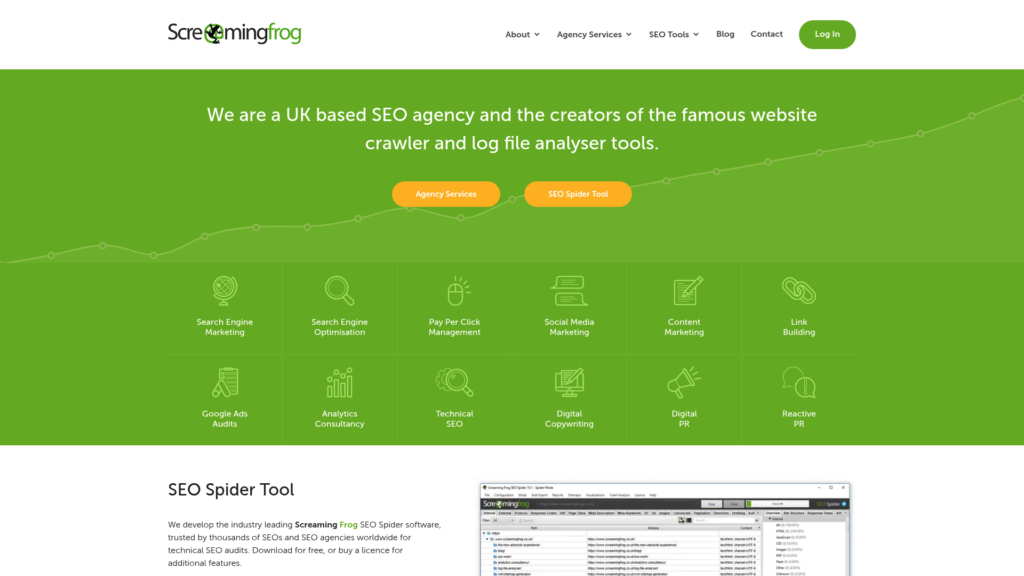
Screaming Frog SEO Spider is the tool technical SEOs reach for when they need deep, granular data about a website’s structure and health. It’s not pretty, but it’s powerful.
Key features:
- Broken link detection: Find broken links, errors, and redirects
- Page title and meta analysis: Audit meta data at scale
- Duplicate content discovery: Find exact and near-duplicates
- XML sitemap generation: Create sitemaps automatically
- JavaScript rendering: Crawl JavaScript-heavy sites
- Google Analytics integration: Connect GA and GSC data
- Accessibility auditing: Check for accessibility issues
- Structured data validation: Validate schema markup
Pricing:
- Free: Limited to 500 URLs per crawl
- Paid: £199 (~$259) per year (unlimited URLs)
- Volume discounts available for 5+ licenses
AI/GEO capabilities: Limited. Offers OpenAI and Gemini integration for crawling assistance, but no dedicated GEO tracking features.
Pros:
- Deep technical insights
- One-time annual fee (not monthly)
- Industry standard for technical SEO
- Fast, desktop-based processing
Cons:
- Technical interface (not beginner-friendly)
- Desktop only (no cloud features)
- No ongoing rank tracking
- Requires SEO knowledge to interpret data
Small business use case: Website migrations, technical audits, large sites, or businesses working with SEO consultants who need detailed crawl data.
Free vs. paid: which SEO software do you actually need?
Here’s a practical progression path:
Start here (free):
- Google Search Console for performance monitoring
- Screaming Frog free tier (under 500 URLs) for technical audits
- This combination handles the basics for most small sites
When to upgrade to paid:
- Need competitor analysis → Ahrefs or Semrush
- Publishing content regularly → SurferSEO
- Managing multiple locations → SE Ranking
- Want all-in-one simplicity → Seobility
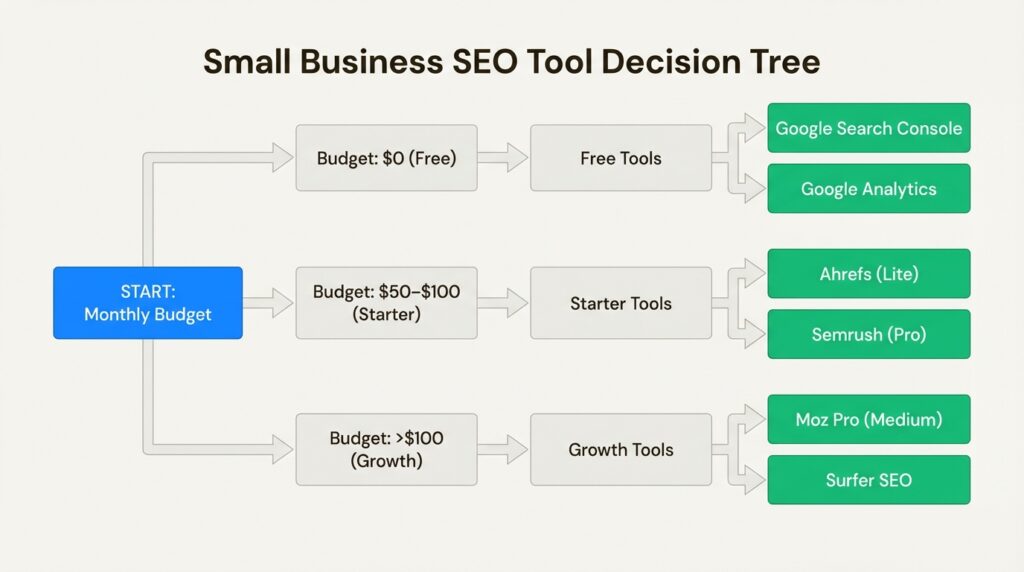
Budget progression:
- $0/month: GSC + free Screaming Frog
- $50-65/month: Seobility Premium or SE Ranking Core
- $100+/month: Semrush Pro, Ahrefs Lite, or SurferSEO Standard
The key is matching the tool to your actual workflow. Don’t pay for features you won’t use.
The AI search factor: why GEO matters in 2026
Traditional SEO focused on ranking in Google’s 10 blue links. But search is fragmenting. Users now start their journeys in ChatGPT, Perplexity, Claude, and Google’s AI Overviews.
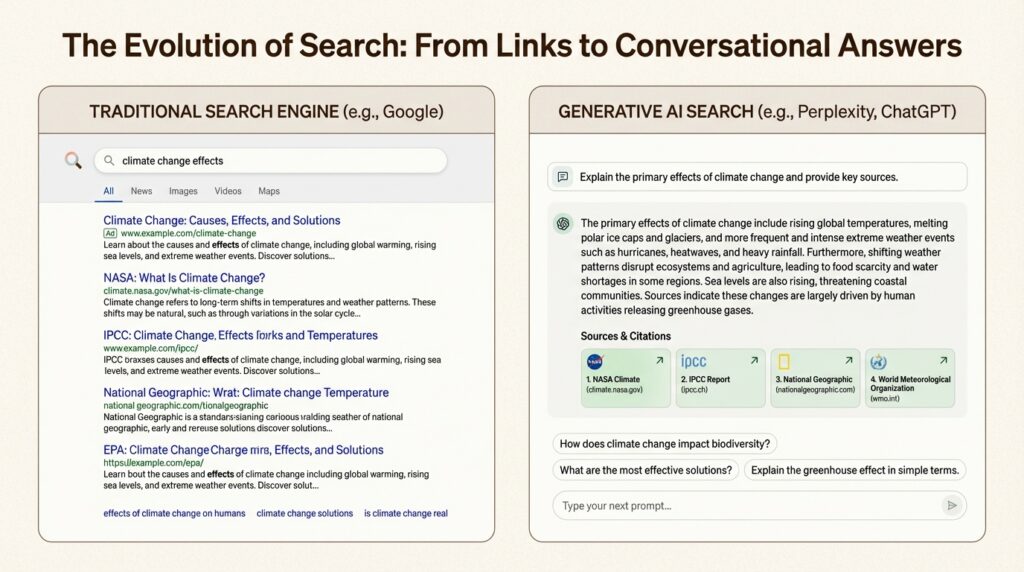
This shift creates a new discipline: Generative Engine Optimization (GEO). GEO is about ensuring your brand gets cited and recommended by AI systems, not just ranked in traditional search results.
Why this matters for small businesses:
- AI search is growing exponentially
- Being cited in AI responses drives high-intent traffic
- Early adopters will have competitive advantage
- Traditional SEO alone is no longer sufficient
Tools with GEO capabilities:
- Semrush: AI Visibility dashboard tracks brand mentions across LLMs
- SurferSEO: AI Tracker monitors visibility across 5 AI platforms
- SE Ranking: SE Visible dashboard with AI sentiment tracking
- Seobility: AI Overview tracking for Google’s AI responses
At Decoding, we specialize in helping small businesses navigate this shift. Our GEO services combine traditional SEO with AI visibility optimization to ensure you’re found everywhere your customers search.
How to choose the right SEO software for your business
Still unsure? Match your situation to the right tool:
Local service business (plumber, dentist, restaurant):
- Start with Google Search Console + SE Ranking Core
- Focus on local SEO features and GBP optimization
E-commerce store:
- Semrush Pro for comprehensive data + SurferSEO for product descriptions
- Budget for both if SEO drives significant revenue
Content/blog business:
- SurferSEO Standard + Google Search Console
- Add Ahrefs later for link building
Agency managing clients:
- Semrush Guru or Ahrefs Standard
- Consider SE Ranking with Agency Pack for white-label needs
Budget under $50/month:
- Seobility Premium ($54/mo is close) or stick with free tools
- Screaming Frog paid ($259/year = ~$22/mo) for technical needs
Decision framework:
- What’s your monthly SEO budget?
- What’s your primary use case (local, content, technical, e-commerce)?
- How steep of a learning curve can your team handle?
- What are your growth plans for the next 12 months?
Get expert help with your SEO strategy
Tools are only as good as the strategy behind them. The best SEO software won’t help if you’re targeting the wrong keywords, ignoring technical issues, or missing the shift to AI search.
At Decoding, we help small businesses make sense of SEO without the enterprise agency price tag. Our approach combines:
- Custom strategy: No templates, just actionable roadmaps
- GEO optimization: Visibility in both Google and AI search
- Senior expertise: 16+ years of experience, no junior teams
- Measurable ROI: We focus on results, not vanity metrics
Whether you need help choosing the right tools, setting up your SEO foundation, or optimizing for AI search, we can help. Get a free consultation or try our AI Visibility Report to see how your brand appears across LLMs.
The right SEO software gets you started. The right strategy gets you results.
Frequently Asked Questions
What is the best SEO software for small business with a limited budget?
Start with Google Search Console (completely free) and Seobility’s free plan. When you’re ready to invest, Seobility Premium at ~$54/month offers the best value for comprehensive features. Screaming Frog at $259/year (~$22/month) is excellent for technical SEO if you can pay annually.
Can I do SEO for my small business without paid software?
Absolutely. Google Search Console, Google Analytics, and Screaming Frog’s free version handle the basics. Paid tools become necessary when you need competitor analysis, advanced keyword research, or scale beyond what free tiers allow.
How does AI search change what SEO software I need?
Traditional SEO tools focus on Google rankings. AI search optimization (GEO) requires tracking how your brand appears in ChatGPT, Perplexity, and other LLMs. Tools like Semrush, SurferSEO, and SE Ranking now offer AI visibility tracking. If AI search is part of your strategy, prioritize these features.
Is Semrush worth the price for a small business?
Semrush is worth it if SEO is a primary growth channel for your business. At $117-208/month, it’s an investment. If you’re a local business with minimal content needs, start with cheaper alternatives. If you’re in e-commerce or competitive niches, Semrush’s data depth justifies the cost.
What’s the difference between Ahrefs and Semrush for small businesses?
Ahrefs excels at backlink analysis and competitor research. Semrush offers broader marketing features including PPC, social media, and content marketing. For pure SEO with focus on link building, choose Ahrefs. For all-in-one marketing intelligence, choose Semrush.
Do I need separate tools for local SEO?
Not necessarily. SE Ranking and Semrush both include strong local SEO features. However, dedicated local tools like BrightLocal can complement your main SEO software if local search is your primary focus.


Leave a Reply