

SEO isn’t what it used to be. The playbook that worked five years ago, or even two, is rapidly becoming obsolete as artificial intelligence reshapes how people find information online.
But here’s the challenge: most SEO advice is still based on assumptions rather than data. Marketers make strategic decisions using outdated benchmarks or gut feelings about what works.
That’s why we compiled this comprehensive collection of 70 verified SEO statistics. These aren’t random numbers pulled from thin air. Each statistic comes from authoritative sources like Backlinko, Ahrefs, Semrush, and SparkToro, with data collected throughout 2024 and early 2026.
Whether you’re building a business case for SEO investment, refining your strategy, or simply want to understand the current search landscape, these numbers tell the real story.
Let’s break it down.
Search engine landscape statistics
Google’s dominance isn’t news, but the scale of that dominance still surprises most people.
Google processes over 8.5 billion searches per day. That’s 99,000 searches every second. The sheer volume means that even capturing a tiny fraction of relevant searches can drive significant business results.
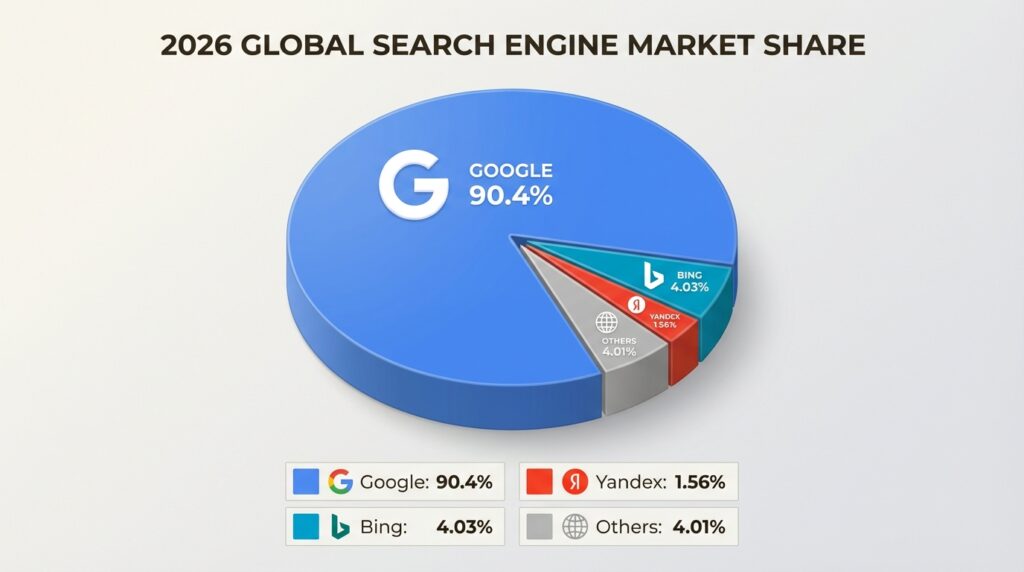
But Google’s market share tells an even more striking story. With 90.4% of global search traffic, Google isn’t just the leader. It’s practically the only game in town for most markets. Bing holds 4.03%, Yandex claims 1.56%, and everyone else fights for scraps.
This concentration has implications for your strategy. Optimizing for Google means optimizing for where your customers actually are. The AI search market share is evolving, but Google remains the foundation.
Other key search landscape statistics:
- 68% of online experiences begin with a search engine. Whether someone is researching a purchase, looking for a solution, or just satisfying curiosity, search is the starting point. (Source: Intergrowth)
- Organic search accounts for 53.3% of all website traffic. Paid ads, social media, email, and direct traffic combined don’t match organic search’s contribution. (Source: Intergrowth)
- The average internet user performs 3 to 4 searches per day. Some users search dozens of times daily, while others search rarely. The median is closer to 1.8 searches per day. (Source: Exploding Topics via AIOSEO)
- Only 9% of users scroll to the bottom of Google’s first page. If you’re not in the top results, you might as well be invisible. (Source: Backlinko via AIOSEO)
AI and the future of search statistics
The most significant shift in search right now isn’t algorithm updates or new ranking factors. It’s the rise of AI-generated answers that satisfy user queries without requiring a click.
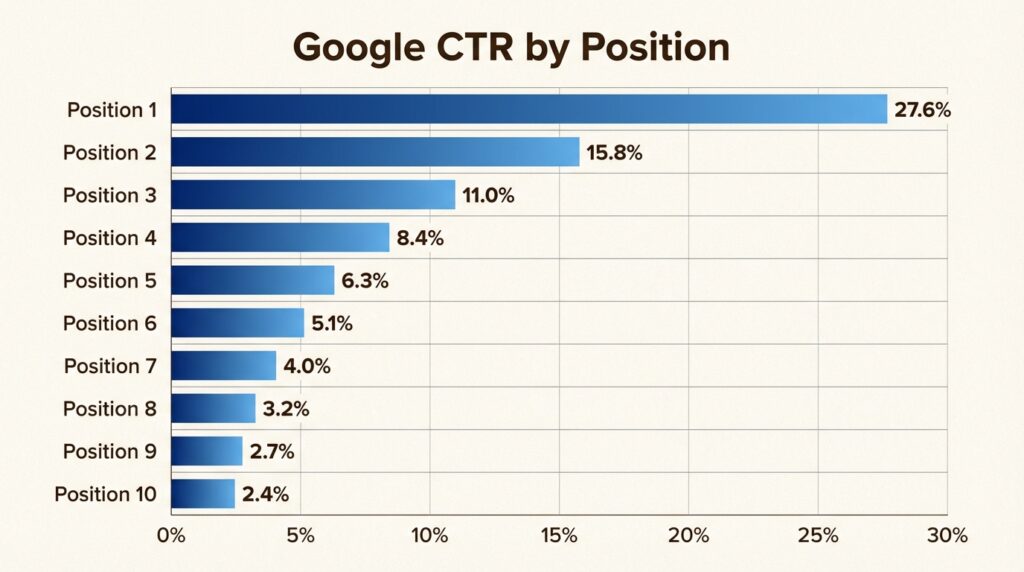
Zero-click searches are accelerating. In March 2025, 27.2% of U.S. searches ended without a click, up from 24.4% in March 2024. The EU and UK saw similar increases, from 23.6% to 26.1%. AI Overviews are the primary driver of this trend. (Source: Search Engine Land)
What does this mean for SEO? The game is changing from “getting clicks” to “getting cited.” When AI systems like ChatGPT, Perplexity, or Google’s AI Overviews answer questions, they pull information from web sources. Being one of those sources, even without the click, builds brand authority and awareness.
Here’s what the data shows about AI’s impact on search:
- 52% of sources cited in Google AI Overviews rank in the top 10 organic results. Traditional SEO still matters for AI visibility. (Source: Semrush)
- AI search traffic is up 527%. The growth is explosive, though from a smaller base than traditional search. (Source: AIOSEO)
- 17.3% of content in Google’s top 20 results is AI-generated. The line between human and AI content is blurring, and Google is ranking both. (Source: Ahrefs)
- 66% of consumers believe AI will replace traditional search within five years. User behavior is shifting faster than many businesses realize. (Source: Search Engine Land)
- 56% of marketers say their company is already using and actively implementing AI, while 44% prefer to wait for more proven solutions. (Source: SurveyMonkey via SeoProfy)
- 67% of small businesses leverage AI to improve their content and SEO numbers. The technology is democratizing access to optimization tools that were previously enterprise-only. (Source: Semrush)
For businesses looking to adapt, understanding AI search optimization is becoming essential. Our GEO services help brands position themselves for visibility in this new landscape.
Google ranking and CTR statistics
Ranking position directly correlates with traffic. The data leaves no room for debate.
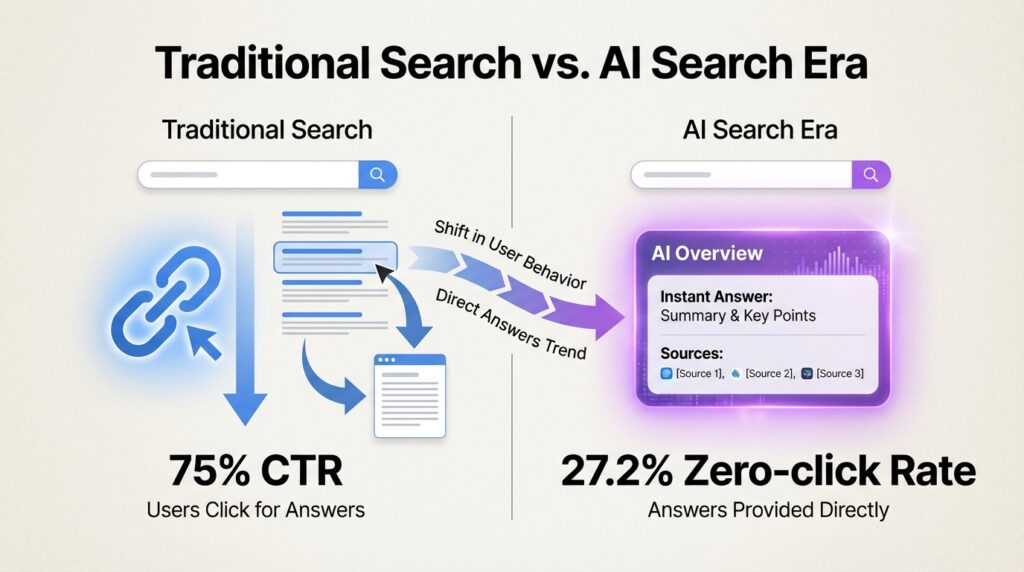
The #1 organic result captures 27.6% of all clicks. Position #2 gets 15.8%, position #3 gets 11%, and the numbers drop steadily from there. By position #10, you’re fighting for 2.4% of clicks. (Source: Backlinko)
Some sources report even higher numbers for position #1, with AIOSEO citing 39.8%. The variation likely reflects different methodologies and time periods, but the pattern is consistent: top positions dominate.
The value of moving up a position is substantial. On average, moving up one spot increases CTR by 2.8%. Moving from position #2 to #1 generates a 74.5% click increase. (Source: Backlinko)
Featured snippets change the equation. When a featured snippet appears at position #0, it captures 42.9% CTR, outperforming even the #1 organic result. (Source: AIOSEO)
Other critical ranking statistics:
- The top three organic results receive 68.7% of all clicks. Positions 4-10 fight over the remaining 31.3%. (Source: AIOSEO)
- Only 0.78% of users click results on Google’s second page. Page 2 is the graveyard of search results. (Source: AIOSEO)
- 94% of all web pages receive no traffic from Google. The vast majority of content published online never reaches an audience through organic search. (Source: Ahrefs)
- About 60% of pages ranking in Google’s top 10 are more than 3 years old. SEO is a long game. Patience pays off. (Source: Ahrefs)
- Moving up one position increases CTR by 32.3% according to some studies, though this varies significantly by position and query type. (Source: Backlinko)
Local SEO statistics
For businesses serving specific geographic areas, local SEO isn’t a nice-to-have. It’s the primary driver of customer acquisition.
46% of all Google searches have local intent. People are looking for businesses, services, and products near them. If you’re not optimized for local search, you’re invisible to nearly half of your potential audience. (Source: Embryo Marketing via Digital Marketing Institute)
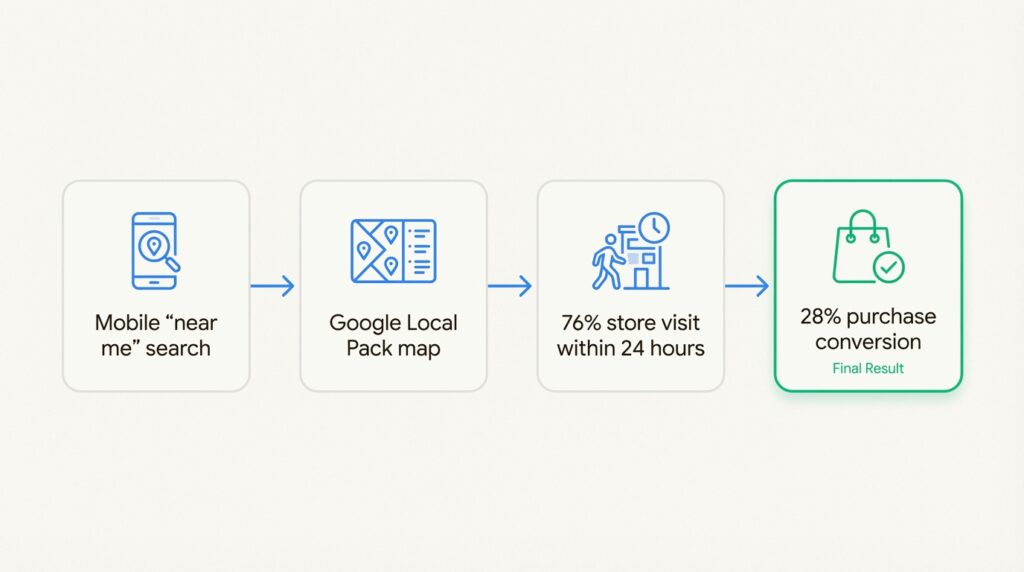
The conversion rate for local searches is remarkable. 76% of people who search for something nearby visit a related business within 24 hours. Local search isn’t just browsing. It’s buying intent. (Source: Google via Intergrowth)
The “near me” phenomenon continues to grow. Searches including “where to buy” and “near me” have increased by 200% since 2017. Mobile users expect immediate, location-relevant results. (Source: Intergrowth)
Key local SEO statistics:
- 72% of consumers use Google Search to find local businesses. Google Business Profile optimization is non-negotiable. (Source: Marketing Charts via SeoProfy)
- 28% of local searches result in a purchase within 24 hours. The intent-to-purchase timeline is incredibly short for local queries. (Source: Intergrowth)
- 42% of consumers regularly read online reviews when browsing with local intent. Reviews are the new word-of-mouth. (Source: BrightLocal)
- 86% of people look up business locations on Google Maps. If your business isn’t on Maps with accurate information, you’re losing customers. (Source: Intergrowth)
- Businesses in the top 3 local positions typically have over 250 images in their Google Business Profile. Visual content matters for local rankings. (Source: Localo via SeoProfy)
For businesses looking to dominate local search, our guide on local SEO for ChatGPT and local SEO services provide actionable strategies. You can read more Local SEO statistics.
Mobile SEO statistics
Mobile isn’t the future of search. It’s the present.
59% to 62.45% of all worldwide internet traffic comes from mobile devices. The exact percentage varies by source and methodology, but the trend is clear: mobile dominates. (Sources: Intergrowth, AIOSEO)
Google’s mobile-first indexing means the mobile version of your site is what Google uses for ranking and indexing. If your mobile experience is poor, your entire SEO performance suffers.
Speed is critical on mobile. 53% of mobile website visitors will leave if a page takes more than 3 seconds to load. Every millisecond counts. (Source: Intergrowth)
More mobile SEO data:
- 30% of all mobile searches are related to location. Mobile and local SEO are deeply intertwined. (Source: Intergrowth)
- 56% of in-store shoppers used their smartphones to research items while physically in the store. The customer journey is increasingly mobile, even during in-person shopping. (Source: Intergrowth)
- 51% of internet users access the internet using only their smartphone, with no desktop or laptop usage. For many people, mobile is their only internet access point. (Source: Intergrowth)
- 61% of mobile searchers are more likely to contact a local business if they have a mobile-friendly site. Mobile optimization directly impacts lead generation. (Source: Intergrowth)
- The average American spends 5-6 hours daily on their phone, not including work-related use. Mobile is where attention lives. (Source: Intergrowth)
Content and keyword statistics
Content remains the foundation of SEO, but the bar for what qualifies as “good content” keeps rising.
Long-form content outperforms. Articles over 3,000 words get 3x more traffic, 4x more shares, and 3.5x more backlinks than average-length content around 1,400 words. Depth wins. (Source: AIOSEO)
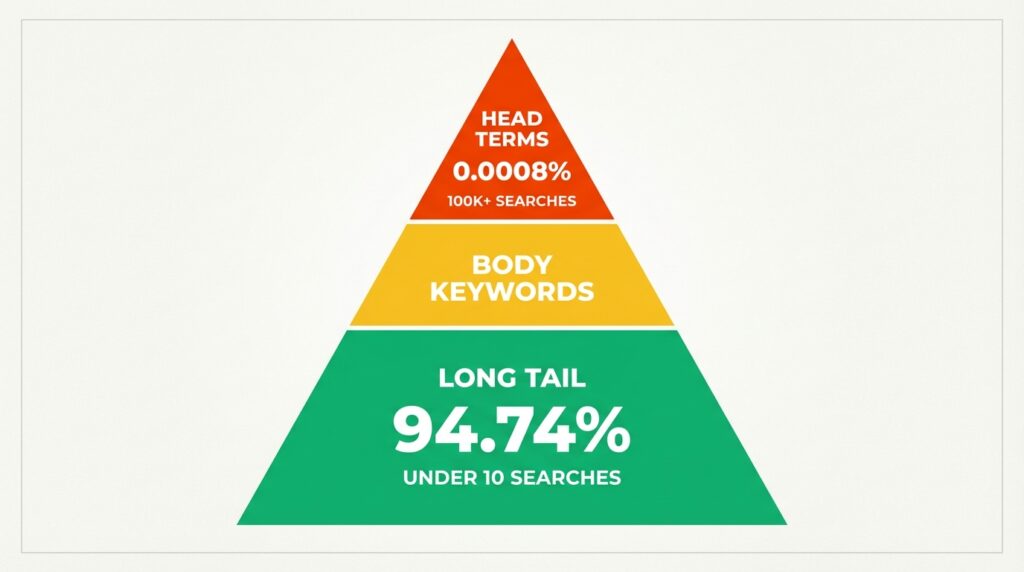
The keyword landscape is more fragmented than most people realize. 94.74% of keywords have monthly search volumes of 10 or less. The long tail isn’t just long. It’s practically infinite. (Source: AIOSEO)
This fragmentation creates opportunity. While everyone fights for high-volume head terms, there’s less competition for the millions of specific, low-volume queries that collectively drive massive traffic.
More content and keyword insights:
- 15% of all Google searches have never been searched before. Google sees completely novel queries daily. (Source: AIOSEO)
- Long-tail keywords (10-15 words) get 1.76x more clicks than single-word queries. Specific intent beats broad volume. (Source: Backlinko)
- URLs containing keywords have a 45% higher click-through rate than URLs without relevant keywords. Every element of the SERP listing matters. (Source: Backlinko)
- Roughly 8% of searches are phrased as questions. Optimizing for question-based queries captures specific intent. (Source: Intergrowth)
- The average first-page result contains 1,447 words. Comprehensive coverage correlates with rankings. (Source: Intergrowth)
- Only 0.0008% of keywords get more than 100,000 monthly searches. The mega-keywords are vanishingly rare. (Source: AIOSEO)
For businesses developing content strategies, our content strategy services help align content creation with search demand.
Link building and authority statistics
Links remain one of Google’s strongest ranking signals, though the quality-over-quantity principle has never been more important.
A site’s overall link authority, measured by Domain Rating, strongly correlates with higher rankings. This isn’t controversial. It’s confirmed by multiple studies. (Source: Backlinko)
What’s less understood is that 89.1% of link builders say nofollow links have an impact on rankings. Google’s treatment of nofollow has evolved from “ignore completely” to “hint.” (Source: Authority Hacker via SeoProfy)
Additional link building data:
- High-quality content, backlinks, and search intent are the top 3 ranking factors in 2026. Links are second only to content quality. (Source: AIOSEO)
- Google uses over 200 ranking factors in its algorithm. Links are among the most heavily weighted. (Source: AIOSEO)
- Thought leadership blogs with transactional keywords have a 748% ROI. Content that attracts links and targets buying intent is incredibly valuable. (Source: AIOSEO)
What these seo statistics mean for your strategy
Data without action is just trivia. Here’s how to apply these statistics to your SEO strategy.
For SMBs and local businesses:
The local SEO statistics tell a clear story. Nearly half of all searches have local intent, and three-quarters of those searchers visit a business within a day. If you serve a geographic area, local SEO should be your top priority.
Start with Google Business Profile optimization. Add photos, collect reviews, ensure your NAP (name, address, phone) is consistent across the web, and target location-specific keywords.
For content marketers:
The content statistics reveal that depth wins. Longer content gets more traffic, shares, and backlinks. But don’t pad word counts. Instead, aim for comprehensive coverage that genuinely answers user questions.
Target the long tail. With 94.74% of keywords having minimal monthly volume, the opportunity lies in capturing many specific queries rather than fighting for a few high-volume terms.
For businesses adapting to AI search:
The AI statistics show that search is fragmenting. Zero-click searches are rising, AI Overviews are changing how users interact with results, and new platforms like ChatGPT Search are emerging.
The strategy shift is from “getting clicks” to “getting cited.” Optimize for visibility within AI-generated answers, not just traditional blue links. This means structured data, clear authoritative content, and positioning your brand as a trusted source.
Our AI visibility audit helps businesses understand how they appear in AI search results, and our guide on getting cited by LLMs provides actionable tactics.
The bottom line:
SEO in 2026 requires balancing traditional best practices (technical optimization, quality content, authoritative links) with emerging AI search realities. The businesses that adapt to both will capture the traffic and customers that others lose.
Methodology and sources
This statistics compilation draws from authoritative industry sources including:
- Original research: Backlinko, Ahrefs, SparkToro, Semrush
- Aggregated compilations: AIOSEO, SeoProfy, Intergrowth
- Industry publications: Search Engine Land, Search Engine Journal, Digital Marketing Institute
- Market data: Statista, Google/Think with Google, HubSpot
Statistics are sourced from studies and reports published throughout 2024 and early 2026. Where sources conflict, we prioritized original research over aggregated data and noted variations.
All statistics include inline citations linking to source materials. For comprehensive SEO research, we recommend consulting the original studies cited throughout this article.
Frequently Asked Questions
What are the most important SEO stats for small businesses to track?
Small businesses should prioritize local SEO metrics (local search visibility, Google Business Profile views, local pack rankings), organic traffic growth, and conversion rates from organic search. The statistics show that 46% of searches have local intent and 76% of local searches result in a visit within 24 hours, making local SEO the highest-ROI focus for most SMBs.
How have SEO stats changed with the rise of AI search?
The most significant change is the rise of zero-click searches, now at 27.2% of U.S. searches up from 24.4% in 2024. AI Overviews provide instant answers that satisfy queries without website visits. Additionally, 52% of sources cited in AI Overviews come from the top 10 organic results, meaning traditional SEO still matters for AI visibility.
Which seo stats prove that SEO is still worth investing in?
Several statistics demonstrate SEO’s continued value: SEO drives 1,000% more traffic than organic social media, leads from SEO have a 14.6% close rate versus 1.7% for outbound leads, and 68% of online experiences begin with search engines. Despite AI changes, organic search remains the dominant traffic source.
What do mobile SEO stats tell us about user behavior?
Mobile statistics reveal that 59-62% of all internet traffic is mobile, 30% of mobile searches have local intent, and 53% of mobile visitors abandon sites that take more than 3 seconds to load. Users expect fast, mobile-optimized experiences, and businesses that don’t deliver lose customers.
How accurate are the SEO stats about ranking positions and CTR?
Multiple studies from Backlinko, Ahrefs, and AIOSEO confirm that the #1 position captures 27.6-39.8% of clicks, with CTR dropping significantly for each subsequent position. While exact percentages vary by study methodology, the pattern is consistent: top positions dominate click share.
What SEO stats should guide my content strategy?
Key content statistics include: content over 3,000 words gets 3x more traffic than shorter content, 94.74% of keywords have fewer than 10 monthly searches (making the long tail essential), and 15% of searches have never been seen before. These numbers suggest creating comprehensive content targeting specific, low-competition queries.
How do local SEO stats compare to national SEO?
Local SEO shows stronger immediate conversion signals: 28% of local searches result in a purchase within 24 hours compared to longer sales cycles for national queries. However, local search volume is typically lower. The strategy depends on your business model. Local businesses should prioritize local SEO, while e-commerce or national brands should focus on broader keyword targeting.








Leave a Reply