


Here’s a number that should get your attention: 84% of B2B buyers start their search for manufacturing services online. Not at trade shows. Not through referrals. On Google.
Yet most manufacturing companies are practically invisible where their buyers are looking. Their websites read like internal brochures, their product pages lack the technical detail engineers need, and their SEO strategy (if they have one) hasn’t been updated since 2015.

The result? Qualified buyers find your competitors instead.
This guide breaks down exactly how to fix that. We’ll cover the unique challenges of SEO for manufacturers (long sales cycles, technical products, niche audiences) and give you an actionable framework to capture high-intent industrial buyers. At Decoding, we’ve spent 16 years helping manufacturers turn search visibility into qualified leads and revenue. Here’s what actually works.
Why SEO matters for manufacturers in 2026
The manufacturing industry has been slow to adopt digital marketing. While other sectors shifted budgets online years ago, manufacturers held onto what worked in the past: trade shows, distributor networks, word-of-mouth.
Those channels still have value. But they’re slow, expensive, and impossible to measure accurately. Meanwhile, your potential buyers have already moved online.
Research shows that 57-70% of B2B buyers complete their research before they ever contact sales. By the time you get that RFQ, they’ve already compared specs, reviewed capabilities, and narrowed their options. If you weren’t visible during that research phase, you weren’t in the conversation.
Here’s why this creates an opportunity: manufacturing is one of the last industries to get serious about digital marketing. That means less competition in organic search compared to other B2B sectors. The companies that invest in SEO now are building a moat that competitors will struggle to cross later.
SEO also compounds in ways that paid advertising cannot. A PPC campaign stops generating leads the moment you pause the budget. A well-optimized piece of content can drive traffic and leads for years. For manufacturers with long sales cycles (6-18 months is common), this compounding effect is especially valuable. The buyer who finds your technical guide today might not request a quote for nine months, but when they do, you’re already positioned as the expert.
The difference between B2B and B2C SEO for manufacturing comes down to intent and complexity. B2C SEO often targets high-volume, lower-intent keywords. Manufacturing SEO is the opposite: lower search volumes, but each visitor represents a potential five, six, or seven-figure opportunity. One qualified lead from organic search can justify months of SEO investment.
Understanding manufacturing buyer search behavior
Here’s where most manufacturers get SEO wrong: they optimize for how they describe their services, not how buyers actually search.
Your marketing team might call it “precision-engineered polymer solutions.” Your buyers search for “plastic injection molding company in Ohio.” If your website doesn’t reflect the exact terminology buyers use, Google won’t connect you with the people looking for what you make.
Engineers and procurement managers search differently than typical consumers. They use:
- Technical specifications: “CNC machining tolerances ±0.002″”
- Material-specific terms: “316 stainless steel fabrication”
- Compliance requirements: “ISO 9001 certified welding services”
- Application-based queries: “aerospace-grade aluminum machining”
Understanding search intent is critical. Someone searching “benefits of powder coating” is in research mode. They’re not ready to buy; they’re learning. Someone searching “custom powder coating services near me” has intent. They know what they need and are looking for a supplier.
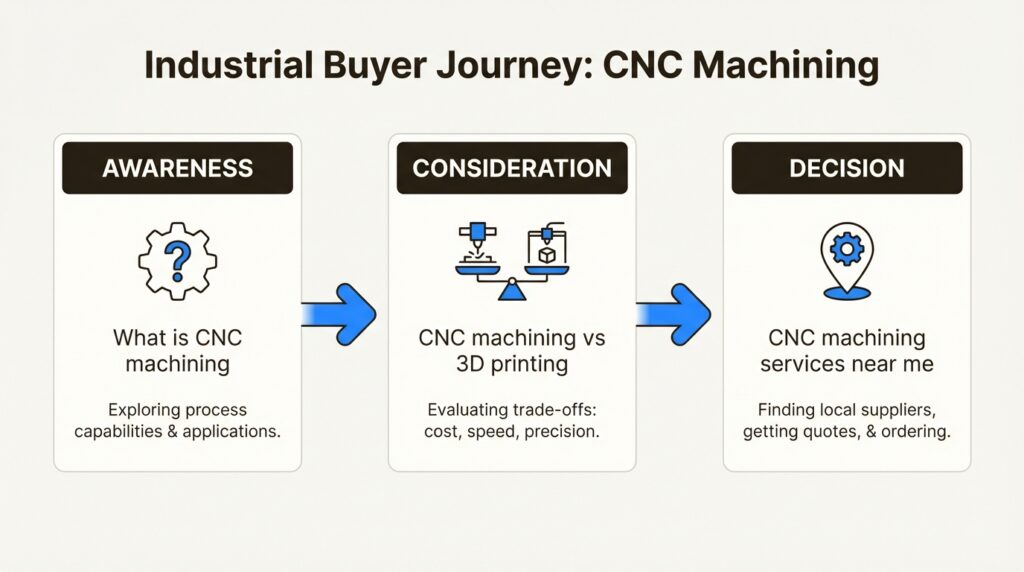
Your content strategy needs to address both. Educational content builds authority and captures buyers early in their journey. Product and service pages convert buyers who are ready to request quotes.
Manufacturing purchases involve multiple stakeholders, each with different questions. The engineer cares about tolerances and materials. Procurement cares about minimum order quantities and lead times. The CFO cares about total cost of ownership. Your SEO content needs to answer all of these questions, not just the technical ones.
The best source of keyword ideas isn’t a tool. It’s your own inbox. Look at the last 20 RFQs you received. What exact phrases did buyers use to describe what they need? Those are your keywords. The language in customer emails, the questions your sales team fields, the terms buyers use on discovery calls (this is gold that most manufacturers ignore).
On-page SEO strategies for manufacturing websites
Most manufacturing websites make the same mistake: they lump everything into a single “Capabilities” or “Services” page. That might work for human visitors who want a quick overview, but it kills your SEO potential.
Google ranks individual pages for specific topics. If you offer CNC machining, injection molding, and sheet metal fabrication, you need separate pages for each service. Each page should target the specific keywords buyers use when searching for that capability.
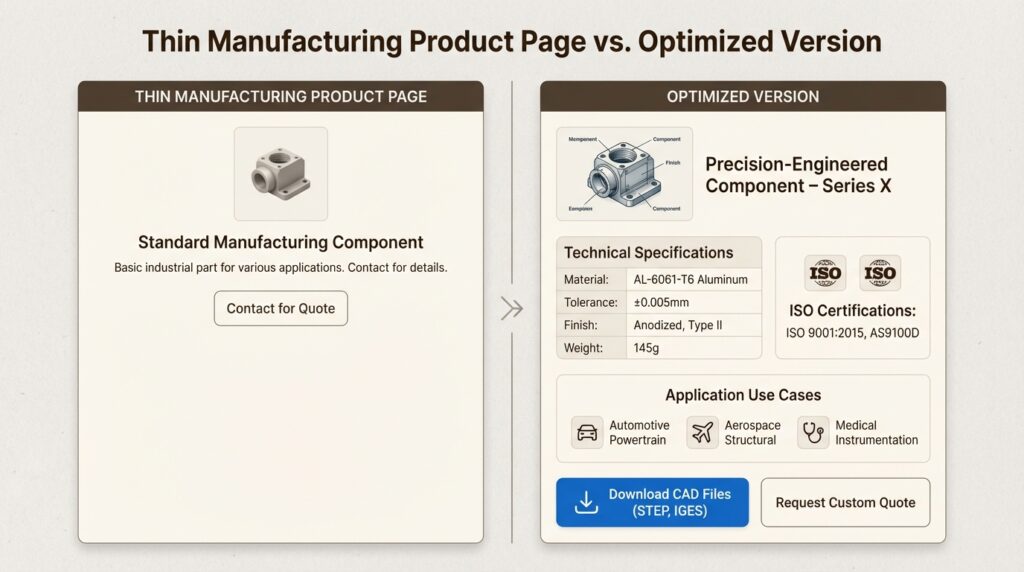
Product descriptions on manufacturing sites are often thin: a part number, a brief description, maybe a PDF spec sheet. That’s not enough to rank. Effective product pages include:
- Detailed specifications: materials, dimensions, tolerances, finishes
- Applications and use cases: where and how the product is used
- Compliance information: certifications, standards, testing data
- Technical documentation: CAD files, drawings, installation guides
- Related products: cross-sells and alternatives
Your URLs should be clean and descriptive. /services/cnc-machining is better than /services?page=3&id=847. Include target keywords in URLs where they fit naturally.
Title tags and meta descriptions are your ad copy in search results. They need to include your target keyword and give buyers a reason to click. Instead of “CNC Machining | ABC Manufacturing,” try “Precision CNC Machining Services | Tight Tolerances, Fast Turnaround | ABC Manufacturing.”
Internal linking helps Google understand your site structure and distributes authority across pages. Link from your homepage to key service pages. Link from service pages to related products. Link from blog posts to relevant product and service pages. Use descriptive anchor text (“our CNC machining capabilities”) instead of generic links (“click here”).
Schema markup is underused in manufacturing but can give you an edge. Product schema can display price, availability, and ratings directly in search results. Organization schema helps Google understand your company. LocalBusiness schema improves your visibility in local searches. Implementation is technical, but the potential visibility gains are worth the effort.
Technical SEO fundamentals manufacturers can’t ignore
You can have the best content in your industry, but if your site is slow, insecure, or broken on mobile, it won’t rank. Google has been explicit: technical performance is a ranking factor.
Site speed matters more than most manufacturers realize. Research from Cloudflare shows that a one-second delay in page load time can reduce conversions by 7%. For a manufacturing site generating $100,000 in monthly online quotes, that’s $7,000 in lost revenue per month from slow loading alone.
Check your speed with Google PageSpeed Insights. If your scores are low, start by compressing images. Manufacturing sites are notorious for uploading high-resolution product photos without optimization. Tools like TinyPNG can reduce file sizes by 70% or more without visible quality loss.
Google uses mobile-first indexing, which means it primarily uses the mobile version of your site for ranking and indexing. If your site looks broken or loads slowly on phones, your rankings will suffer. Test your site on actual mobile devices, not just desktop browsers resized to mobile dimensions.
HTTPS isn’t optional anymore. If your URL still starts with http:// instead of https://, you’re sending a signal that your site (and by extension, your company) isn’t keeping up with modern standards. SSL certificates are free from most hosting providers now. There’s no excuse for not having one.
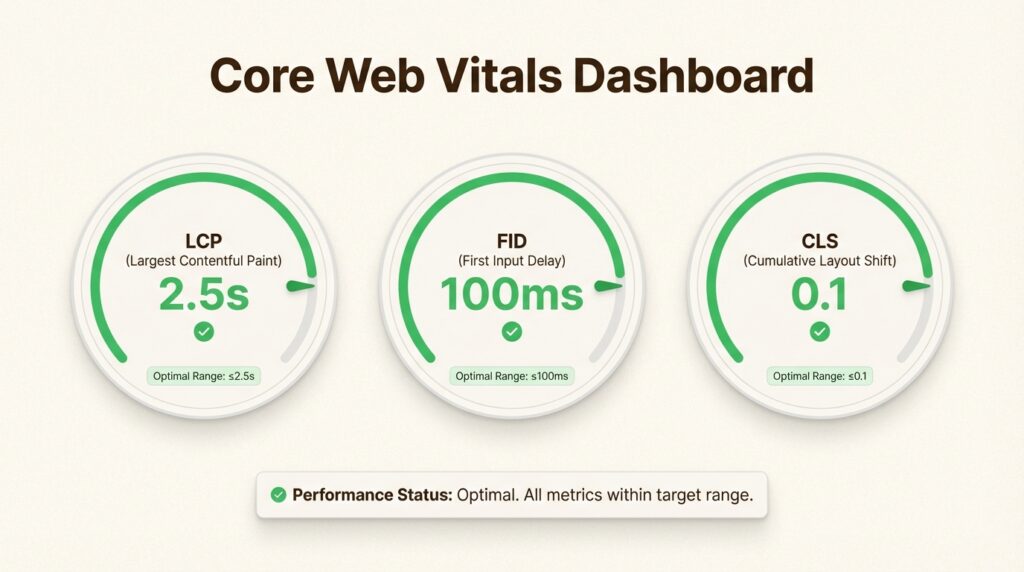
Core Web Vitals are Google’s way of measuring user experience. They track three things: how fast your largest content element loads (LCP), how quickly your page responds to user input (FID), and how stable your page layout is (CLS). You don’t need to understand the technical details. Just know that poor Core Web Vitals scores will hurt your rankings.
Common technical issues on manufacturing sites include:
- Duplicate content: Product descriptions copied across multiple pages
- Broken links: Links to old products, outdated resources, or moved pages
- Thin content: Pages with fewer than 300 words of unique content
- Missing alt text: Images without descriptive text for accessibility and SEO
Tools like Screaming Frog can crawl your site and identify these issues. Google Search Console will alert you to problems Google has detected.
Content strategy that attracts qualified industrial buyers
Content marketing for manufacturers isn’t about viral blog posts or trendy topics. It’s about answering the specific questions your buyers have at each stage of their decision process.
The content types that work best for manufacturing SEO include:
- Technical guides: Deep dives into processes, materials, or applications
- Case studies: Real projects with measurable outcomes and client testimonials
- Comparison content: “Stainless steel vs. galvanized fasteners” or “CNC machining vs. 3D printing”
- FAQ pages: Addressing common objections and questions
- Specification sheets: Downloadable technical documentation
Match your content to the buyer’s journey. Early-stage buyers need educational content that helps them understand their options. Mid-stage buyers need comparison content that helps them evaluate solutions. Late-stage buyers need product-specific content that helps them justify a decision.
Google’s E-E-A-T framework (Experience, Expertise, Authoritativeness, Trustworthiness) is especially important for manufacturing content. Buyers are making high-stakes decisions. They need to trust that you know what you’re talking about.
Build E-E-A-T by:
- Including author bylines with credentials (“Written by John Smith, PE, with 20 years in aerospace manufacturing”)
- Citing authoritative sources and industry standards
- Showcasing real client projects and measurable results
- Keeping content updated and accurate
- Displaying certifications and industry memberships prominently
Video content is underutilized in manufacturing but highly effective. The Content Marketing Institute found that blogs with video attract 150% more traffic than text-only posts. Product demonstrations, facility tours, and technical explanations work well in video format. Complex manufacturing processes are often easier to show than to describe in text.
Content refresh is an underrated SEO tactic. Instead of only creating new content, regularly update your existing pages. Add new case studies. Update statistics. Expand thin sections. Google favors fresh content, and refreshed pages often see ranking improvements within weeks.
Building authority with off-page SEO
Off-page SEO is about building signals of trust and authority that happen outside your website. For manufacturers, the most important off-page factor is backlinks: links from other websites pointing to yours.
Not all backlinks are equal. A link from a respected industry publication carries far more weight than a link from a random blog. For manufacturers, the most valuable backlinks come from:
- Industry directories: ThomasNet, GlobalSpec, IndustryNet, and MFG.com
- Trade publications: Industry magazines and online publications
- Professional associations: Manufacturing associations and trade groups
- Partner and supplier websites: Companies you work with who list you as a vendor
- Educational institutions: Universities and technical schools (if you have research partnerships)
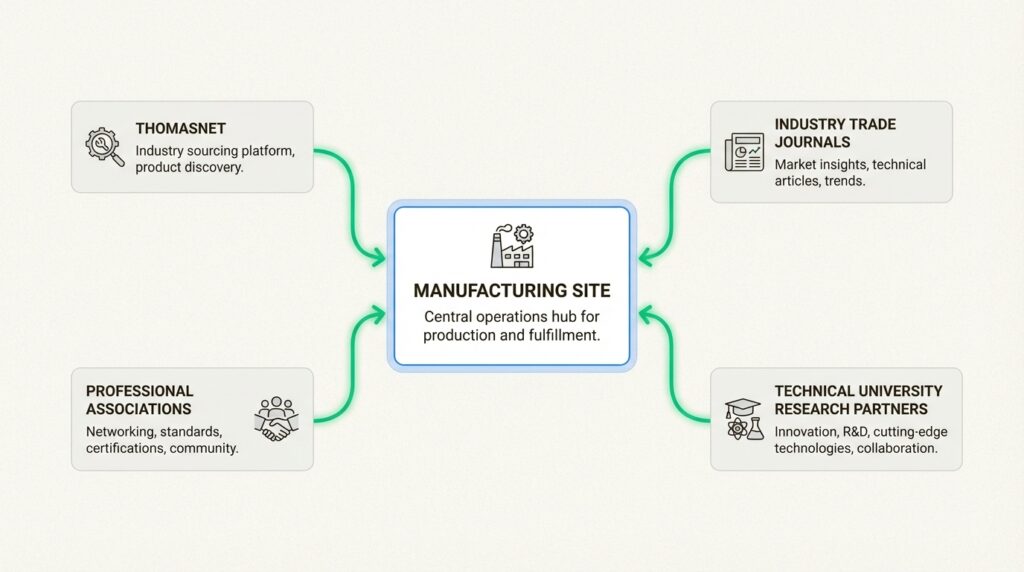
Guest articles in trade publications serve two purposes: they position you as a thought leader and they earn you valuable backlinks. Focus on publications your buyers actually read. A link from a niche manufacturing publication is worth more than a link from a general business blog.
Even if you serve customers nationwide, local SEO matters for manufacturers. Google often prioritizes local results for searches that include location modifiers (“CNC machining in Dallas”). A complete, optimized Google Business Profile improves your visibility in local searches and Google Maps.
Local citations (mentions of your business name, address, and phone number on other websites) reinforce your geographic relevance. Get listed in local business directories, regional manufacturing associations, and your local Chamber of Commerce.
Avoid link schemes and black-hat tactics. Buying links in bulk, participating in link exchanges, or using automated link-building tools can result in Google penalties that are difficult to recover from. Focus on earning links naturally by creating valuable content and building real relationships in your industry.
Measuring SEO success for manufacturing companies
SEO isn’t a set-it-and-forget-it channel. You need to track performance, identify what’s working, and continuously improve.
The key metrics for manufacturing SEO include:
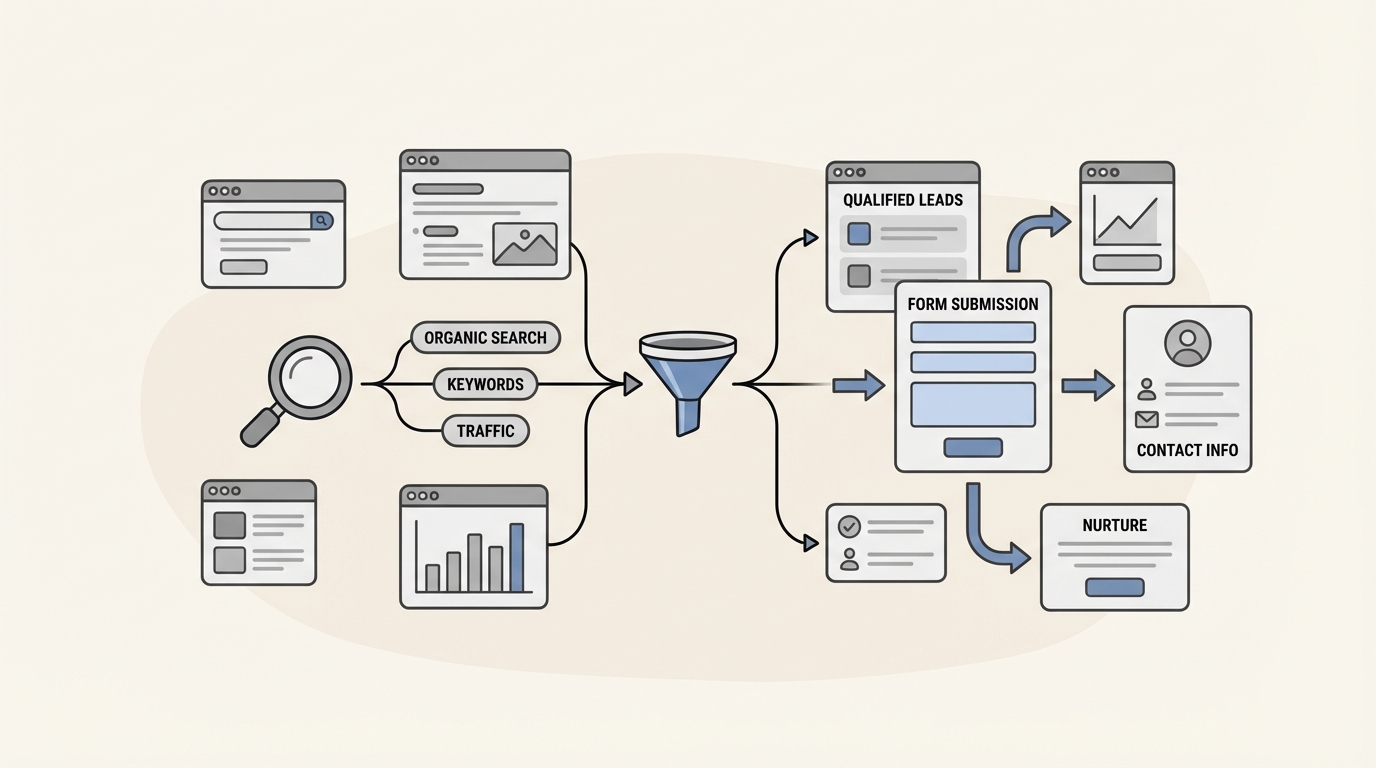
- Organic traffic: Visitors coming from non-paid search results
- Keyword rankings: Where you rank for target terms (track monthly)
- Form submissions: Contact forms, RFQ requests, quote inquiries
- Phone calls: Trackable phone numbers can attribute calls to organic search
- Revenue attribution: The ultimate metric (though challenging with long sales cycles)
The tools you need are mostly free:
- Google Analytics 4: Tracks traffic, user behavior, and conversions
- Google Search Console: Shows which keywords drive traffic and identifies technical issues
- Rank tracking tools: SEMrush, Ahrefs, or Ubersuggest for monitoring keyword positions
Set realistic expectations for timelines. SEO for manufacturers typically takes 3-6 months to show meaningful results. You’re not just optimizing pages; you’re building authority in a competitive space. The companies that stick with it see compound returns over time.
Attribution is challenging in B2B manufacturing because of long sales cycles. A buyer might find your site through organic search in January, download a whitepaper in March, attend a webinar in June, and finally request a quote in September. Most analytics tools will attribute that conversion to the last touch (the webinar), but SEO played a critical role in the initial discovery.
Consider implementing multi-touch attribution if your sales process is complex. At minimum, survey new customers and ask how they found you. You’ll often discover that organic search was the first touchpoint, even if it wasn’t the last.
Getting started with manufacturing SEO
You don’t need to overhaul your entire digital strategy overnight. Start with quick wins that deliver immediate impact:
- Optimize your homepage: Make sure your H1 tag clearly states what you do and where you do it (“Custom Metal Fabrication | ISO Certified | Houston, TX”)
- Claim your Google Business Profile: Complete every field, add photos of your facility, and start collecting reviews
- Fix critical technical issues: Address broken links, slow loading, and mobile problems first
- Expand your top product page: Pick your most important product and add detailed specs, applications, and technical content
- Create one piece of educational content: Answer the most common question your sales team receives
Deciding whether to handle SEO in-house or hire an agency depends on your resources and timeline. DIY SEO is possible if you have someone on your team with the time to learn and execute. But be realistic: effective SEO requires ongoing effort across content, technical optimization, and link building.
Working with an agency accelerates results and brings specialized expertise, but not all agencies understand manufacturing. Look for partners who have experience in B2B industrial marketing and can speak your language (literally: they should understand terms like “tolerance,” “fabrication,” and “CNC” without you explaining them).
At Decoding, we specialize in SEO for manufacturers. We’ve helped companies generate 78 RFQs in 12 months, achieve 540% increases in search traffic, and build sustainable lead generation engines that work while they focus on making great products. If you’re ready to turn your website into a 24/7 sales tool, let’s talk about how we can help.
Frequently Asked Questions
How long does it take to see results from SEO for manufacturers?
Most manufacturing companies see initial improvements in 3-6 months, with significant results typically appearing within 6-12 months. The timeline depends on your starting point, competition level, and consistency of effort. Unlike paid advertising, SEO compounds over time, so results accelerate as your authority builds.
What is the most important SEO tactic for manufacturing companies?
Creating dedicated pages for each product or service is the highest-impact tactic most manufacturers overlook. Instead of lumping everything into a ‘Capabilities’ page, build individual pages optimized for specific keywords like ‘CNC machining services’ or ‘custom sheet metal fabrication.’ This gives Google clear signals about what you offer and matches how buyers actually search.
Should manufacturers focus on local SEO even if they sell nationally?
Yes. Google often prioritizes local results for manufacturing searches, especially those including location modifiers like ‘near me’ or city names. An optimized Google Business Profile and consistent local citations improve visibility even for companies with national reach. Plus, many buyers still prefer working with suppliers in their region.
How much should manufacturing companies budget for SEO?
Budgets vary based on goals and competition, but most mid-size manufacturers should expect to invest $3,000-$10,000 monthly for comprehensive SEO services. DIY SEO is possible with internal resources but requires consistent time investment. Consider the lifetime value of a single qualified manufacturing lead (often tens or hundreds of thousands of dollars) when evaluating ROI.
Can manufacturers do SEO themselves, or do they need an agency?
DIY SEO is possible if you have team members with time to learn and execute across content creation, technical optimization, and link building. However, manufacturing SEO has unique challenges (technical products, long sales cycles, niche keywords) that benefit from specialized experience. Agencies accelerate results but should have proven manufacturing experience.
What are the biggest SEO mistakes manufacturers make?
The most common mistakes include: using internal jargon instead of buyer language, having thin product descriptions without technical details, relying on PDF brochures instead of HTML content, neglecting mobile optimization, and expecting immediate results without consistent effort. Many manufacturers also fail to track SEO performance properly, making it impossible to optimize effectively.
How does SEO for manufacturers differ from other B2B industries?
Manufacturing SEO differs in several key ways: buyers use highly technical search terms rather than general business language, sales cycles are longer (requiring content for multiple decision stages), average order values are higher (making each qualified lead extremely valuable), and competition is often lower (since many manufacturers underinvest in digital). The content must also address multiple stakeholders with different priorities, from engineers to procurement to executives.











Leave a Reply