
Every time ChatGPT answers a question in your industry, it’s choosing a winner. Track exactly how much share of voice your competitors hold in AI-generated answers, and where you’re losing ground.
Other features: ChatGPT Tracker – AI Citation Tracking – Competitive AI Monitoring




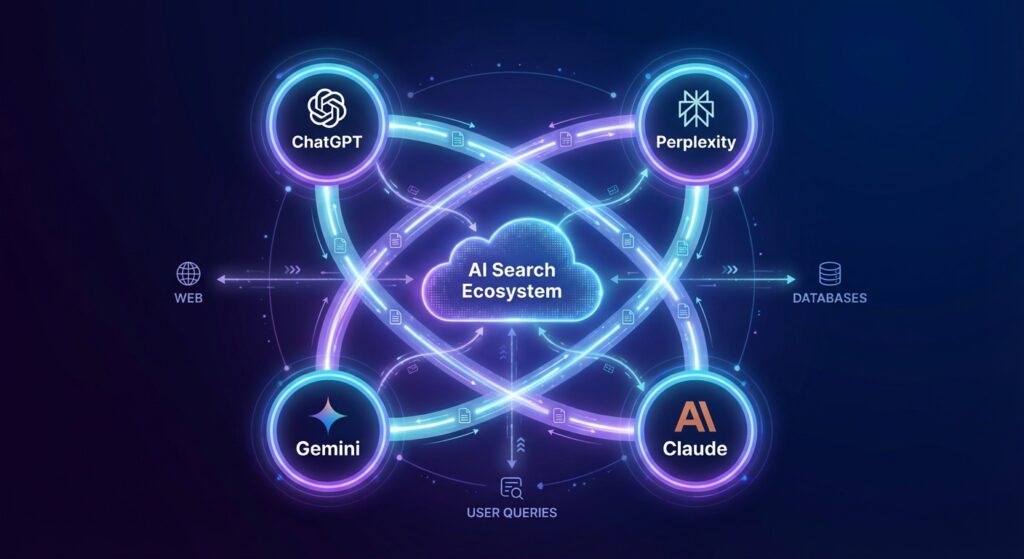
The shift from traditional search to AI discovery has created an invisible competitive battlefield.
While your Google rankings may look stable, competitors could be capturing AI traffic you cannot detect with existing analytics. Google Analytics shows website visits. Search Console shows Google rankings. Neither shows AI recommendations.
This guide provides a practical framework for tracking competitor visibility across ChatGPT, Perplexity, Gemini, and AI Overviews. Whether you’re a solo marketer or leading an enterprise team, you’ll learn how to measure what matters and act on what you find.
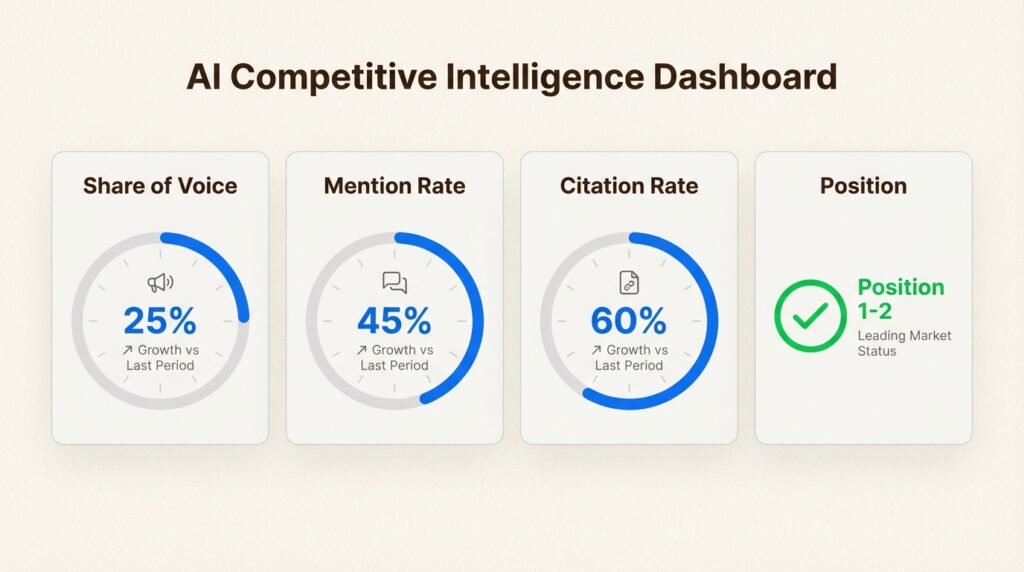
The four metrics that matter for AI competitive intelligence
Before you start tracking, you need to know what to measure. Here’s the Competitive Visibility Framework we use with clients:
| Metric | Formula | What It Reveals | Strong Benchmark |
|---|---|---|---|
| Share of Voice (SOV) | (Your mentions ÷ Total competitor mentions) × 100 | Your competitive slice of AI recommendations | 20%+ in mature markets |
| Mention Rate | (Queries with your brand ÷ Total queries) × 100 | Baseline visibility independent of competitors | Varies by category |
| Citation Rate | Mentions with source links ÷ Total mentions | AI system confidence in your authority | Higher = stronger authority |
| Position | Where you appear in multi-brand responses | Attention capture vs. competitors | First 2 sentences = 5x consideration |
Here’s why position matters so much. Research across thousands of AI responses shows that brands mentioned in the first two sentences receive approximately 5x more consideration than those mentioned later. In a ChatGPT response listing five project management tools, the first two get the attention. The last three get skimmed or ignored.
Citation rate reveals something different: AI system confidence. When ChatGPT or Perplexity includes a link to your site, it signals that the AI trusts your content enough to source it. High citation rates correlate with stronger brand authority and better conversion from AI-referred traffic.
Share of Voice is your competitive baseline. If you’re mentioned in 10 queries and your three main competitors appear in 90 total, your SOV is 10%. In mature markets, 20% SOV indicates healthy competitive positioning. In emerging categories, even 5% can be significant.
Our AI brand visibility tracker can help you calculate these metrics automatically.
Building your AI competitor tracking system
You don’t need enterprise software to start. Here’s a three-step process that works for teams of any size.
Step 1: Identify your AI search competitors
Your AI competitors may not match your Google competitors. Open ChatGPT, Gemini, and Perplexity. Ask questions your customers would ask, then document every brand mentioned.
Start with these query types:
- “What is the best [category] for [use case]?”
- “Compare [category] options”
- “[Your brand] vs [competitor]”
Look for patterns. Who appears first? Who appears consistently across multiple queries? Who never appears despite being a known competitor? Document everything in a simple spreadsheet.
Step 2: Build a query testing framework
Create 50-100 structured prompts across the buyer journey:
- Awareness stage (category education): “What is project management software?”
- Consideration stage (comparison): “Best project management software for remote teams”
- Decision stage (direct comparison): “Asana vs Monday.com vs ClickUp”
Structure by buyer journey stage for complete funnel coverage. A software company might track 30 awareness queries, 40 consideration queries, and 30 decision queries.
Step 3: Choose your tracking approach
Manual tracking works for query sets under 50, initial research, or budget constraints. Run your queries weekly, screenshot results, and track changes in a spreadsheet.
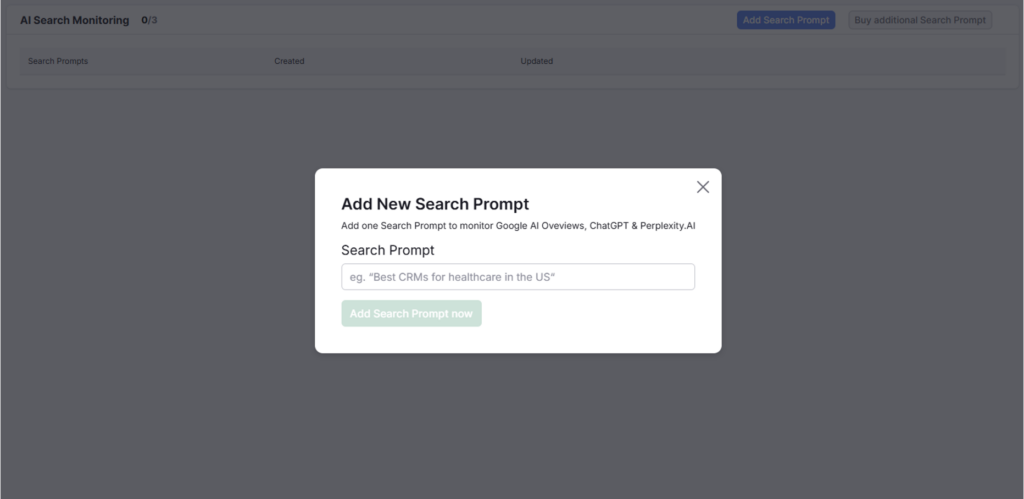
Automated platforms provide scale. Decoding starts at $49/month for 50 prompts tracked per month and offers deeper insights. Most teams need a hybrid approach automation for routine monitoring, human analysis for interpretation.
For teams needing help with GEO strategy alongside tracking, our GEO services provide integrated support.
Platform-specific tracking priorities
Not all AI platforms matter equally. Focus your limited resources where they count.
Essential platforms: ChatGPT and Perplexity
Together these cover the majority of AI search activity. But here’s the critical insight: cross-platform citation overlap is only 11%. Competitors dominating ChatGPT may be completely invisible on Perplexity.
| Platform | Market Share | Citation Rate | Priority |
|---|---|---|---|
| ChatGPT | 60.7% | 42% | Essential |
| Perplexity | 6.6-11% | ~30% | Essential |
| Gemini | Growing | 35% | Secondary |
| Claude | Niche | 28% | Secondary |
ChatGPT’s 60.7% market share makes it non-negotiable. Perplexity punches above its weight with higher citation rates and a research-focused audience. Gemini is growing but still secondary. Claude remains niche despite technical sophistication.
Measurement cadence
Monthly or quarterly tracking works for stable brands. Increase frequency to weekly during campaigns, after major model updates, or when you notice unusual competitive shifts.
Content changes take 4-12 weeks to reflect in LLM responses. Don’t expect overnight results from optimization efforts. Track consistently over quarters, not days.
For current platform market share data, see our AI search market share analysis.
Understanding why competitors appear (and you don’t)
Research from Evertune analyzing 7,000+ citations identified the factors that actually drive AI visibility:
- Brand search volume (0.334 correlation) strongest predictor
- Web mention volume top 25% get 10x more citations
- Multi-source signal convergence presence on 4+ platforms = 2.8x likelihood
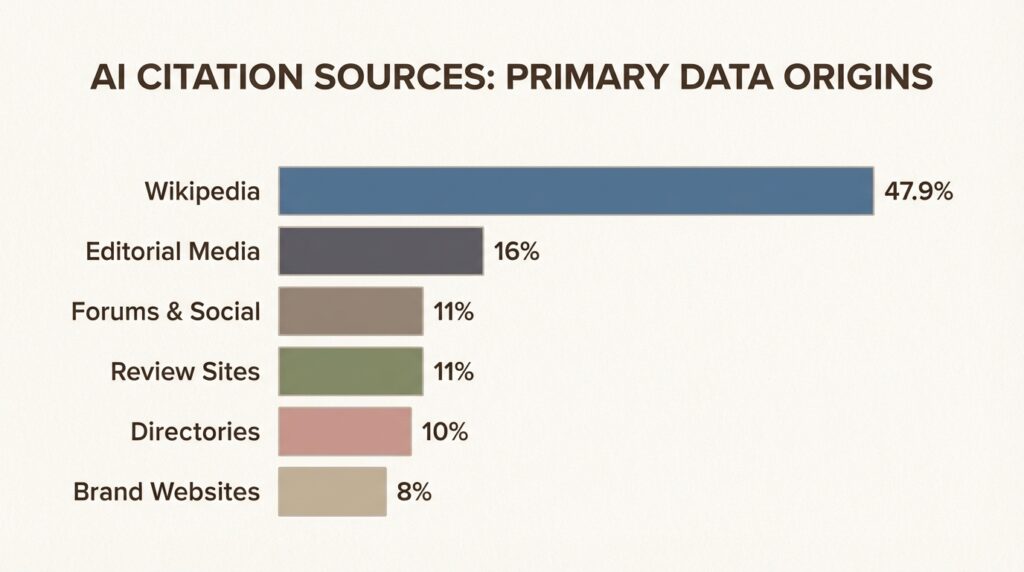
- Wikipedia presence 47.9% of top citations include Wikipedia
- Structured data implementation +30-40% visibility boost
The SEO-to-AI disconnect
Here’s the counterintuitive finding: traditional SEO success metrics show inverse correlation with AI citation rates. The top 10% most-cited pages have LESS traffic, rank for FEWER keywords, and receive FEWER backlinks than the bottom 90%.
This means your high-performing blog posts might not be what AI systems cite. They prefer authoritative reference content over popular traffic drivers.
Third-party content drives recommendations
AI systems rely heavily on sources you don’t control:
- Editorial media (16% of citations)
- Forums and social (11%)
- Review sites (11%)
- Directories (10%)
Your own website is just one input. Brand mentions across the broader web often matter more.
For tactics to improve your citation rates, read our guide on how to get cited by LLMs.
Acting on competitive intelligence
Tracking without action is just expensive reporting. Use this decision framework:
- Fix: Close visibility or perception gaps compared to competitors. These cost you brand authority in AI responses. If ChatGPT describes your competitor as “industry-leading” and you as “an alternative,” that perception gap directly affects consideration.
- Build: Strengthen content and topical coverage where competitors lead. Create or update pages that align with formats AI rewards: comparison content, FAQ sections, how-to guides with clear structure.
- Influence: Strengthen relationships with publications, creators, and data sources that frequently feed AI answers in your category. Guest articles, podcast appearances, and research collaborations all increase your mention footprint.
ROI benchmarks to expect
Organizations that implement systematic AI visibility tracking report:
- 340% AI mention increases within 6 months
- 31% shorter sales cycles for AI-referred leads
- 17% inbound lead increase within 6 weeks
- 25x higher conversion rates from AI-driven leads vs. traditional organic
Timeline expectations: Technical fixes show in 4-8 weeks, noticeable ranking improvement in 3-6 months, stable competitive position in 6-12+ months.
For more statistics on AI search performance, see our SEO statistics for AI search research.
Start tracking your AI search competitors today
Begin with 20-30 manual queries across ChatGPT and Perplexity to see if a competitive gap exists. Document which competitors appear, in what position, for which query types.
If the gap is significant, evaluate Decoding (7 day free trial, then $49/month) for systematic tracking. Build your initial query set from actual customer language sales calls, support tickets, search data not keyword tools.
For teams needing strategic guidance, we provide AI visibility audits and competitive intelligence services that integrate with your existing SEO workflow. Our pricing starts at $3,000 for one-time projects and scales based on your needs.
The brands winning in AI search aren’t necessarily the ones with the biggest SEO budgets. They’re the ones measuring what matters and acting on what they find.
Frequently Asked Questions
What tools do I need to start tracking how competitors appear in AI search?
You can start with free manual tracking using ChatGPT, Perplexity, and Gemini. Document 20-30 queries in a spreadsheet and check them monthly. For systematic tracking, tools like Decoding automate the process across multiple platforms.
How often should I check my AI search competitor rankings?
Monthly or quarterly works for stable brands. Increase to weekly during campaigns, after model updates, or when you notice competitive shifts. Remember that content changes take 4-12 weeks to reflect in LLM responses, so do not expect overnight changes.
Which AI platforms matter most for competitor tracking?
ChatGPT (60.7% market share) and Perplexity are essential. Gemini is growing but secondary. Claude remains niche. Focus 80% of your tracking effort on ChatGPT and Perplexity, where the majority of AI search activity occurs.
Can I track AI search competitors without paid tools?
Yes, manual tracking works for small query sets. Run your queries weekly, screenshot results, and track changes in a spreadsheet. Paid tools become necessary when you need to track 50+ queries or want automated reporting across multiple platforms.
What is the difference between AI search visibility and traditional SEO rankings?
Traditional SEO optimizes for clicks from search results. AI search optimizes for mentions and citations in AI-generated answers. The metrics differ: SEO tracks traffic and rankings; AI visibility tracks mention rate, citation rate, share of voice, and position within responses.
How long does it take to see results from AI search optimization?
Technical fixes show in 4-8 weeks. Noticeable ranking improvement takes 3-6 months. Stable competitive positioning requires 6-12+ months of consistent effort. AI models update training data periodically, so changes do not reflect immediately like traditional SEO.
Why do my Google rankings not translate to AI search visibility?
Only 43% overlap exists between top LLM results and traditional SERP winners. AI systems prioritize different signals: brand search volume, web mention volume, multi-platform presence, and structured data. The top 10% most-cited pages actually have LESS traffic and fewer backlinks than lower-ranked pages.