

SEO Fraggles are the future of search visibility: Google now ranks and shows content fragments with AI, not just top 10 pages, meaning your content must be structured so specific sections can stand alone and directly answer user queries.
Instead of relying on entire articles to rank, search engines and AI are increasingly extracting and displaying concise pieces of information (text, video segments, or definitions) directly in results. These fragments can appear independently, often without requiring a click, fundamentally changing how content is discovered and consumed.
As a result, SEO is shifting from page-level optimization to fragment-level optimization. Where clarity, structure, and semantic relevance determine whether your content gets surfaced.
What are Fraggles? Defining fragments and handles
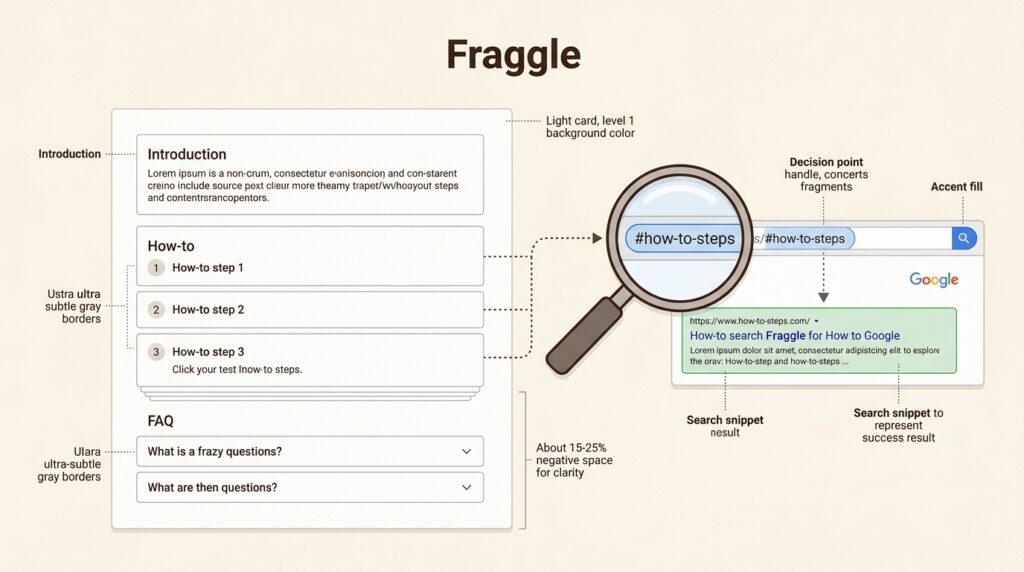
The term “Fraggles” was coined by Cindy Krum, CEO of MobileMoxie, during a 2019 MozCon presentation. It’s a portmanteau of two concepts: fragments and handles.
A fragment is a specific, self-contained piece of content on a page. It could be a paragraph answering a specific question, a video chapter, an image with explanatory text, or even an audio clip. The key is that it can stand alone as a meaningful unit of information.
A handle is the mechanism that lets users (and search engines) navigate directly to that fragment. Traditionally, this meant named anchors or jump links, like example.com/page#section-name. More recently, Google’s Text Fragments technology allows linking to arbitrary text without requiring any special markup on the page.
Here’s why this matters for SEO. Historically, Google indexed entire pages. If your page covered multiple topics, say, vegetables in general, with sections on lettuce, celery, and radishes, the specific information about radishes might get diluted by the broader context. Fraggles allow Google to index and rank each section independently. Your radish content can rank for radish queries, even if it’s buried in a longer page about vegetables.
This shift aligns with how Google has reorganized its index around entities in the Knowledge Graph. Entities, things like “radish,” “celery,” or “lettuce,” exist as distinct nodes that can be connected across languages and contexts. Fraggles let your content attach to these entity nodes with precision.
How Fraggles work in Google’s index
The concept of Fraggles is closely tied to Google’s mobile-first indexing rollout, which began in 2016 and became the default for all new sites in 2019. While Google described this as simply switching from a desktop crawler to a mobile crawler, many SEO experts believe something deeper was happening.
The theory, which Krum and others have presented strong evidence for, is that Google was simultaneously reorganizing its entire index around entities in the Knowledge Graph. This wasn’t just about how content was crawled. It was about how it was stored, categorized, and retrieved.
Under this model, a page about vegetables doesn’t just live at one URL in Google’s index. Instead, the lettuce section gets indexed under the “lettuce” entity node, the celery section under “celery,” and so on. When someone searches for “how to grow lettuce,” Google can retrieve exactly the relevant fragment, not the entire vegetable page.
This is where the handle comes in. When Google displays a fragment in search results, often as a featured snippet or in the People Also Ask section, clicking that result takes the user directly to the relevant section. With modern Text Fragments, the browser even highlights the specific text and scrolls it into view.
The technical mechanism behind this is elegant. Traditional fragment identifiers use the hash symbol followed by an element ID, like #section-name. Text Fragments use a newer syntax: #:~:text=search-term. When a browser supporting this feature (Chrome 89+, Edge 89+, Firefox 131+, Safari 18.2+) encounters such a URL, it searches the page for matching text, highlights it, and scrolls it into view. Google Search automatically generates these URLs for featured snippets.
Why Fraggles matter for SEO?
The shift toward fragment-based indexing has profound implications for how content creators should approach SEO.
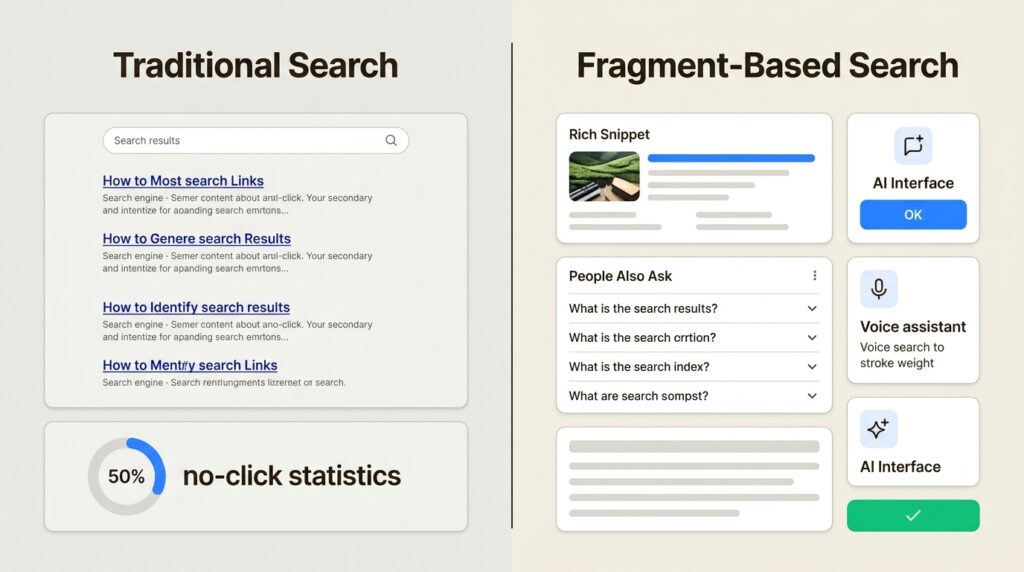
Zero-click searches are the new normal. Research from MobileMoxie found that 61% of mobile searches don’t result in a click. Users find what they need directly in the search results. While this might seem bad for website traffic, being the source of that answer builds brand authority and trust. When users do need to click through, they’re more likely to choose a brand they’ve seen provide accurate answers.
Generative AI depends on structured fragments. Large language models like GPT-5, Claude, and Gemini don’t read web pages like humans do. They retrieve and process content in chunks. Fraggle-optimized content, with clear sections, distinct headings, and semantic markup, is exactly what these systems need to identify and cite reliable information. If your brand’s content isn’t optimized for fraggles, it risks being ignored by both traditional and GenAI-powered discovery systems.
Voice search relies entirely on speakable fragments. When someone asks Google Assistant or Alexa a question, the response comes from a specific fragment marked as “speakable.” Google’s speakable schema markup, currently in beta, allows publishers to identify which sections of their content are best suited for audio playback. The optimal length is 20-30 seconds of content, roughly 2-3 sentences.
Mobile users expect instant answers. Mobile searchers don’t want to scroll through long articles to find the one fact they need. Fraggles let you serve them exactly what they’re looking for, improving user experience even if it means fewer page views.
E-E-A-T signals travel with fragments. Google’s emphasis on Experience, Expertise, Authoritativeness, and Trustworthiness applies at the fragment level, not just the domain level. A well-written, accurate fragment about a specific topic can earn trust signals that benefit your entire site’s authority on that subject.
How to optimize your content for Fraggles
Optimizing for Fraggles doesn’t require a complete content overhaul. It’s mostly about structure and markup. Here’s what to focus on:
Use clear heading hierarchies. Every major section of your content should have a descriptive H2 or H3 heading that accurately describes what the section covers. These headings serve as signposts for both users and search engines. Avoid vague headings like “Overview” or “Details.” Instead, use specific, keyword-rich headings like “How to implement speakable schema markup.”
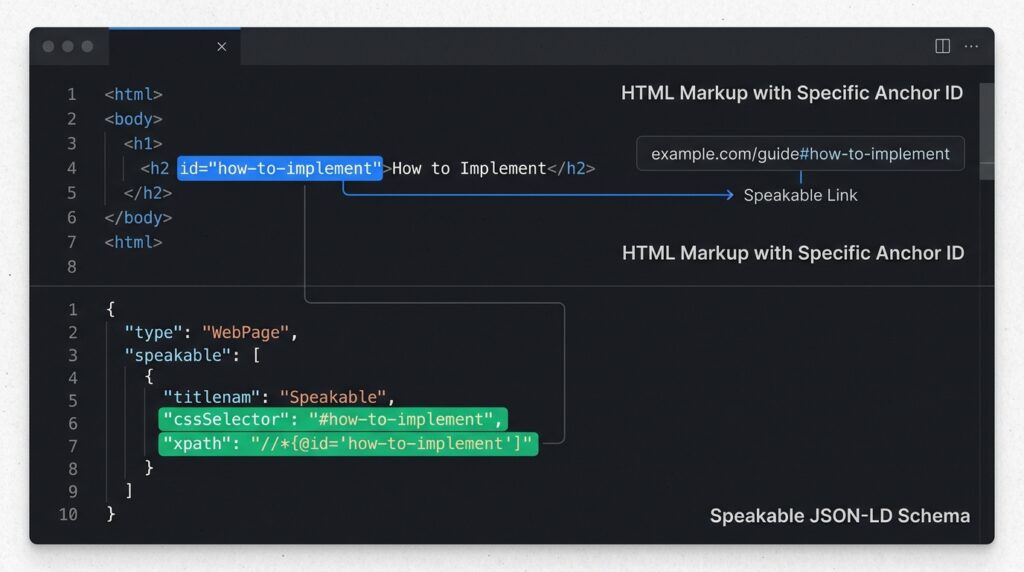
Implement named anchors for key sections. While Google can now link to arbitrary text through Text Fragments, explicitly marking important sections with ID attributes still helps. Add id attributes to your headings or section containers, then link to them with a table of contents at the top of long articles. This creates handles that work across all browsers and devices.
Structure content as self-contained Q&A units. Each section should make sense on its own. Someone landing on that specific fragment should be able to understand the answer without reading the entire article. This means briefly restating context when necessary and avoiding dependencies on earlier sections.
Use Schema.org markup, especially speakable schema. For content you want to appear in voice search results, add speakable schema markup. You can use CSS selectors or XPath expressions to identify which content should be read aloud. Currently, this is only supported for English content in the United States, but it’s worth implementing if that’s your market.
Add video chapters for video content. If you use video, add chapter markers in your YouTube descriptions. These become clickable timestamps that Google can use as fragment handles, taking viewers directly to relevant sections of your video.
Organize around entities, not just keywords. Think about the core concepts your content covers. Each major entity deserves its own clearly marked section. This helps Google understand the semantic structure of your content and index fragments under the appropriate Knowledge Graph nodes.
Test your fragment handles. After implementing named anchors or reviewing your heading structure, test the links. Make sure they scroll to the correct position and that the relevant content is immediately visible without requiring additional scrolling.
Start optimizing for Fraggles today
Fraggles represent more than a technical SEO tactic. They’re a symptom of how search is fundamentally changing. We’re moving from a web of pages to a web of information fragments, surfaced through search, voice assistants, and AI systems in whatever format the user needs.
The good news is that optimizing for Fraggles aligns with creating better content overall. Clear structure, specific headings, and self-contained sections help human readers too. You’re not gaming the system; you’re making your content more accessible.
At Decoding, we help businesses navigate these shifts in search behavior. Our AI Visibility tools track how your brand appears across AI search engines like ChatGPT, Claude, and Perplexity, the very systems that rely on well-structured content fragments to generate answers.
As search continues to evolve, having visibility into how AI systems discover and cite your brand will only become more critical.
Start by auditing your existing content. Look for long articles that cover multiple topics. Could they be better structured with clear fragment boundaries? Add jump links, improve your headings, and consider implementing speakable schema. These small changes can have an outsized impact on how your content appears in an increasingly fragmented search landscape.
Frequently Asked Questions
What exactly are SEO Fraggles and how do they differ from regular featured snippets?
Fraggles are the combination of a content fragment (a specific section of text, video, or audio) and a handle (a mechanism to navigate directly to it). Featured snippets are one way Fraggles appear in search results, but Fraggles also power jump links, voice search responses, and AI citations. The key difference is that Fraggles focus on the underlying structure that makes these features possible.
Do I need special technical knowledge to optimize my content for Fraggles?
Not necessarily. The most important steps, using clear heading structures and organizing content logically, don’t require coding. Adding named anchors (jump links) requires basic HTML knowledge, and implementing speakable schema requires JSON-LD markup, but these are straightforward implementations that most content management systems support.
Will optimizing for Fraggles reduce my website traffic since users get answers directly in search results?
It’s possible that some users will get what they need without clicking, but the trade-off is worth it for most sites. Being the source of the answer builds brand authority. When users do need more information, they’re more likely to click a brand they recognize as knowledgeable. Additionally, Fraggle optimization improves the experience for users who do visit your site, potentially increasing engagement and conversions.
How do Fraggles relate to AI search engines like ChatGPT and Perplexity?
AI search engines retrieve and process content in chunks, not as full pages. Well-structured Fraggles, with clear sections and semantic markup, make it easier for these systems to identify and cite reliable information from your content. If your content isn’t optimized for fragment-based discovery, AI systems may simply skip it in favor of more structured sources.
Can I track how often my content appears as Fraggles in search results?
Unfortunately, Google Search Console doesn’t currently report on Fraggles separately from other rich results. However, you can use third-party tools like MobileMoxie’s SERPerator to track whether your content is earning jump links or fragment-based results. You can also monitor featured snippet appearances, which often indicate Fraggle indexing.





Leave a Reply