

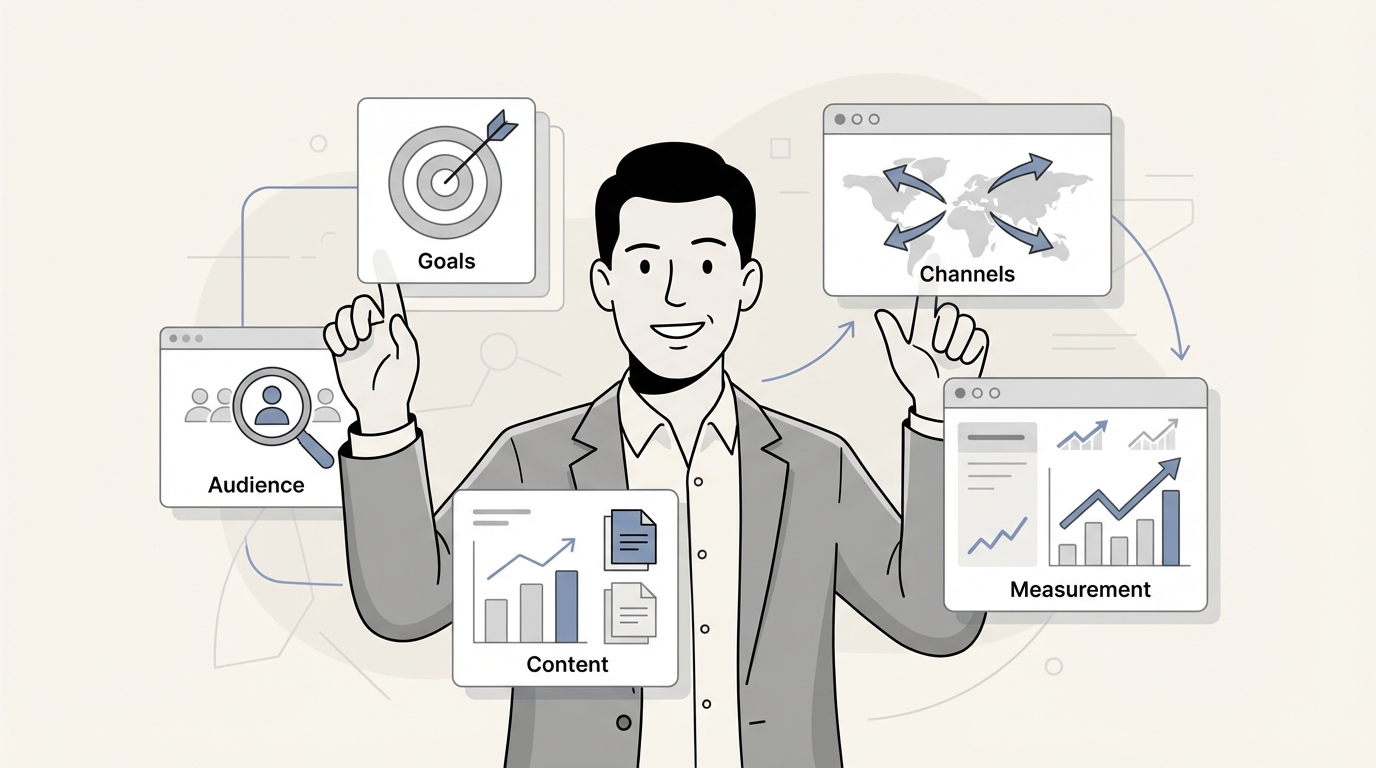
Content marketing has evolved from a nice-to-have tactic into a fundamental business strategy. According to recent research, 91% of B2B marketers now use content marketing to reach customers, and 86% of decision-makers plan to maintain or increase their content marketing budgets.
But here’s the catch: most companies approach content marketing backwards. They start creating content before they understand why they’re creating it, who it’s for, or how it connects to business goals. The result is what marketers call “blog and pray” pumping out content and hoping something sticks.
This guide walks you through building a content marketing strategy that actually delivers results. We’ll cover the frameworks, content types, and measurement approaches that work in 2026, including how AI is reshaping the landscape.
What is content marketing strategy?
A content marketing strategy is your plan for creating and sharing content that attracts your target audience and drives profitable action. It’s the difference between random content creation and purposeful communication.
At its core, a solid strategy answers three questions:
- Why are you creating content?
- Who are you helping?
- How will you help them in ways no one else can?
Here’s why this matters: research from Semrush shows a direct correlation between having a documented content marketing strategy and achieving success. Companies with written strategies consistently outperform those flying blind.
Think of your strategy as a filter. Every content idea should pass through it before production begins. If a piece doesn’t serve your strategic goals, it doesn’t get made. This discipline prevents the content sprawl that plagues so many marketing teams.
The 5 core pillars of effective content marketing
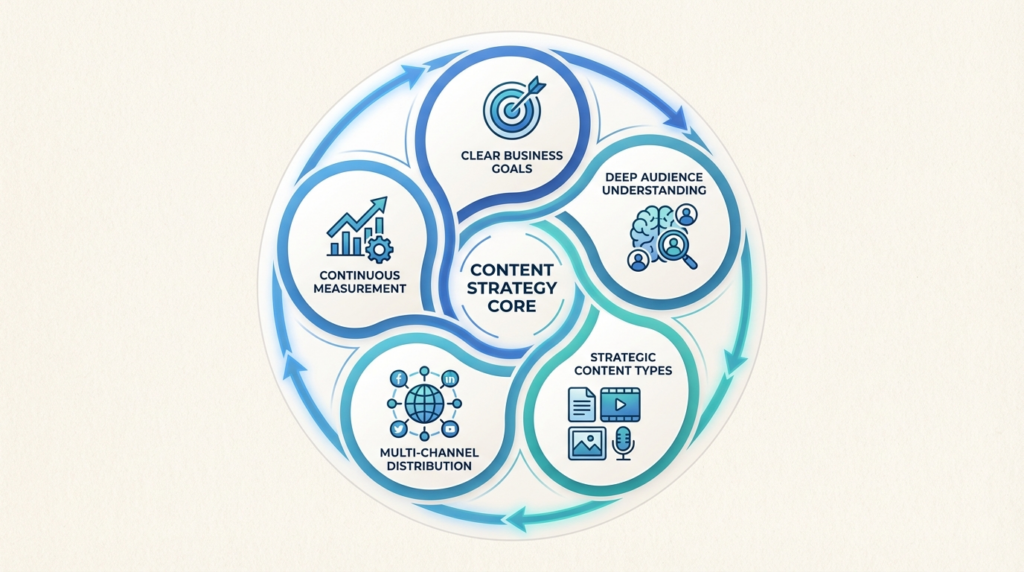
Every successful content marketing strategy rests on five foundational pillars. Skip any one of them and your entire structure becomes unstable.
1. Clear business goals
Your content marketing goals must be SMART: Specific, Measurable, Achievable, Relevant, and Time-bound. Vague objectives like “increase brand awareness” won’t cut it. Instead, aim for “increase organic traffic from search engines by 50% over the next 12 months.”
Common content marketing goals include:
- Traffic growth attracting more visitors to your website
- Lead generation capturing contact information from prospects
- Revenue attribution directly influencing sales and customer lifetime value
- Customer retention reducing churn through ongoing engagement
Your goals shape every subsequent decision. A strategy focused on lead generation looks very different from one prioritizing brand awareness.
2. Deep audience understanding
You can create the most brilliant content in the world, but it’s worthless if it doesn’t resonate with the right people. Understanding your audience means going beyond basic demographics to their deeper beliefs, values, fears, and aspirations.
Build detailed customer personas that capture:
- Roles and responsibilities what hats do they wear at work?
- Goals and objectives what are they trying to achieve?
- Pain points and challenges what’s standing in their way?
- Content preferences where do they consume information and in what formats?
Don’t rely on assumptions. Use surveys, interviews, analytics, and social listening to gather real data. The goal is empathy: understanding what would make someone stop scrolling and care about what you have to say.
3. Strategic content types
Different content types serve different strategic purposes. Your mix should align with both your goals and your audience’s preferences.
Match content formats to your objectives:
- Blog posts and SEO articles organic traffic and thought leadership
- Video content engagement, brand awareness, and product education
- Email newsletters nurturing relationships and driving repeat visits
- Podcasts deep engagement and authority building
- Visual content shareability and quick information delivery
The key is strategic selection, not trying to be everywhere at once. As one expert noted, “You don’t need to be everywhere. Start where you can be consistent. Depth beats distribution.”
4. Multi-channel distribution
Creating great content is only half the battle. You need a clear plan for getting it in front of your target audience.
Content distribution happens across three channel types:
- Owned channels your blog, email list, and social media accounts (you control these completely)
- Earned channels guest posts, PR coverage, backlinks, and mentions (you earn these through quality and outreach)
- Paid channels social media advertising, native ads, and sponsored content (you buy these for predictable reach)
The 80/20 rule applies here: spend 20% of your time creating content and 80% promoting it. Many marketers get this backwards, publishing brilliant work that nobody sees because they skipped distribution.
5. Continuous measurement
A good strategy doesn’t end with publishing. You need to continuously measure impact and optimize based on what you learn.
Track metrics that tie to your specific goals:
- Traffic metrics unique visitors, page views, organic growth
- Engagement metrics time on page, comments, shares, bounce rate
- Lead metrics conversion rates, cost per lead, email signups
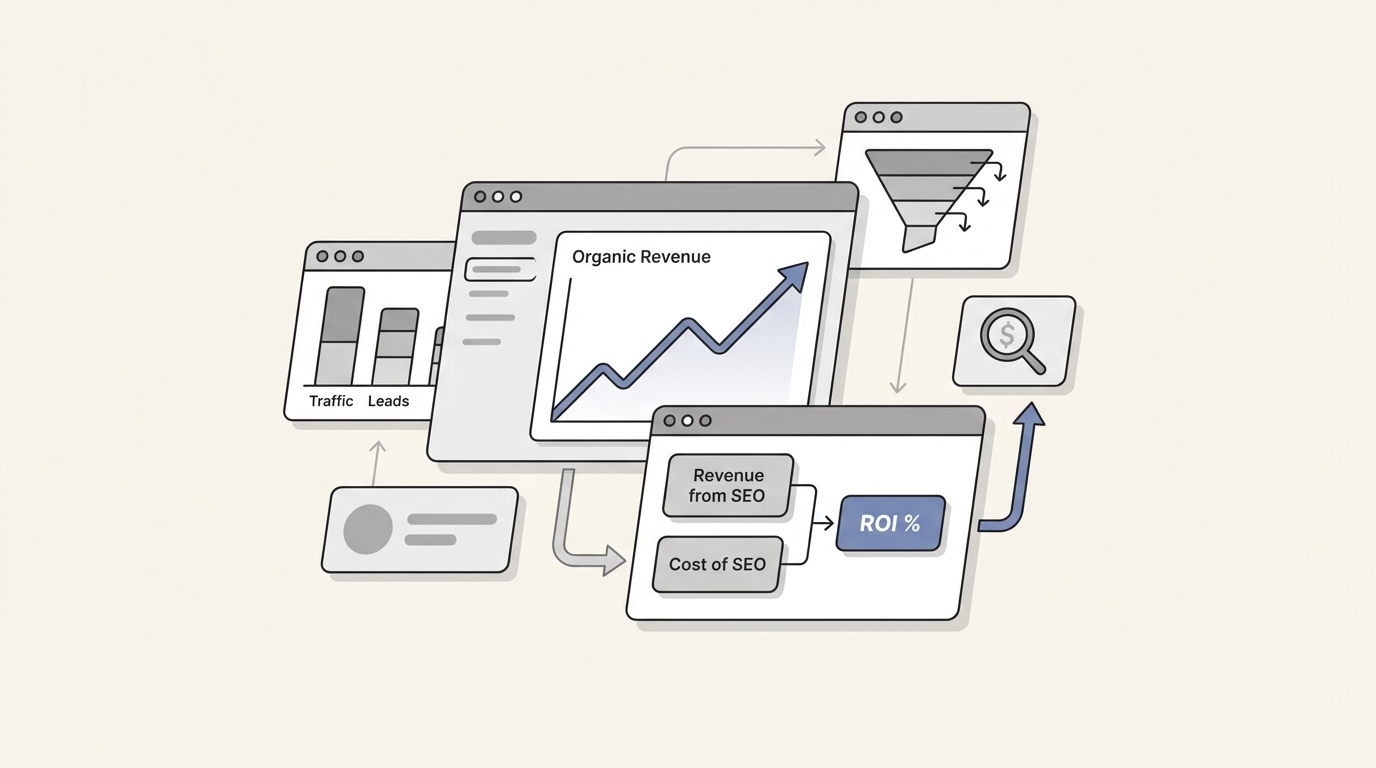
- Revenue metrics content-influenced revenue, customer lifetime value
Review performance monthly for tactical adjustments and quarterly for strategic shifts. Double down on what works, cut what doesn’t, and always be learning.
Content types that drive results in 2026
Not all content is created equal. Here are the formats delivering the strongest results right now, with data to back up the claims.
Blog content and SEO articles
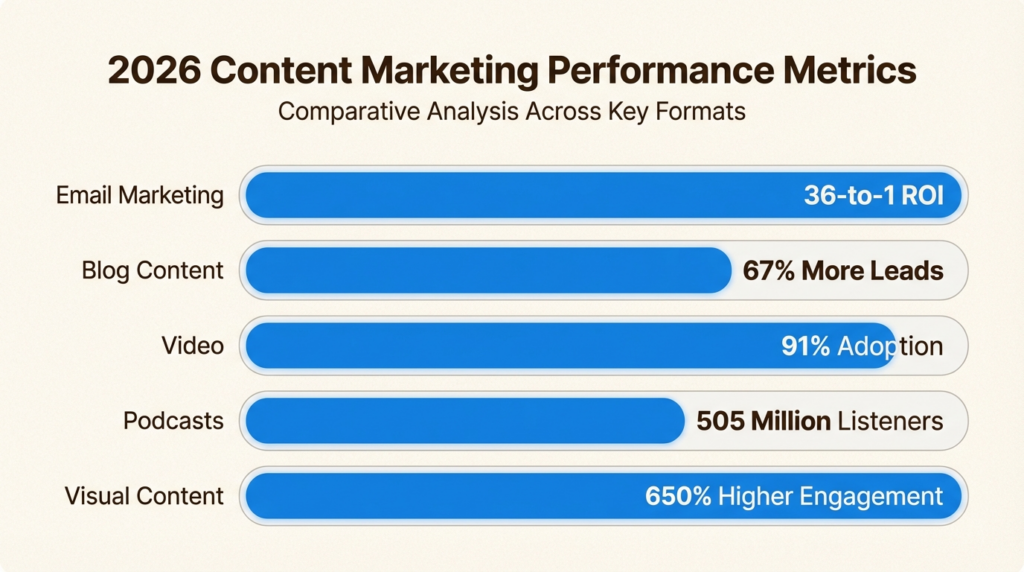
Blog posts remain the cornerstone of content marketing. Websites with active blogs have 434% more indexed pages and generate 67% more leads monthly than those without.
For optimal results in 2026:
- Focus each post on a single, well-defined topic
- Use structured formatting with clear headings and short paragraphs
- Mix short- and long-form content to address different user intents
- Optimize for search engines without sacrificing readability
Well-executed blog content supports all funnel stages, from awareness to conversion. It also serves as source material that can be repurposed into other formats.
Video content
Video has grown significantly as a content format. 91% of content marketers already use video as a key marketing tool, with nearly 78% planning to increase their video content production.
The video landscape has split into two main categories:
- Short-form video (TikTok, Instagram Reels, YouTube Shorts) ideal for reach and brand awareness
- Long-form video (YouTube, webinars) better for education and deep engagement
Video works because it combines visual and audio storytelling. 90% of video marketers report that video has significantly boosted their brand awareness, while 88% say it has helped increase user understanding of their product or service.
Email marketing
Email remains one of the most efficient content marketing channels, boasting an impressive average ROI of $36 for every dollar spent.
Effective email marketing in 2026 requires:
- Segmentation sending targeted emails based on behavior and interests
- Personalization going beyond “Hi [First Name]” to truly relevant content
- Automation triggered sequences that nurture leads based on their actions
- Mobile optimization over 60% of emails are opened on mobile devices
Your email list is an owned asset that no algorithm can take away. Unlike social media reach, which platforms can throttle at will, email gives you direct access to your audience.
Podcasts and audio content
Podcasting has matured into a powerful content format, with nearly 505 million worldwide podcast listeners projected. Audio content offers unique advantages:
- Convenience listeners consume on the go while commuting, exercising, or multitasking
- Intimacy audio creates a personal connection that’s hard to replicate in writing
- Authority hosting a podcast positions you as an industry expert
- Loyalty podcast audiences tend to be highly engaged and dedicated
For B2B brands especially, podcasts can be a differentiator. 82% of Gen Z monthly podcast listeners have taken action after hearing a podcast advertisement, and 61% have visited a company website after hearing a podcast ad.
Visual and interactive content
Visual content significantly outperforms text-only posts. Content with images sees up to 650% higher engagement compared to text-only posts. On LinkedIn specifically, posts with images have a 98% higher comment rate.
Infographics remain particularly effective, with over 60% of businesses using them in their marketing strategies. They simplify complex information and are highly shareable across social platforms.
Interactive content, such as quizzes, calculators, and assessments, takes engagement further by encouraging active participation. These tools collect valuable insights while guiding prospects toward relevant solutions.
Building your content marketing funnel
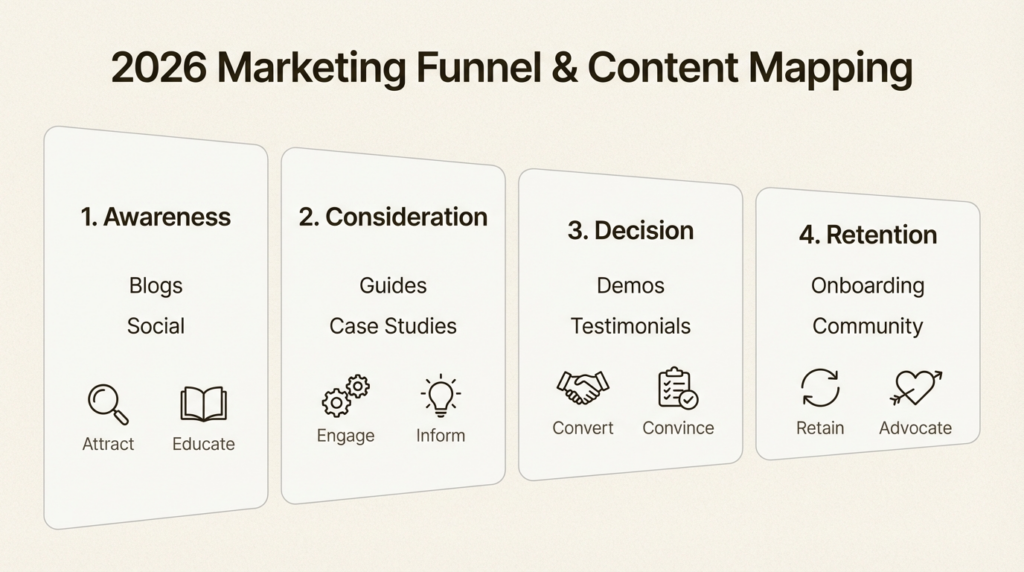
Effective content marketing maps content to the customer journey. Different stages require different approaches.
Top of funnel: Awareness and attraction
At this stage, prospects are discovering they have a problem or opportunity. They’re not looking for solutions yet; they’re looking for education.
Content that works here:
- Educational blog posts that answer common questions
- SEO-driven content that captures search traffic
- Social content that builds reach and brand recognition
- Thought leadership that establishes expertise
The goal is building trust, not making sales. 61% of decision-makers agree that thought leadership can be more effective than product-focused advertising in showcasing organizational value.
Middle of funnel: Consideration and nurture
Now prospects understand their problem and are evaluating solutions. They’re comparing options and looking for guidance.
Content that works here:
- How-to articles and guides
- Comparison content (your solution vs. alternatives)
- Case studies and social proof
- Webinars and in-depth resources
Email nurture sequences become critical at this stage. Prospects who aren’t ready to buy immediately need ongoing engagement to stay warm until the timing is right.
Bottom of funnel: Conversion and decision
Prospects are close to making a purchase decision. They need reassurance that your solution is the right choice.
Content that works here:
- Product demos and free trials
- Customer testimonials and reviews
- Detailed feature explanations
- ROI calculators and implementation guides
Remove friction from the purchase process. Answer objections before they’re raised. Make it easy for prospects to say yes.
Post-funnel: Retention and advocacy
The journey doesn’t end at purchase. Keeping customers engaged reduces churn and turns buyers into advocates.
Content that works here:
- Onboarding sequences and getting-started guides
- Advanced education and power-user tips
- Community building and user forums
- Customer success stories
It’s significantly cheaper to retain existing customers than to acquire new ones. Content marketing supports retention just as effectively as acquisition.
Measuring content marketing success
You can’t improve what you don’t measure. But not all metrics matter equally. Focus on tracking indicators that connect to your business goals.
Traffic metrics tell you if people are finding your content:
- Unique visitors and page views
- Organic traffic growth from search
- Traffic sources and channel performance
Engagement metrics tell you if people care about your content:
- Time on page and scroll depth
- Comments, shares, and social engagement
- Return visitor rate
Lead metrics tell you if content drives business results:
- Conversion rates by content type
- Cost per lead from content channels
- Email signups and gated content downloads
Revenue metrics tell you the ultimate impact:
- Content-influenced revenue
- Customer acquisition cost via content
- Customer lifetime value of content-generated leads
The key is connecting these metrics to your original goals. If your goal was lead generation, traffic alone doesn’t matter. If your goal was brand awareness, revenue attribution might be less relevant.
Tools for measurement include Google Analytics 4 for traffic data, Google Search Console for search performance, and your CRM for lead and revenue tracking. The best marketers build dashboards that connect these data sources for a complete picture. For a deeper look at how AI is changing search metrics, see our guide on how to track AI visibility.
Content marketing in the AI era: 2026 trends
Content marketing is changing rapidly as AI reshapes how content is created, distributed, and consumed.
AI-assisted content creation
AI tools now handle significant portions of the content creation workflow. From research and outlining to drafting and editing, AI can speed up production without sacrificing quality. The key is using AI as an amplifier of human creativity, not a replacement for it.
At Decoding, we’ve found that AI-assisted workflows can reduce content production time by 60-70% while maintaining (and often improving) quality. The human element remains essential for strategy, storytelling, and editorial judgment.
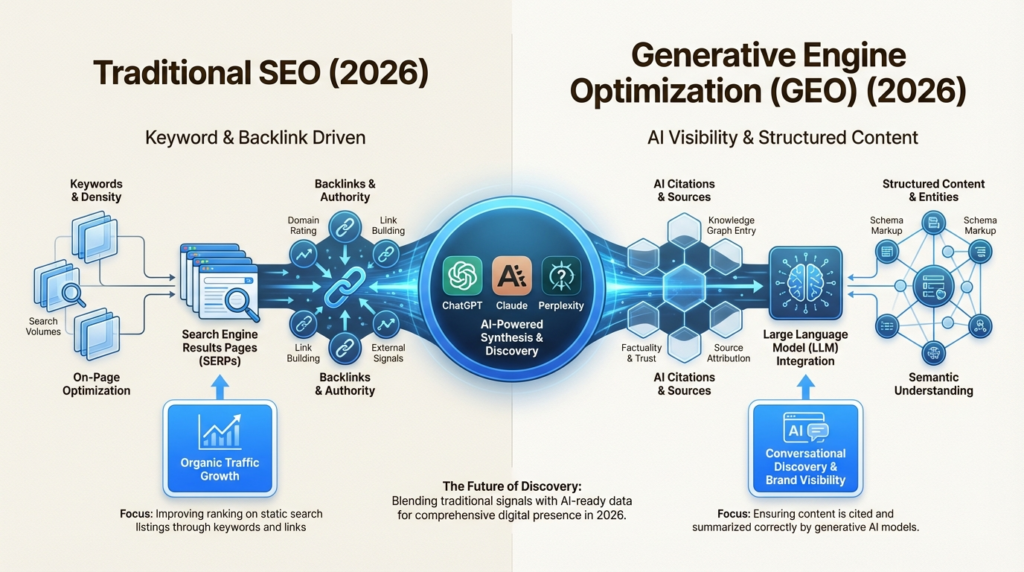
Generative Engine Optimization (GEO)
Traditional SEO focused on ranking in Google search results. But with AI search engines like ChatGPT, Claude, and Perplexity gaining traction, a new discipline has emerged: Generative Engine Optimization.
GEO is about ensuring your brand gets cited and recommended by AI systems. This requires:
- Structured, quotable content that AI can easily extract
- Authority signals across the web, not just on your own site
- Presence in AI training data through high-quality publications and citations
We help businesses optimize for both traditional SEO and emerging AI visibility. Our AI Visibility Report tracks how often brands appear in LLM responses across different platforms.
Personalization at scale
AI enables content personalization that was previously impossible. Instead of one-size-fits-all content, you can deliver tailored experiences based on:
- Visitor behavior and content consumption history
- Industry, company size, and role
- Stage in the buyer journey
This personalization improves engagement and conversion rates. The technology exists today; the challenge is implementation and maintaining authenticity at scale.
Content operations and automation
Adobe research shows that marketers lose an average of 60 hours annually due to inefficient tools and workflows. AI and automation can reclaim much of this time.
Smart content operations include:
- Automated content distribution across channels
- AI-powered content optimization and A/B testing
- Workflow automation for approval and publishing processes
- Predictive analytics for content performance
The human element matters more than ever
Here’s the paradox: as AI makes content creation easier, human-created content becomes more valuable. Anyone can generate generic AI content. The winners in 2026 will be those who combine AI efficiency with human insight, creativity, and authenticity.
Your unique perspective, proprietary data, and genuine expertise can’t be replicated by AI. These become your competitive advantages in a world of AI-generated content saturation. Learn more about getting cited by LLMs to maximize your brand’s AI visibility.
Start building your content marketing strategy today
Content marketing has evolved from a fringe tactic to a fundamental business strategy. The brands winning today genuinely help their audiences by answering questions, solving problems, and providing value without immediate expectation of return.
The core principles remain constant: understand your audience deeply, create useful content, distribute strategically, and measure what matters. Success comes from consistency, quality, and genuine commitment to serving audience needs.
If you’re ready to take your content marketing to the next level, Decoding can help. We specialize in:
- SEO-integrated content strategies that drive organic traffic
- AI-powered content workflows that scale without sacrificing quality
- Generative Engine Optimization to ensure visibility in AI search
- Content audits and roadmaps based on data, not guesswork
Our free Googlebot and AI Crawlability Checker audits your domain’s accessibility for both traditional and AI crawlers. Or explore our AI Visibility Report to see how your brand appears across LLMs.
The content marketing landscape will keep evolving. But the fundamental truth remains: businesses that consistently create valuable content for their audiences will win. Start building your strategy today.
Sources
- https://www.semrush.com/blog/content-marketing-strategy-guide/
- https://www.ama.org/marketing-news/what-is-content-marketing/
- https://www.straightnorth.com/blog/the-complete-guide-to-content-marketing-strategies-for-success/
Frequently Asked Questions
What are the most effective content marketing strategies for small businesses with limited budgets?
Focus on high-impact, low-cost channels. Blogging and SEO deliver compounding returns over time without ongoing costs. Email marketing offers exceptional ROI at $36 for every $1 spent. Repurpose every piece of content across multiple formats to maximize value. Start with one or two channels you can execute consistently rather than trying to be everywhere.
How long does it take to see results from a content marketing strategy?
It depends on your goals and channels. Paid content promotion can drive immediate traffic, while SEO typically takes 3-6 months to show significant results. Email marketing can generate quick wins with existing lists. The key is patience with organic strategies and consistency across all channels. Most businesses see meaningful results within 6-12 months of consistent execution.
What content types should B2B companies prioritize in their content marketing strategies?
B2B companies should focus on thought leadership content that addresses complex buying decisions. White papers and case studies are particularly effective, with 67% of successful B2B businesses using them. Blog content for SEO, webinars for lead generation, and email newsletters for nurturing all play important roles. Video is increasingly important for B2B as well.
How do you measure ROI from content marketing strategies?
Connect content metrics to business outcomes. Track traffic and engagement as leading indicators, but focus on lead generation, conversion rates, and content-influenced revenue as the true measures of success. Use attribution modeling to understand how content contributes to the customer journey. The specific metrics depend on your goals: brand awareness campaigns track reach and engagement, while lead generation campaigns track conversions and cost per lead.
What’s the difference between content marketing strategy and content strategy?
Content marketing strategy focuses specifically on using content to achieve marketing and business goals, typically customer acquisition and retention. Content strategy is broader, encompassing all content within an organization, including internal communications, product documentation, and support content. Content marketing strategy is a subset of content strategy with a specific commercial focus.
How is AI changing content marketing strategies in 2026?
AI is transforming content marketing in three main ways: creation (AI-assisted writing and editing), distribution (automated personalization and optimization), and discovery (Generative Engine Optimization for AI search). The most significant shift is the need to optimize for AI citations and recommendations, not just traditional search rankings. Human creativity and expertise remain essential, but AI amplifies productivity and enables personalization at scale.




Leave a Reply