

Here’s a striking number: 46% of all Google searches have local intent. People are looking for businesses near them right now. Yet most multi-location companies fail to capture this high-converting traffic.
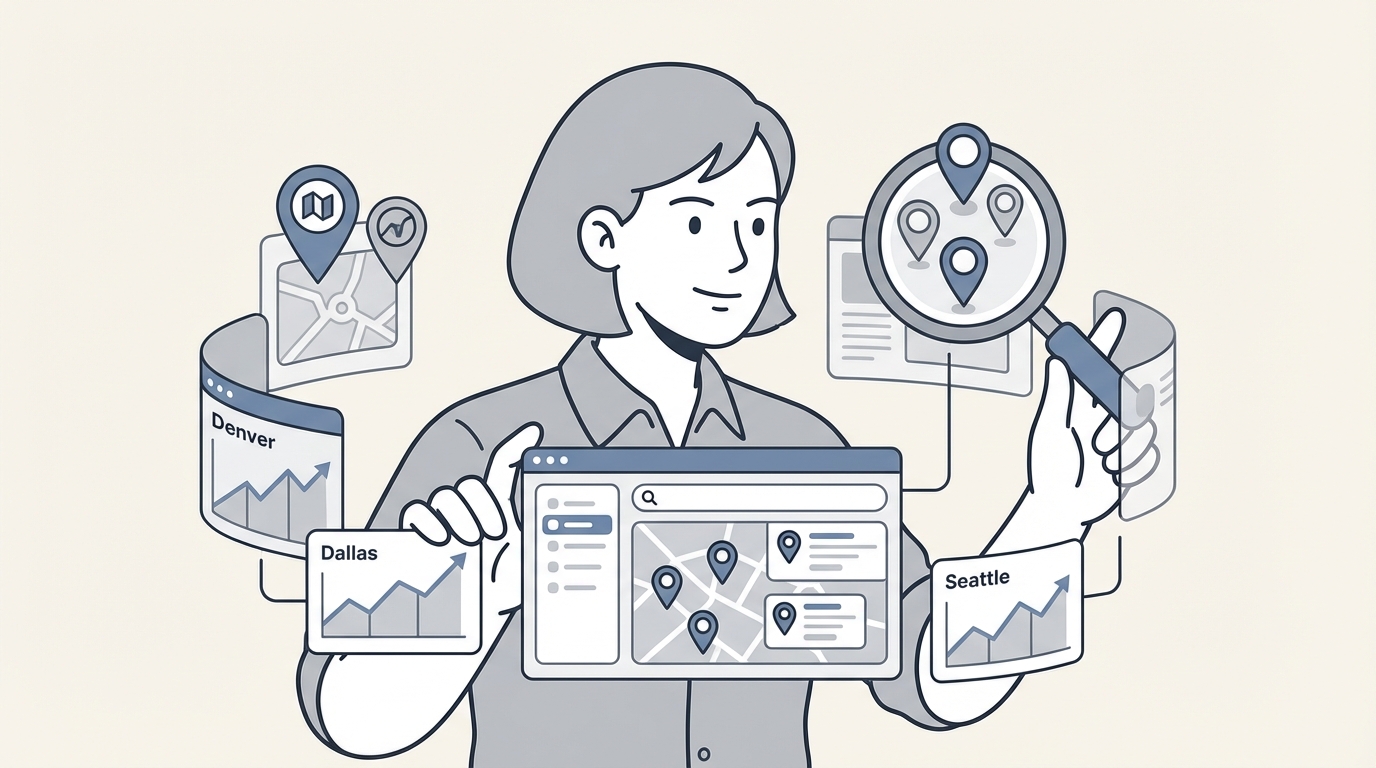
Why? Because local SEO for multiple locations isn’t just single-location SEO repeated. Each of your branches competes in a unique market with different competitors, customer behaviors, and search patterns. What works in Denver might flop in Dallas.
This guide gives you a practical framework that treats each location as both unique and connected. You’ll learn how to build a unified brand presence while ensuring every branch dominates its local market.
At Decoding, we’ve spent 16 years helping multi-location businesses navigate exactly these challenges. We’ve outranked Fortune 500s and developed proprietary tools to track what actually moves the needle. This framework distills what works.
What is local SEO for multiple locations?
Local SEO for multiple locations is the practice of optimizing each of your physical business locations so they appear in local search results for their specific geographic area. When someone searches “coffee shop near me” or “plumber in [city],” each of your locations should have a fighting chance to show up.
The key difference from single-location SEO comes down to three factors:
- Scale: You’re managing dozens or hundreds of location pages, Google Business Profiles, and citation listings instead of one
- Consistency: Your brand must present unified information across all locations while allowing for local customization
- Unique competition: Each location faces different local competitors with varying SEO sophistication
This matters because 76% of local searches result in a store visit within 24 hours. Local searchers have high purchase intent. They’re not browsing. They’re buying.
Several business models need multi-location SEO:
- Corporate-owned chains like retail stores, restaurants, and medical clinics with centralized management
- Franchises with independent owners operating under your brand
- Service area businesses with multiple territories (plumbers, HVAC companies, cleaning services)
- Hybrid models combining corporate and franchisee ownership
The 4 pillars of multi-location SEO success
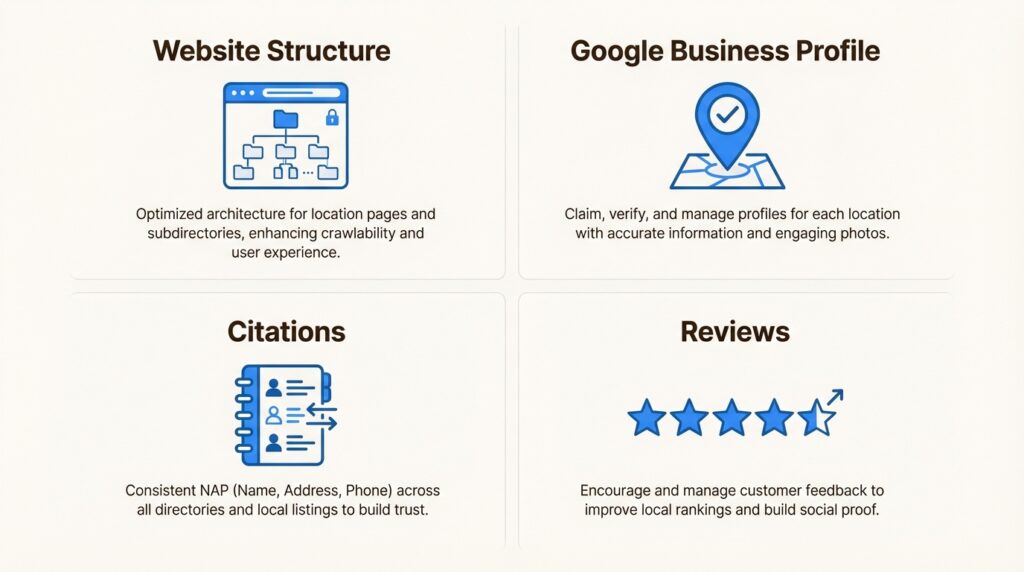
After analyzing what works across hundreds of multi-location campaigns, we’ve identified four non-negotiable pillars. Skip any one and your results suffer.
Pillar 1: Website structure and location pages
Google ranks pages, not just websites. If you want your Chicago location to rank in Chicago searches, it needs its own dedicated page.
The most common mistake? Listing all your locations on a single “Contact Us” page. That approach guarantees only one location has any chance of ranking.
URL structure best practices:
Use a consistent, logical format like yourdomain.com/locations/chicago or yourdomain.com/chicago. This helps both users and search engines understand your site architecture.
Essential elements for each location page:
- Unique NAP information: Name, Address, and Phone number specific to that location
- Embedded Google Map: Show the exact pin for that branch
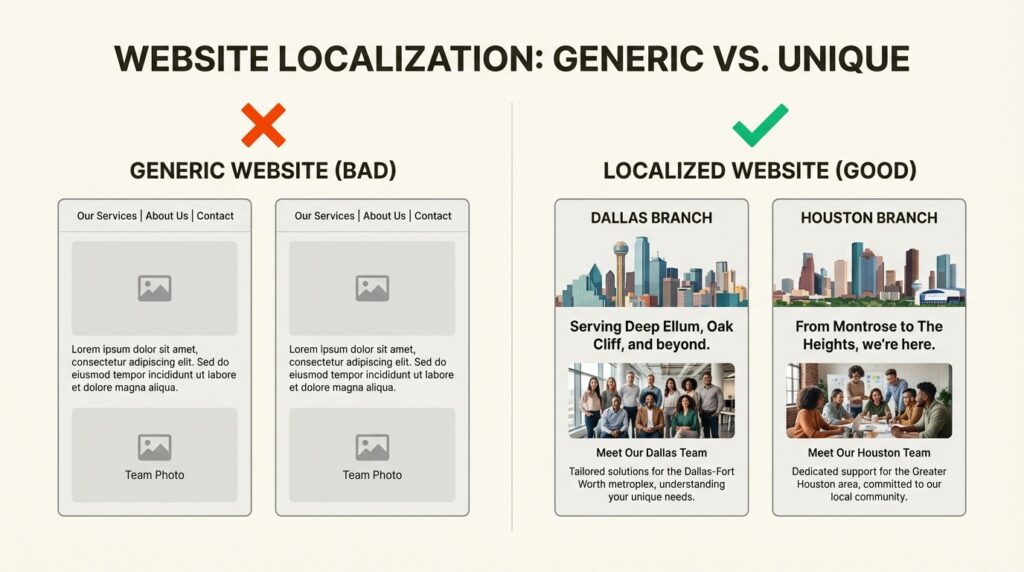
- Location-specific content: Mention local landmarks, neighborhoods, or events to signal regional relevance
- Real photos: Actual images of that specific storefront, team, and interior
- Hours and services: Include hours specific to that branch, plus any unique offerings
Here’s the critical warning: do not copy and paste content across location pages. Google’s Helpful Content Update specifically targets thin, duplicate content. If your Dallas and Houston pages are 90% identical, neither will rank well.
Create a content template to maintain brand consistency, but customize each page’s text and visuals to reflect that location’s character.
Pillar 2: Google Business Profile optimization
Every physical location needs its own verified Google Business Profile (formerly Google My Business). This is non-negotiable. These profiles feed Google Maps, local pack results, and “near me” searches.
For businesses with 10 or more locations, use Google’s bulk verification process. Manual verification of each listing is too time-consuming to scale.
Optimization checklist for each GBP:
- Accurate categories: Your primary category must be consistent across all locations. Secondary categories can vary based on local offerings.
- High-quality photos and videos: Show all aspects customers care about: storefront, interior, products, team, and amenities
- Regular Google Posts: Share offers, events, or updates relevant to that specific branch
- Complete attributes: Use identifiers like “wheelchair accessible” or “women-owned” that signal you meet specific customer needs
- Q&A section: Upload and answer the FAQs each branch receives
Link each GBP to its corresponding location page on your website. This connection helps Google understand the relationship between your listings and your site.
Pillar 3: Citation consistency and management
Citations are mentions of your business name, address, and phone number on directories and third-party websites. They’re a core local SEO signal.
Structured citations live on formal business indexes:
- General directories: Yelp, Facebook, Apple Maps, Bing Places, YP.com, BBB
- Industry-specific: TripAdvisor (hospitality), Findlaw (legal), ZocDoc (medical)
- Local directories: Chambers of commerce, city business indexes
The consistency of your NAP information across these citations is critical. Even small variations like “Ste.” versus “Suite” or “St” versus “Street” can weaken your authority. Search engines see these as potentially different businesses.
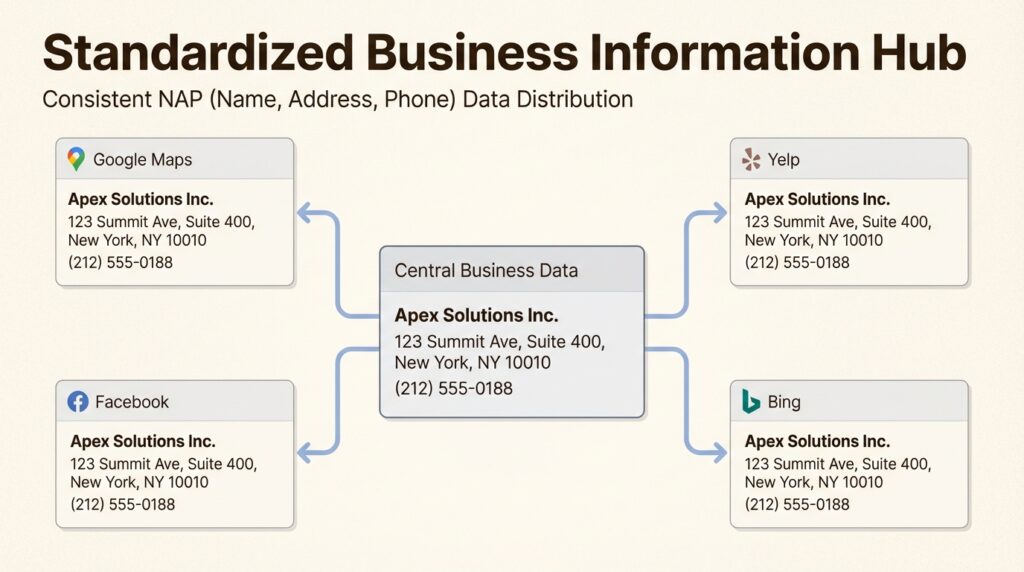
For multiple locations, managing citations manually becomes nearly impossible. Consider using citation management tools that can:
- Identify missing or inconsistent listings
- Submit accurate NAP data for each location to top directories
- Remove duplicates and correct old data
- Track citation growth and its effect on local rankings
Audit your citations quarterly. Addresses change, phone numbers get updated, and inconsistencies creep in over time.
Pillar 4: Reviews and reputation management
Reviews factor heavily into where your business locations rank in local search results. According to Semrush research, “user interaction, like getting ratings and generating reviews from active customers, are a key component of any solid local SEO strategy.”
Review acquisition strategy:
Implement an ongoing program that asks for reviews at the time of service and follows up with customers who don’t respond initially. Train staff at each location on the importance of customer service and its direct impact on online reviews.
Response protocol:
Every review deserves a speedy response. Thank happy customers for taking time to praise your business. Address unhappy customers with offers to make things right. This shows potential customers that you care about feedback.
Sentiment tracking:
Monitor review trends to identify what’s working at high-performing locations so you can replicate it elsewhere. More importantly, catch negative trends early so you can implement fixes before they damage your brand reputation.
Consider publishing first-party reviews (testimonials collected directly from customers) on your location pages. This diversifies your content and gives you ownership of the reviews.
Common multi-location SEO mistakes to avoid
Even experienced SEO professionals make these errors when scaling across multiple locations. Here’s what to watch for.
Mistake 1: Duplicate or thin location pages
The problem is obvious but tempting: copy your Phoenix page, change the city name to Tucson, and publish. Fast, easy, and completely ineffective.
Google’s Helpful Content Update introduced a sitewide signal that rewards publishers with an overall pattern of high-quality, helpful content. If you’re publishing volumes of thin, near-duplicate pages, your entire site can suffer.
The solution is creating genuinely unique content for each location. Mention neighborhood specifics, local team members, community involvement, and regional service variations. Yes, it takes more effort. It also produces results.
Mistake 2: Inconsistent NAP information
Small variations in how your business name, address, and phone number appear across the web create confusion for search engines. Common culprits include:
- Abbreviation inconsistencies (“Ave” vs “Avenue”, “Ste” vs “Suite”)
- Suite number formatting (“#100” vs “Suite 100” vs “Ste 100”)
- Phone number formats (“(555) 123-4567” vs “555-123-4567” vs “555.123.4567”)
Create a brand standards document that specifies the exact formatting for every location’s NAP information. Distribute this to anyone who manages listings, citations, or website content.
Mistake 3: Neglecting reviews at specific locations
One location with terrible reviews drags down your entire brand reputation. A customer who has a bad experience at your Atlanta location won’t distinguish it from your Austin location when they see your brand name.
Implement location-specific review monitoring and response protocols. Each branch manager should own their location’s reputation and have systems to address issues quickly.
Mistake 4: Ignoring local competition differences
Your Denver location might face fierce competition from established local businesses while your Phoenix location has minimal SEO competition. Using the same strategy for both wastes resources in Phoenix and underfunds Denver.
Conduct local keyword research for each location’s market. Understand who you’re competing against in each geographic area and adjust your investment accordingly.
Measuring success across multiple locations
You can’t improve what you don’t measure. For multi-location SEO, you need location-specific tracking.
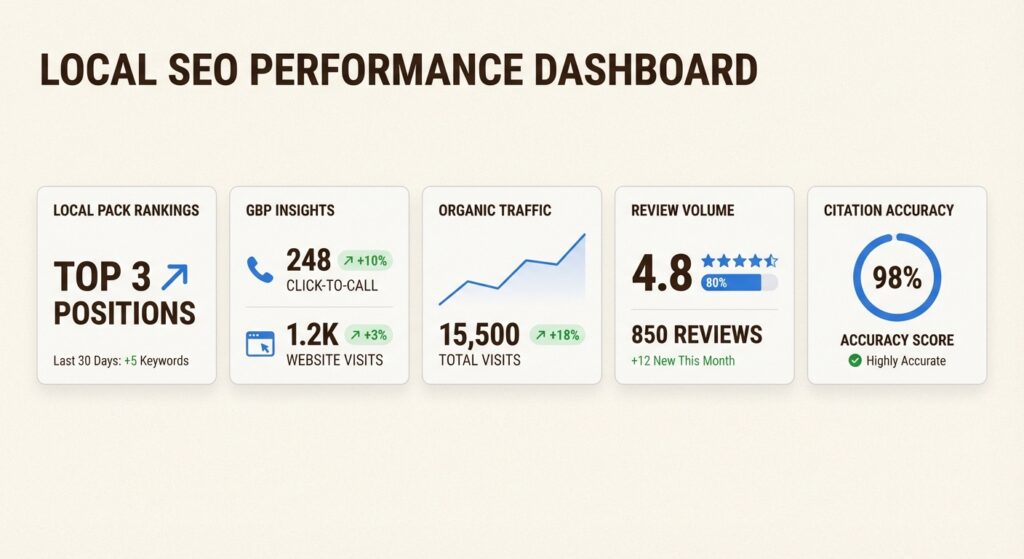
Key metrics to track per location:
- Local pack rankings: Where does each location appear for target keywords in its market?
- Google Business Profile insights: Track calls, direction requests, and website clicks for each profile
- Organic traffic to location pages: Which location pages drive the most organic visits?
- Review volume and average rating: How many reviews is each location generating, and what’s the sentiment?
- Citation accuracy score: Are all citations for each location consistent and complete?
Tools for multi-location tracking:
- Local rank trackers: Semrush, Whitespark, and similar tools can monitor rankings per location
- GBP bulk management: Tools that let you manage and report on multiple Google Business Profiles from one dashboard
- Review monitoring platforms: Solutions that aggregate reviews across all locations and platforms
The attribution challenge is real. A customer might research your business online at one location but purchase at another. Use unique phone numbers, location-specific offers, and careful CRM tracking to understand the full customer journey.
The AI search shift: Why local SEO for multiple locations is evolving
Traditional SEO focused on ranking on Google. The AI search era changes the game. Now you need to be cited by ChatGPT, Perplexity, and Google AI Overviews.
What does this mean for multi-location businesses?
Structured data becomes even more critical. AI systems rely heavily on structured data to understand entities and their relationships. Implementing LocalBusiness schema on each location page helps AI systems understand that you have multiple locations and how they relate to your main brand.
Clear entity relationships matter. AI needs to understand that “YourBrand Dallas” and “YourBrand Houston” are both part of “YourBrand.” Consistent naming, linking between your main site and location pages, and proper schema markup all help establish these relationships.
Consistent information builds AI trust. When AI systems find the same information about your business across multiple sources (your website, GBP, Yelp, industry directories), they gain confidence in that information. Inconsistent data creates uncertainty.
At Decoding, we believe the fundamentals of local SEO remain sound. Quality content, consistent citations, and genuine customer engagement still drive results. But structured implementation matters more than ever because AI systems need clear signals to understand and cite your business correctly.
Getting started with your multi-location SEO strategy
Ready to implement this framework? Here’s how to begin without getting overwhelmed.
Audit your current state. How many locations have optimized pages? How many have claimed and verified Google Business Profiles? What’s your current citation accuracy? Document your baseline.
Prioritize by market opportunity. Don’t try to optimize everything at once. Start with your highest-revenue locations or those in the most competitive markets. Early wins here fund expansion to other locations.
Build your brand standards document. Define exact NAP formatting, URL structures, content templates, and review response protocols. This ensures consistency as you scale.
Implement in phases. Phase one might cover your top 10 locations. Phase two expands to the next tier. This approach lets you learn and refine before scaling to dozens or hundreds of locations.
At Decoding, we take a different approach to multi-location SEO. We don’t deliver 50-page reports that sit unread. We build data-driven roadmaps with clear priorities and actionable steps. We learn your business, analyze your markets, and create custom strategies focused on ROI outcomes. If you’re ready to stop guessing and start growing, let’s talk.
Frequently Asked Questions
Do I need a separate Google Business Profile for each location?
Yes. Each physical location needs its own verified Google Business Profile. This allows each branch to appear in local map packs and ensures accurate contact information, hours, and reviews for each specific store or office.
How do I avoid duplicate content issues across location pages?
Create genuinely unique content for each page. Mention local landmarks, neighborhood specifics, team members at that location, community involvement, and any services unique to that branch. Use a template for structure but customize every paragraph.
What’s the best URL structure for multi-location businesses?
Use a consistent format like yourdomain.com/locations/city-name or yourdomain.com/city-name. The key is consistency and clarity. Both users and search engines should immediately understand your site structure.
How often should I audit citations for multiple locations?
Quarterly audits are the minimum recommendation. Addresses change, phone numbers get updated, and inconsistencies creep in over time. For businesses with frequent changes, monthly audits may be necessary.
Can I use the same primary category for all my Google Business Profiles?
Yes, and you should. Google requires that all locations of a business share the same primary category. You can use different secondary categories that best represent the offerings of each specific location.
How does AI search impact local SEO for multiple locations?
AI search makes structured data and consistent information more important. AI systems need clear signals to understand entity relationships between your main brand and individual locations. Implement LocalBusiness schema and ensure NAP consistency across all platforms.
What’s the biggest mistake businesses make with multi-location SEO?
Treating it as single-location SEO repeated. Each location competes in a unique market with different competitors and customer behaviors. What works in one city may not work in another. You need both unified brand standards and localized execution.









Leave a Reply