


If you’re running a SaaS company, you’ve probably noticed something: the playbook for growth keeps changing. Paid ads are getting more expensive. Social media algorithms are unpredictable. And your competitors seem to be everywhere at once.
But there’s one channel that keeps delivering: organic search.
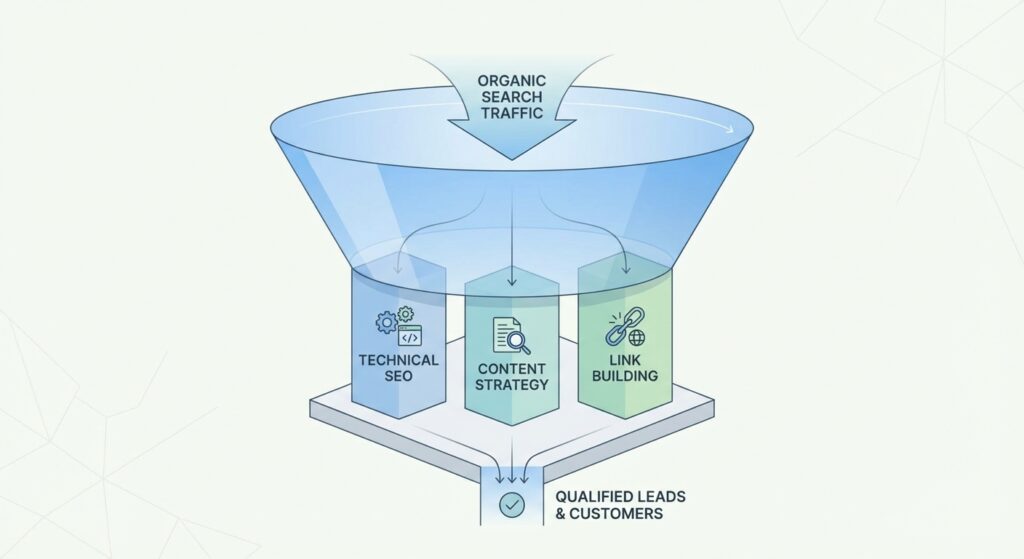
The problem? Most SaaS SEO advice is recycled generic SEO tips that don’t account for the realities of selling software. Long sales cycles. Multiple decision-makers. The need to educate before you can sell. This guide cuts through the noise and gives you a practical framework for building an SEO strategy that actually drives qualified leads and conversions for your SaaS business.
At Decoding, we’ve spent 16 years helping SaaS companies grow through search. Not with templates or 50-page reports that sit unread, but with custom strategies built on data and focused on ROI.
What is SaaS SEO (and why it’s different from traditional SEO)
SaaS SEO is the practice of optimizing your software company’s website to rank in search engines and attract potential customers. At its core, it’s still SEO. But the execution is fundamentally different from, say, optimizing an ecommerce store or a local business website.
Here’s why SaaS SEO stands apart:
Longer sales cycles. Most SaaS purchases aren’t impulse buys. A visitor might read five blog posts, download two whitepapers, and attend a webinar before requesting a demo. Your SEO strategy needs to nurture prospects through every stage of that journey.
Multiple stakeholders. The person searching for “project management software” isn’t always the person signing the check. You need content that speaks to end users, IT administrators, and C-level executives, each with different concerns.
Subscription economics. Unlike one-time purchases, SaaS revenue compounds. A customer acquired through SEO this month might pay you for years. This changes how you calculate ROI and justifies investing in content that may take months to rank.
Product-led growth integration. Modern SaaS companies increasingly use their product as an acquisition channel. Your SEO strategy needs to bridge educational content and product experiences, whether that’s free trials, interactive demos, or freemium tiers.
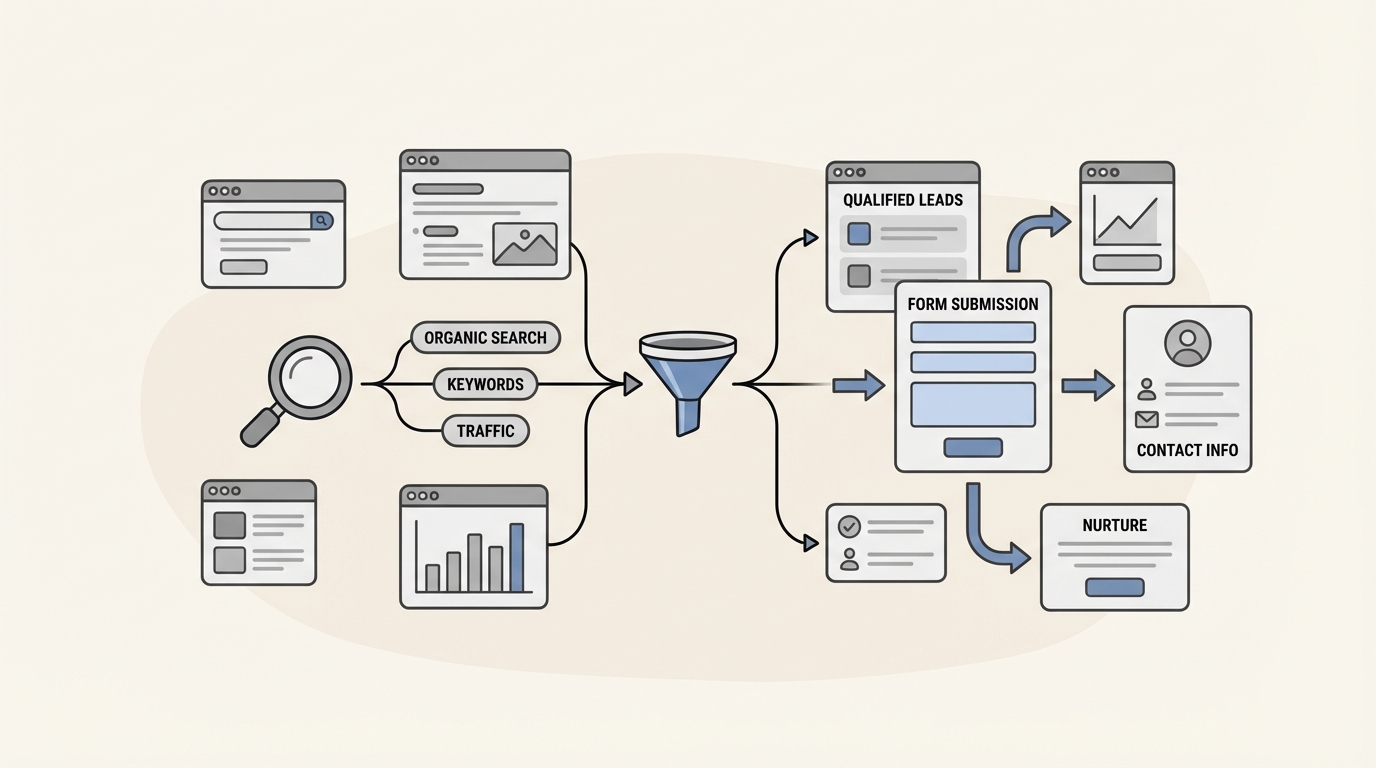
Generic SEO advice tells you to “target high-volume keywords.” But for SaaS, a keyword with 500 monthly searches that signals buying intent is often worth more than one with 5,000 searches from casual browsers. The goal isn’t just traffic. It’s qualified traffic that converts.
The three pillars of SaaS SEO
Think of SaaS SEO as a system with three interconnected components. Weakness in any one area limits your overall results.
Technical SEO: your foundation
Your website is the engine. Without proper technical foundations, even brilliant content won’t reach its potential.
Site architecture matters. SaaS websites often have complex structures: marketing pages, product documentation, blog content, help centers, and app interfaces. A clear hierarchy helps search engines understand what content is most important and how pages relate to each other.
Page speed is non-negotiable. Core Web Vitals directly impact rankings. For SaaS companies, speed also affects conversion rates. A prospect evaluating your software will judge your technical competence partly by how fast your site loads.
Mobile optimization is essential. B2B buyers research on their phones more than you might think. Your site needs to work flawlessly across devices.
Schema markup helps you stand out. Software application schema, FAQ schema, and organization markup can enhance how your listings appear in search results, increasing click-through rates.
Internal linking distributes authority. Strategic internal links help search engines discover your content and understand topical relationships. They also keep visitors engaged longer, signaling quality to search engines.
Content strategy: your fuel
Content is what attracts visitors and moves them through your funnel. But not all content is created equal.
Map content to buyer journey stages. Someone searching “what is CRM software” needs different content than someone comparing “Salesforce vs HubSpot.” Your content strategy should cover the full spectrum from awareness to decision.
Product-led content converts better. Content that naturally integrates your product into the solution tends to outperform purely educational content. Instead of “10 productivity tips,” write “How to automate your workflow with [your product category].”
Build content clusters. Create comprehensive pillar pages on broad topics, then link to more specific supporting articles. This builds topical authority and helps visitors find exactly what they need.
Balance quality and quantity. One exceptional piece of content beats ten mediocre ones. But you also need consistent publishing to build authority and capture long-tail keywords. Find a sustainable rhythm for your team.
Link building: your authority signal
Links remain one of the strongest ranking factors. For SaaS companies, they serve two purposes: improving search rankings and driving referral traffic.
Internal linking is under your control. Every new piece of content should link to relevant existing pages. This spreads authority throughout your site and keeps visitors engaged longer.
Digital PR builds high-value backlinks. Original research, data studies, and thought leadership content attract links naturally. A single mention in a major publication can be worth more than dozens of low-quality directory listings.
Integration partnerships create linking opportunities. When you integrate with other tools, both companies can benefit from cross-promotion and mutual links.
Guest posting still works when done right. Contributing valuable content to industry publications builds authority and drives qualified traffic. Focus on relevance over volume.
Keyword research for SaaS: the full-funnel approach
Most SaaS companies make the same mistake: they target only bottom-of-funnel keywords like “[category] software” and wonder why their traffic plateaus. The key is mapping keywords to each stage of the buyer journey.
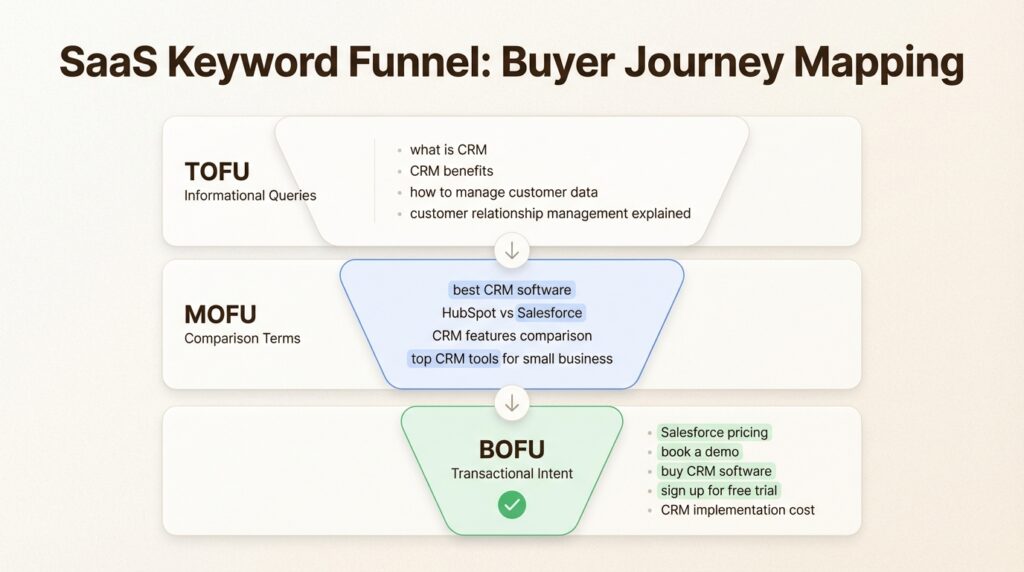
Top-of-funnel (ToFu) keywords
These are informational searches from people who have a problem but don’t know solutions exist yet.
Examples include “how to improve team collaboration,” “what is project management software,” and “signs your business needs a CRM.”
Content types: Educational blog posts, comprehensive guides, glossaries, and explainers work best for this stage.
Strategy: Focus on being genuinely helpful. The goal is to introduce your brand as a trusted resource, not to pitch your product. Include subtle CTAs for related content or lead magnets.
Middle-of-funnel (MoFu) keywords
These searchers know solutions exist and are evaluating options.
Examples include “best project management software for agencies,” “Asana vs Monday.com,” and “Trello alternatives for enterprise teams.”
Content types: Comparison pages, use case guides, feature breakdowns, and industry-specific landing pages excel here.
Strategy: Be honest and comprehensive. If your product isn’t the best fit for every use case, say so. Credibility converts better than desperation. Include clear paths to trials or demos.
Bottom-of-funnel (BoFu) keywords
These prospects are ready to buy and comparing specific vendors.
Examples include “[Your product] pricing,” “[Your product] vs [competitor],” and “[Your product] free trial.”
Content types: Product pages, pricing pages, case studies, ROI calculators, and demo request pages convert best at this stage.
Strategy: Remove friction. Make it easy to start a trial, book a demo, or talk to sales. Social proof (testimonials, case studies, review site ratings) is crucial at this stage.
Tools for SaaS keyword research
Several tools can help you identify and prioritize keyword opportunities for your SaaS business:
Semrush and Ahrefs are the industry standards for keyword research, competitor analysis, and tracking rankings. Both start around $129/month and provide comprehensive data on search volume, difficulty, and competitive landscape.
Google Search Console shows you what you’re already ranking for and where there are quick wins. It’s free and essential for understanding your current search performance.
AlsoAsked visualizes “People Also Ask” data, revealing question-based keywords your content should answer. This helps you understand the full context of user intent around your target topics.
Your own sales and support data is often overlooked. What questions do prospects ask during demos? What problems drive support tickets? These are keyword opportunities waiting to be captured.
Building your SaaS SEO content strategy
Keyword research tells you what to write about. Your content strategy determines how you organize and produce that content.
Content clusters that convert
Instead of publishing random blog posts, build content around core themes.
Start with a pillar page targeting a broad keyword like “project management software.” This page should be comprehensive, covering the topic thoroughly. Then create supporting articles on related topics: “project management methodologies,” “project management for remote teams,” “project management software pricing.”
Link all supporting content back to the pillar page, and link the pillar page to the most important supporting articles. This creates a web of related content that signals topical authority to search engines and helps visitors find exactly what they need.
Product-led SEO pages
Some of the highest-converting SEO content directly showcases your product.
Template libraries work especially well for tools where users create things. A form builder might rank for “event registration form template.” A design tool might rank for “social media banner templates.” Typeform used this strategy to generate $3M in annual revenue from SEO.
Integration directories capture searches for “[your product] + [popular tool] integration.” These pages attract users who already use complementary tools.
Use case galleries show how different types of customers use your product. “How marketing agencies use [product]” speaks directly to a specific segment.
Comparison pages are controversial but effective when done honestly. Instead of trashing competitors, focus on use cases where your product genuinely excels.
Content production at scale
The biggest challenge for most SaaS companies isn’t knowing what to write. It’s producing content consistently.
In-house teams maintain brand voice and product knowledge but can be expensive and may lack SEO expertise.
Agencies bring specialized knowledge and can scale quickly, but quality varies widely. Look for agencies with SaaS experience, not just general SEO experience.
Freelance writers offer flexibility but require significant editorial oversight to maintain quality and accuracy.
Many successful SaaS companies use a hybrid approach: in-house strategists and editors working with freelance writers or specialized agencies for execution. Monday.com published over 1,000 articles in 12 months using this hybrid model.
Technical SEO checklist for SaaS websites
Before investing heavily in content, make sure your technical foundation is strong.
Site speed optimization. Compress images, minimize JavaScript, use a CDN, and consider static site generation for marketing pages. Test with Google PageSpeed Insights and aim for scores above 90.
Mobile-first indexing. Google primarily uses the mobile version of your site for indexing and ranking. Test thoroughly on mobile devices, not just responsive design simulators.
XML sitemaps and robots.txt. Submit your sitemap to Google Search Console. Use robots.txt to prevent indexing of low-value pages like admin interfaces or filtered search results.
Canonical tags and pagination. Prevent duplicate content issues with proper canonicalization. For paginated content, use rel=”next” and rel=”prev” tags.
HTTPS and security. SSL certificates are table stakes. Consider additional security headers and regular vulnerability scanning.
Structured data markup. Implement software application schema, organization schema, and relevant markup for your content types.
JavaScript rendering. If your site relies heavily on JavaScript, ensure search engines can render your content. Use server-side rendering or dynamic rendering for critical content.
Measuring SaaS SEO success
Traffic is a vanity metric if it doesn’t drive business results. Here’s what actually matters for SaaS SEO.
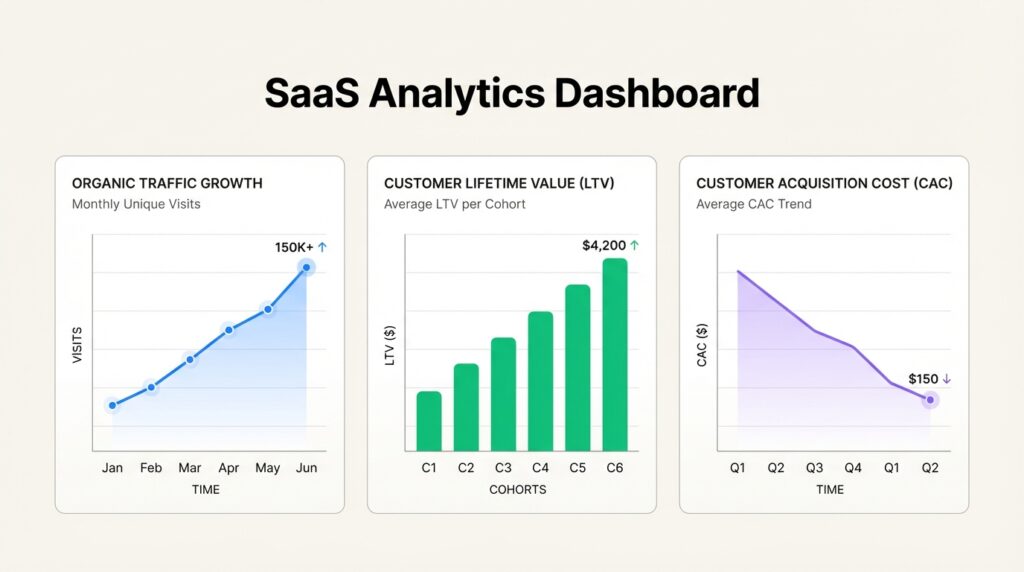
Qualified organic traffic. Not all visitors are equal. Track which pages attract visitors who take meaningful actions: starting trials, requesting demos, or signing up for newsletters.
Conversion rates by channel. Compare how organic search traffic converts versus paid channels, social media, or referrals. SEO traffic typically has higher intent and converts better over time.
Customer acquisition cost (CAC). Calculate your fully-loaded SEO CAC, including content production, tools, and team time. Compare this to paid acquisition costs. SEO CAC should decrease over time as content continues to perform.
Customer lifetime value (LTV) by channel. SEO-acquired customers often have higher LTV because they found you organically while researching solutions, indicating stronger product-market fit. Hotjar saw a 47% traffic increase and 20% signup increase after implementing topic clusters.
Time to rank and compound growth. Set realistic expectations. New content typically takes 3-6 months to rank for competitive keywords. Track cumulative traffic growth month over month to see the compounding effect.
Tools for measurement: Google Analytics 4 for traffic and conversion tracking, Google Search Console for search performance, and your CRM for connecting SEO to revenue.
Common SaaS SEO mistakes to avoid
After working with dozens of SaaS companies, we’ve seen the same mistakes repeatedly.
Targeting only high-volume keywords. High volume usually means high competition and low intent. A keyword with 500 monthly searches from people ready to buy beats one with 5,000 searches from casual researchers.
Ignoring bottom-of-funnel content. Educational content is easier to write, but product-focused pages drive conversions. Balance your content mix.
Neglecting technical foundations. You can publish brilliant content, but if your site is slow, poorly structured, or has crawl errors, it won’t rank.
Inconsistent publishing. SEO compounds over time, but only if you maintain momentum. A sporadic publishing schedule confuses search engines and limits growth.
Forgetting about retention. SaaS success depends on keeping customers, not just acquiring them. SEO can support retention through onboarding content, feature documentation, and help center optimization.
Copying competitors blindly. Just because a competitor ranks for a keyword doesn’t mean you should target it. Their domain authority, backlink profile, and resources differ from yours. Build your own strategy.
Getting started with your SaaS SEO strategy
If you’re just starting out, here’s a practical framework:
Month 1: Audit and foundation. Fix technical issues, set up analytics and Search Console, and identify your highest-opportunity keywords.
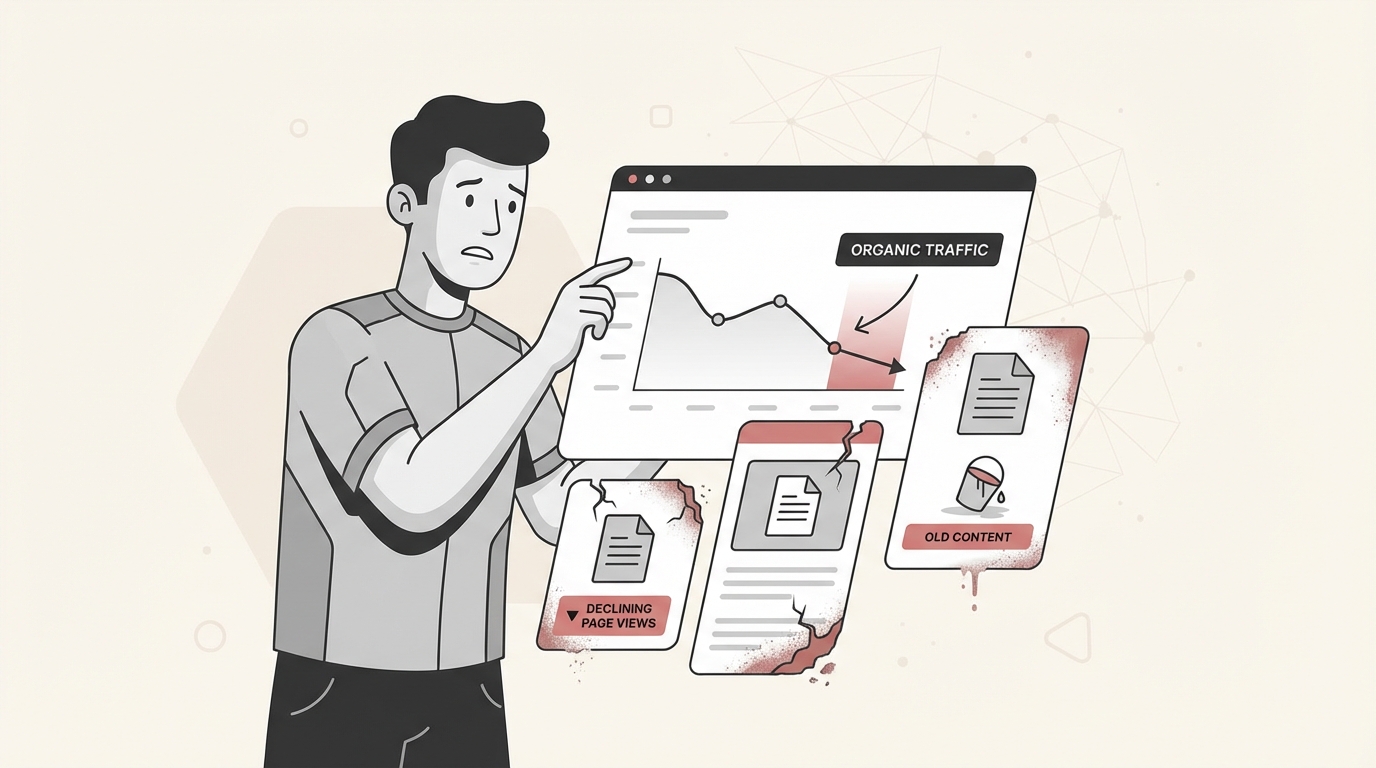
Months 2-3: Quick wins. Optimize existing pages, update outdated content, and target low-competition keywords where you can rank quickly.
Months 4-6: Content investment. Begin publishing consistently, focusing on one or two content clusters where you can build topical authority.
Months 6-12: Scale and refine. Double down on what’s working, expand to new keyword clusters, and begin proactive link building.
When to DIY versus hiring help: If you have a marketing team with SEO experience and can dedicate at least 20 hours per week to content, DIY can work. If SEO isn’t your team’s core competency, or you need results faster, consider working with specialists.
At Decoding, we help SaaS companies build custom SEO strategies that drive qualified leads and revenue. Not templates. Not 50-page reports that collect dust. Just actionable roadmaps focused on what moves the needle for your business.
If you’re ready to turn organic search into a growth engine for your SaaS company, let’s talk.
Frequently Asked Questions
How long does it take to see results from SEO for SaaS?
Most SaaS companies see meaningful traction within 6-12 months, though this varies by competition level and starting point. Early wins often come from technical fixes and optimizing existing content. Significant organic traffic growth typically requires 12-18 months of consistent effort.
How much should a SaaS company budget for SEO?
Budgets vary widely based on goals and competition. Early-stage SaaS might start with $3,000-5,000 monthly for content and tools. Growth-stage companies often invest $10,000-30,000 monthly including agency support or dedicated hires. Enterprise SaaS can spend significantly more.
Should SaaS companies focus on SEO or paid ads?
Both have their place. Paid ads deliver immediate results but stop working when you stop paying. SEO takes longer but compounds over time and reduces customer acquisition costs. Most successful SaaS companies use paid for immediate growth while building SEO for long-term sustainability.
What are the best content types for SaaS SEO?
The best content depends on your funnel stage. Educational blog posts and guides work for top-of-funnel. Comparison pages and use case studies excel at middle-of-funnel. Product pages, pricing information, and case studies convert bottom-of-funnel visitors.
How do you measure SEO ROI for SaaS?
Track organic traffic growth, but more importantly, measure qualified leads and conversions from organic search. Calculate customer acquisition cost by channel and compare lifetime value of SEO-acquired customers versus other channels. The goal is demonstrating that SEO delivers profitable, sustainable growth.
Can small SaaS companies compete with big players in SEO?
Yes, by focusing on specificity rather than breadth. Target long-tail keywords, niche use cases, and specific industries where you have advantages. Big companies often ignore smaller segments. Build topical authority in specific areas before expanding.








Leave a Reply