
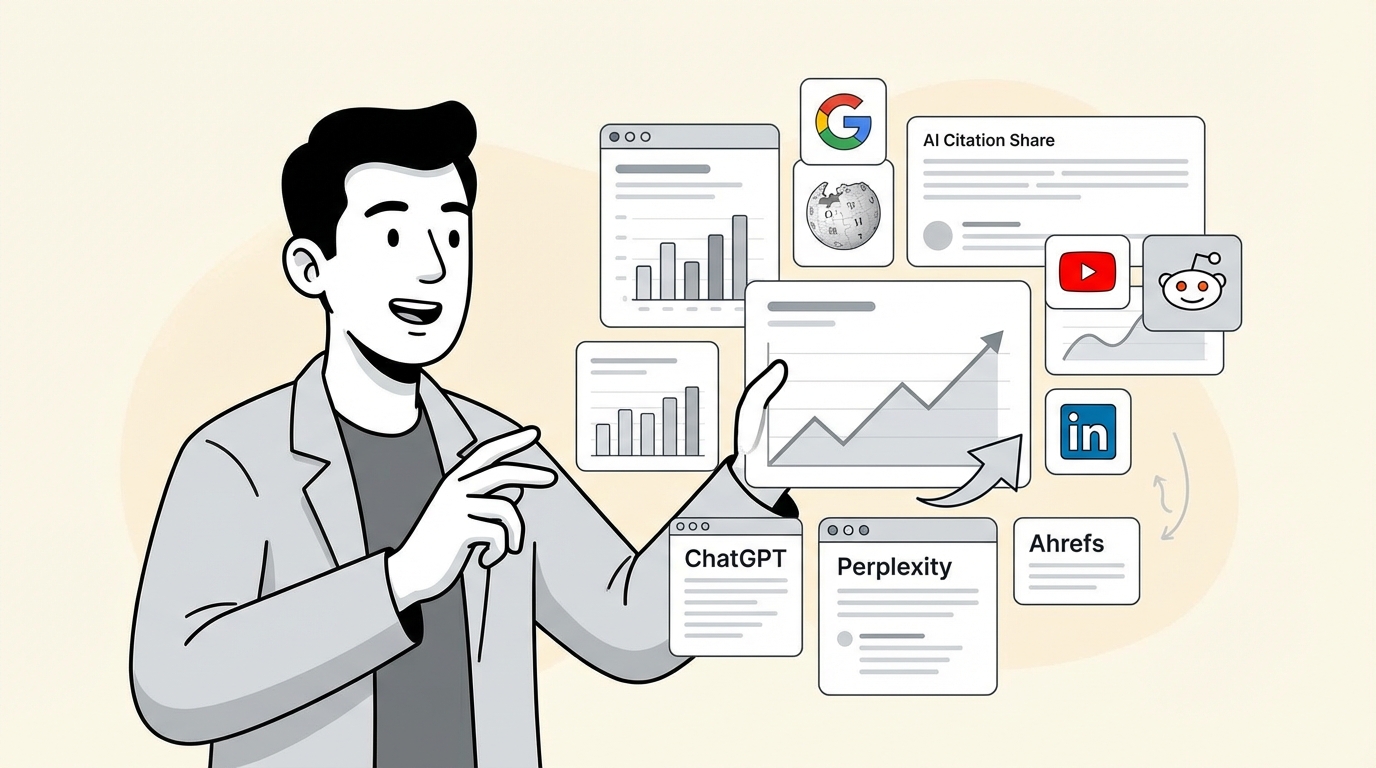
The rules of search visibility are being rewritten. Ranking #1 on Google used to be the holy grail of SEO. Now, a new metric matters just as much: whether AI systems cite your domain when answering user questions.
This shift from “ranking well” to “being cited” has profound implications for every brand creating content online. But which domains are actually winning in this new landscape? And what can you learn from them?
If you’re building a GEO strategy to improve your visibility in AI search, understanding these patterns is essential.
To find out, we analyzed data from four major independent studies covering more than 10 million AI citations:
- Semrush analyzed 230,000+ prompts across ChatGPT, Google AI Mode, and Perplexity over 13 weeks
- Ahrefs examined 863,000 keywords and 4 million AI Overview URLs
- First Page Sage catalogued 36,127 buying-intent queries on ChatGPT
- Goodie processed 5.7 million citations across major LLMs
The data tells a clear story: a small group of domains dominates AI citations, but the path to getting there (and staying there) is shifting rapidly. If you’re building a GEO strategy to improve your visibility in AI search, our AI brand visibility tracker can help you monitor your progress.
What does “most cited” actually mean?
Before diving into the rankings, let’s clarify what we’re measuring. When AI systems like ChatGPT, Perplexity, or Google AI Overviews generate responses, they often include citations. These appear as footnotes, carousel cards, sidebar links, or inline references that point to the sources the AI used to construct its answer.
Citation share measures how frequently a particular domain appears across these AI-generated responses. It’s becoming the new PageRank: a signal of which sources AI systems trust most consistently.
Here’s the challenge: unlike traditional SEO where rankings are distributed across thousands of domains, AI citations show extreme concentration. The top 5 domains capture 38% of all citations. The top 20 control 66%.
This winner-takes-most dynamic creates a high barrier for smaller publishers. But it also reveals where you should focus your efforts if you want to earn AI visibility. Learn more about how to get cited by LLMs in our detailed guide.
The citation hierarchy: top cited domains in AI across platforms
The dominant five
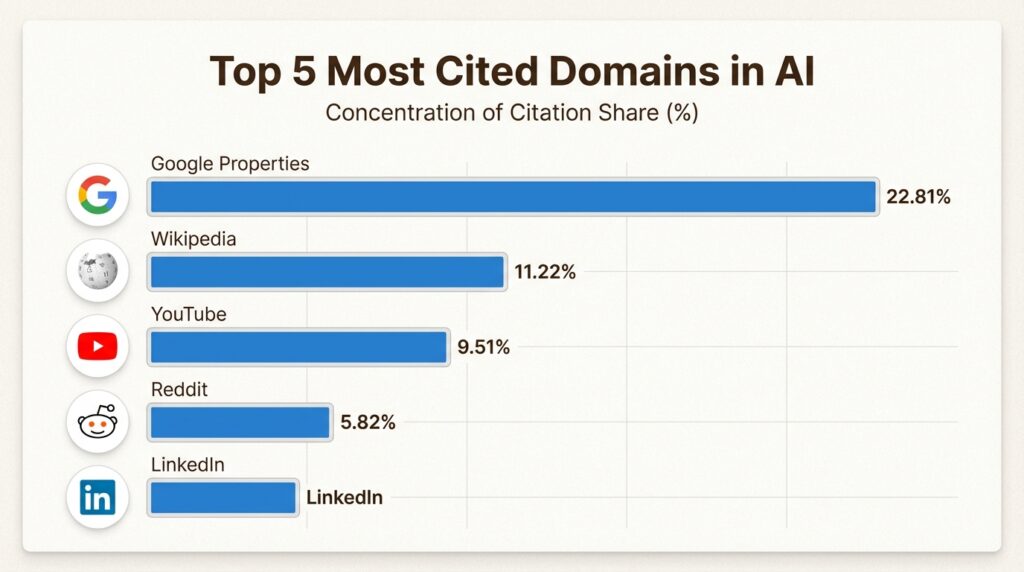
Five domains stand above the rest, collectively accounting for more than a third of all AI citations:
1. Wikipedia
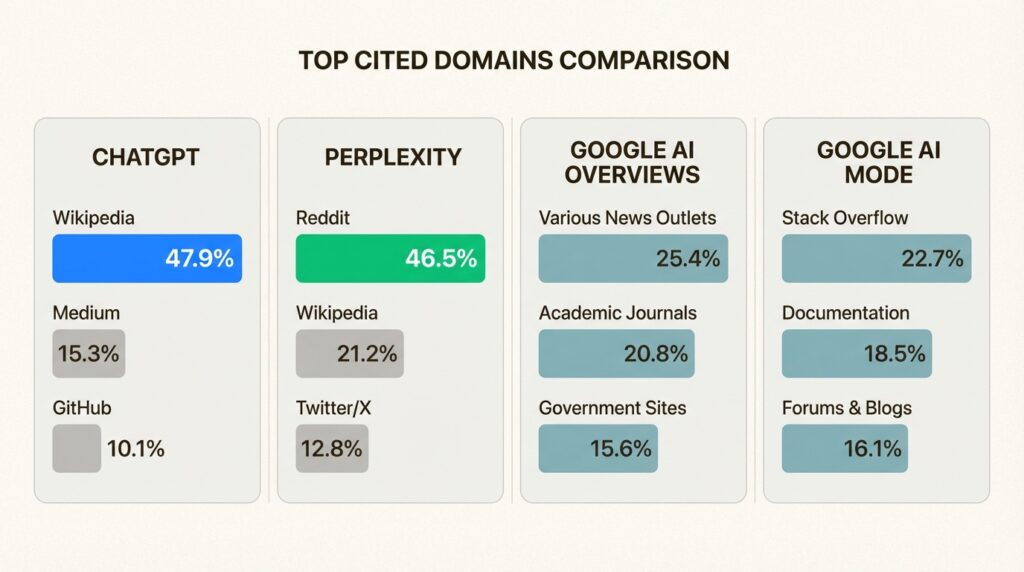
With 1.1 million mentions in Google AI Mode alone (11.22% of all citations), Wikipedia remains the undisputed leader. Its dominance is particularly pronounced on ChatGPT, where it accounts for 47.9% of the top 10 most-cited sources.
The reasons are straightforward. Wikipedia offers structured, neutral, comprehensive coverage across virtually every topic. For AI systems trained to prioritize factual accuracy, it’s a reliable starting point.
2. YouTube
YouTube ranks second with 961,938 mentions (9.51% of citations) and has grown 34% over the past six months. According to Ahrefs, it’s now the most-cited domain in AI Overviews overall.
This represents a significant shift. Among citations that don’t rank in Google’s top 100 results for the same keyword, 18.2% are YouTube URLs. AI systems are increasingly pulling from video content that provides practical, demonstrative answers.
3. Reddit
Reddit occupies a unique position. With 588,596 mentions (5.82%), it’s the premier source for user-generated perspectives. But its trajectory has been volatile.
Between March and June 2025, Reddit’s citation rate surged 450%. In Google AI Overviews specifically, it commands 21% of all citations. On Perplexity, that number jumps to 46.5%.
4. Google properties
Google’s AI systems show a strong preference for their own ecosystem. blog.google alone accounts for 601,835 mentions (5.95%). When combined with YouTube, google.com, support.google.com, and play.google.com, Google-controlled domains represent 22.81% of all citations. The 43% self-referential citation rate raises competitive fairness questions.
5. LinkedIn
LinkedIn has shown steady growth across all platforms. While individual citation numbers are lower than the top four, its consistent upward trend suggests professional content is gaining AI trust.
The extended elite (positions 6-20)
Beyond the top five, a diverse set of platforms commands significant citation share:
- Amazon (431,080 mentions) dominates commerce queries
- Quora (360,239 mentions) and Facebook (338,391 mentions) provide community perspectives
- Forbes doubled its citations after September 2025
- Healthline, Mayo Clinic, Cleveland Clinic, and WebMD maintain strong presence for medical queries
- Yelp and TripAdvisor serve location-based searches
- Reuters, AP News, NYT, and CNN represent traditional journalism
Platform-specific patterns
Not all AI systems cite sources the same way. Understanding these differences is crucial for optimizing your visibility across platforms, especially if you’re targeting ChatGPT specifically.
| Platform | Top Source | Citation Pattern |
|---|---|---|
| ChatGPT | Wikipedia (47.9%) | Encyclopedia-heavy, authoritative |
| Perplexity | Reddit (46.5%) | UGC-dominant, discussion-focused |
| Google AI Overviews | Reddit (21%), YouTube (18.8%) | Balanced mix |
| Google AI Mode | Wikipedia (11.22%), YouTube (9.51%) | Authoritative with video |
The September 2025 shift: what changed
Something significant happened around September 11, 2025. Semrush’s 3-month study captured a dramatic shift in ChatGPT’s citation behavior.
Reddit citations collapsed from roughly 60% of prompt responses to around 10%. Wikipedia dropped from 55% to less than 20%.
The timing coincided with Google removing its num=100 search parameter, which some SEOs theorized limited tools’ ability to access deeper rankings. But Semrush’s Head of Organic and AI Visibility, Sergei Rogulin, offered a different explanation:
“I believe the main reason for the drop is an attempt to avoid over-citing on certain websites, to be less biased toward them, while generating answers. As a result, ChatGPT has become more resilient to manipulation attempts.”
The winners from this shift? PRNewswire, Forbes, and Medium all saw significant citation gains. The lesson is clear: AI citation patterns can change rapidly, and strategies built on a single source are fragile.
The traffic paradox: why citations don’t equal clicks
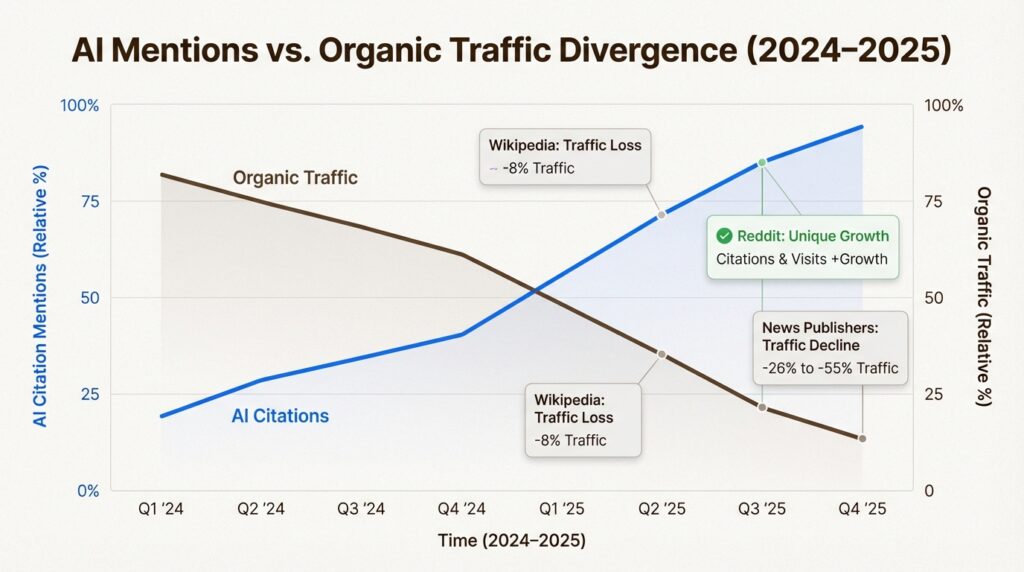
Here’s where it gets complicated: being highly cited by AI systems doesn’t necessarily translate to website traffic. In fact, the correlation can be negative.
Consider Wikipedia. Despite being the most-cited source with over 1.1 million mentions, it experienced an 8% decline in human pageviews comparing 2025 to 2024. Marshall Miller, Senior Director of Product at the Wikimedia Foundation, attributed this to “the impact of generative AI and social media on how people seek information.”
News publishers have been hit even harder:
- Business Insider: 55% traffic decline
- Forbes: 50% traffic decline
- HuffPost: 50% traffic decline
- The Washington Post: 40% traffic decline
These losses occurred despite many of these sites maintaining significant citation presence. The disconnect illustrates a fundamental shift: AI systems extract value from content while reducing the need for users to visit source sites.
Reddit is the notable exception. Its traffic grew to 1.4 billion monthly visits by April 2025, supported by its explosive citation growth. The platform’s authentic, experience-based content appears to drive both AI citations and human engagement.
The broader trend is stark. Zero-click searches rose from 56% in 2024 to 69% by May 2025. When AI Overviews appear, CTR for position-one organic results drops 34.5%. Only 8% of users who encounter an AI Overview click a traditional search result, compared to 15% when no AI summary appears.
What types of sites get cited (and why)
First Page Sage’s analysis of buying-intent queries reveals which website categories dominate commercial recommendations:
| Website Type | Citations | Why AI Systems Trust Them |
|---|---|---|
| Product recommendation media | 7,642 | Structured reviews, affiliate authority |
| Consumer review platforms | 5,983 | Aggregated user feedback |
| Traditional media | 4,581 | Editorial credibility |
| New media | 3,826 | Digital-native authority |
| YouTube/Video | 3,211 | Demonstrative, practical content |
| Directory sites | 2,639 | Structured provider listings |
| Commercial/brand sites | 2,208 | Official product information |
| B2B marketplaces | 1,762 | Software comparisons |
The pattern is clear: AI systems prioritize sources that offer structured, authoritative, and comprehensive information. According to Goodie’s analysis, 74% of the most-cited domains are susceptible to marketing influence. This presents a significant opportunity for brands willing to invest in the right content and partnerships.
Industry-specific leaders
Citation preferences vary significantly by vertical:
- Healthcare: Healthline, Cleveland Clinic, Mayo Clinic, WebMD
- Finance: NerdWallet, Investopedia, Forbes Advisor
- B2B SaaS: G2, Capterra, Clutch, TrustRadius
- E-commerce: Amazon, Wirecutter, Tom’s Guide
- Real Estate: Zillow, Realtor.com, Redfin
- Automotive: Car and Driver, Kelley Blue Book, Edmunds
Strategic implications for your GEO strategy
The data reveals several critical shifts that should inform your generative engine optimization approach:
Traditional SEO is no longer sufficient. Only 38% of AI citations come from top-10 organic results, down from 76% in July 2025. Ranking well for your target keyword doesn’t guarantee AI visibility.
Query fan-out matters more than single-keyword ranking. Google’s AI systems split initial queries into multiple related sub-queries. The pages that appear across these expanded searches get cited. Covering your topic from multiple angles is now essential.
YouTube is non-negotiable. With 34% growth and the #1 position in AI Overviews, video content has moved from “nice to have” to critical infrastructure for AI visibility.
Platform-specific optimization is required. ChatGPT favors encyclopedic authority. Perplexity prioritizes community discussion. Google balances both. Your content strategy needs to account for these differences.
Citation and traffic strategies may diverge. You need to decide whether your goal is maximizing citations (brand awareness in AI responses) or driving direct traffic. The tactics differ.
How to improve your AI citation visibility
Based on the patterns identified across these studies, here are concrete steps to increase your domain’s citation share:
- Target strategic placements on high-citation domains. Getting mentioned on Wikipedia, Forbes, or industry-specific leaders like Healthline or G2 can significantly boost your AI visibility.
- Optimize for E-E-A-T signals. Experience, Expertise, Authoritativeness, and Trustworthiness are the foundation. AI systems are trained to prioritize sources demonstrating these qualities.
- Create structured, quotable content. Statistics, definitions, step-by-step guides, and original research are more likely to be cited than narrative content.
- Build YouTube presence. Given its dominance in AI citations, video content should be a core component of your strategy.
- Monitor citation share with dedicated tools. Understanding where you currently appear (and where you don’t) is essential for prioritizing efforts. Our AI visibility audit can help you establish a baseline.
The future of AI citations: what to watch
The landscape continues to evolve rapidly. Several trends are worth monitoring:
Citation volatility will continue. The September 2025 shift shows that AI systems regularly adjust their source preferences. What works today may not work tomorrow.
Platform differentiation is increasing. ChatGPT, Perplexity, and Google are developing distinct citation personalities. A one-size-fits-all approach will become less effective.
Video and UGC are gaining ground. YouTube’s rise and Reddit’s dominance on Perplexity suggest AI systems increasingly value authentic, experience-based content over polished corporate messaging.
Google’s self-referential bias creates challenges. With 43% of citations pointing to Google properties, competing for visibility within Google’s ecosystem requires understanding (and potentially working around) this preference.
The zero-click trend will accelerate. As AI search market share grows, the disconnect between citations and traffic will likely widen. Brands need strategies that work within this reality.
Understanding top cited domains in AI for your visibility strategy
The dominance of Wikipedia, YouTube, Reddit, and a handful of other domains in AI citations isn’t random. It reflects what AI systems value: structured information, authentic perspectives, comprehensive coverage, and demonstrable expertise.
For brands, the path forward requires a fundamental shift in thinking. SEO was about ranking for keywords. GEO is about becoming a source that AI systems trust enough to cite. These are related but distinct goals.
The data from 10 million citations makes one thing clear: the window for establishing AI visibility is narrowing. The winner-takes-most dynamic means early movers who earn citations now will be increasingly difficult to displace.
If you’re serious about tracking and improving your AI visibility, understanding which domains dominate citations is just the starting point. The real work is building the authority, relationships, and content that earns you a place on that list.
Frequently Asked Questions
Which domains are most frequently cited by AI systems like ChatGPT and Perplexity?
The top cited domains in AI are Wikipedia, YouTube, Reddit, Google properties (blog.google, support.google), and LinkedIn. These five domains collectively account for 38% of all AI citations. Wikipedia dominates ChatGPT specifically with 47.9% of top-10 citations, while Reddit leads on Perplexity with 46.5% of citations.
How can I get my website listed among the top cited domains in AI search results?
Focus on building authority through E-E-A-T signals (Experience, Expertise, Authoritativeness, Trustworthiness), creating structured and quotable content, earning mentions on already-trusted domains, building a YouTube presence, and covering your topics comprehensively across related queries rather than targeting single keywords.
Do top cited domains in AI automatically get more organic traffic?
No. There’s a significant disconnect between citation frequency and traffic. Wikipedia is the most-cited domain but experienced an 8% traffic decline. News publishers with high citation rates have seen 26-55% traffic drops. Reddit is the exception, showing both citation growth and traffic growth.
Which AI platform cites the most diverse range of domains?
Google AI Mode shows the most balanced mix of cited domains, though it still demonstrates a 43% self-referential bias toward Google properties. Perplexity is the most concentrated, with Reddit alone accounting for 46.5% of citations. ChatGPT falls in between, heavily favoring Wikipedia but showing more diversity than Perplexity.
How often do the top cited domains in AI change?
Citation patterns can shift rapidly. The September 2025 change saw Reddit and Wikipedia citations on ChatGPT drop dramatically (from 60% and 55% to 10% and 20% respectively). This volatility means strategies built on a single source or platform are fragile.
What types of content get cited most by AI systems?
Product recommendation media, consumer review platforms, traditional media outlets, video content, and structured directories get cited most frequently. For buying-intent queries specifically, ‘best of’ and ‘top 10’ review sites, user-generated review aggregators, and established publishers dominate.



Leave a Reply