

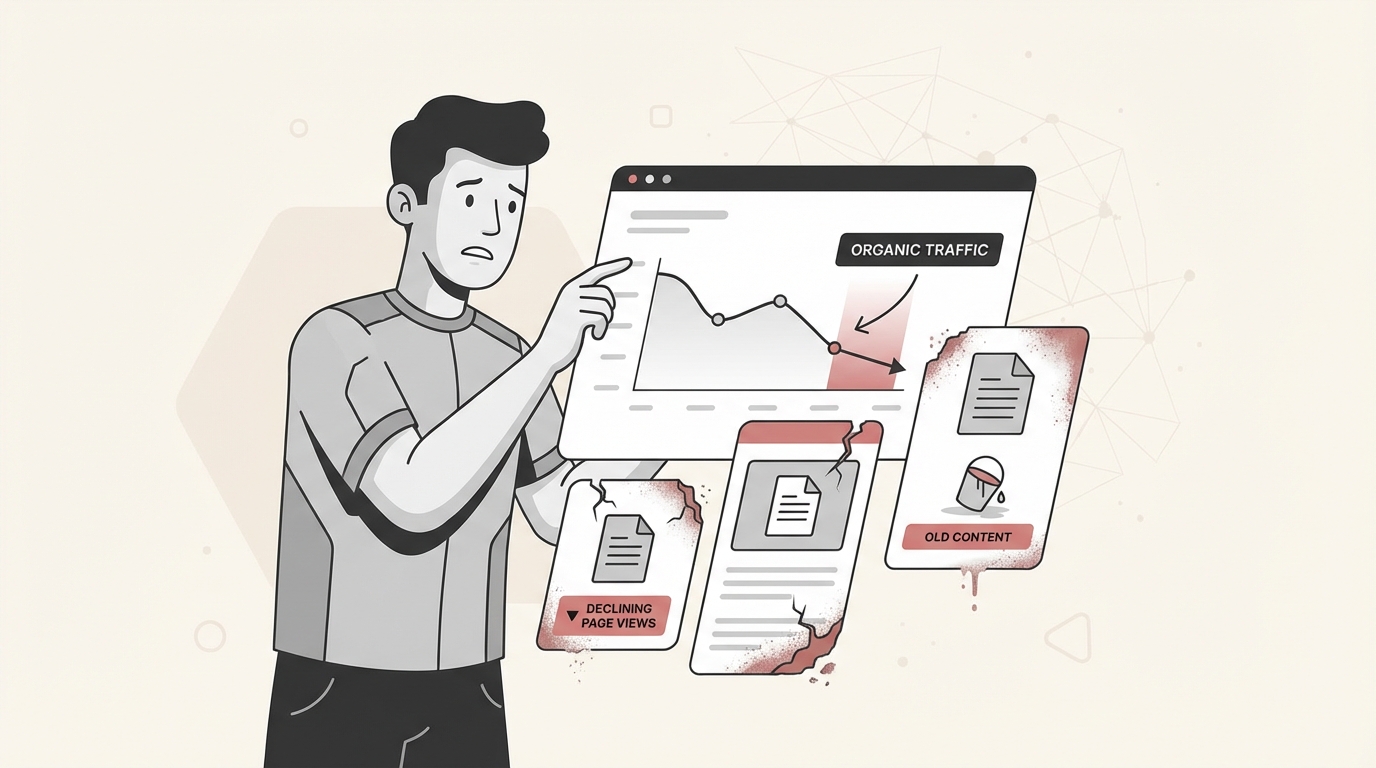
Picture this: your content team publishes a stellar blog post. It climbs the rankings, lands on page one, and brings in qualified leads for months. Then, without warning, the numbers start sliding. Traffic trickles down, conversions dry up, and your once-reliable asset sits on page three.
This is content decay. It’s not a penalty from Google. It’s not a technical error. It’s the natural, gradual decline that happens when content ages and the digital landscape shifts around it.
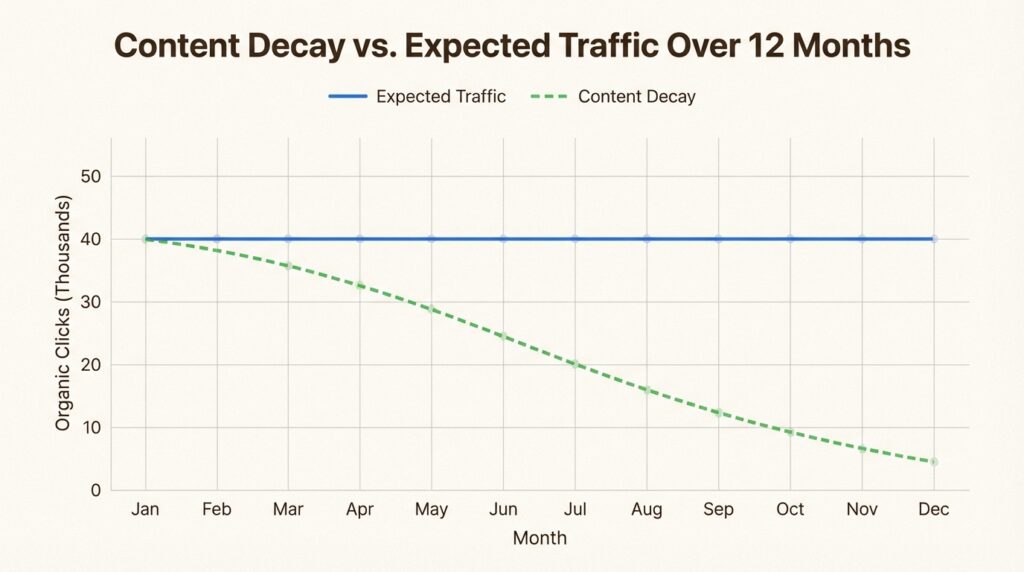
The problem? Most businesses treat content like a “publish and forget” asset. They pour resources into creating new pieces while old content rots in the archives. It’s like pouring water into a leaky bucket.
Here’s the good news: content decay is fixable. With the right approach, you can identify decaying pages, revive them with strategic updates, and build a system that prevents future losses. At Decoding, we help businesses do exactly this as part of our comprehensive AI SEO services.
What is content decay?
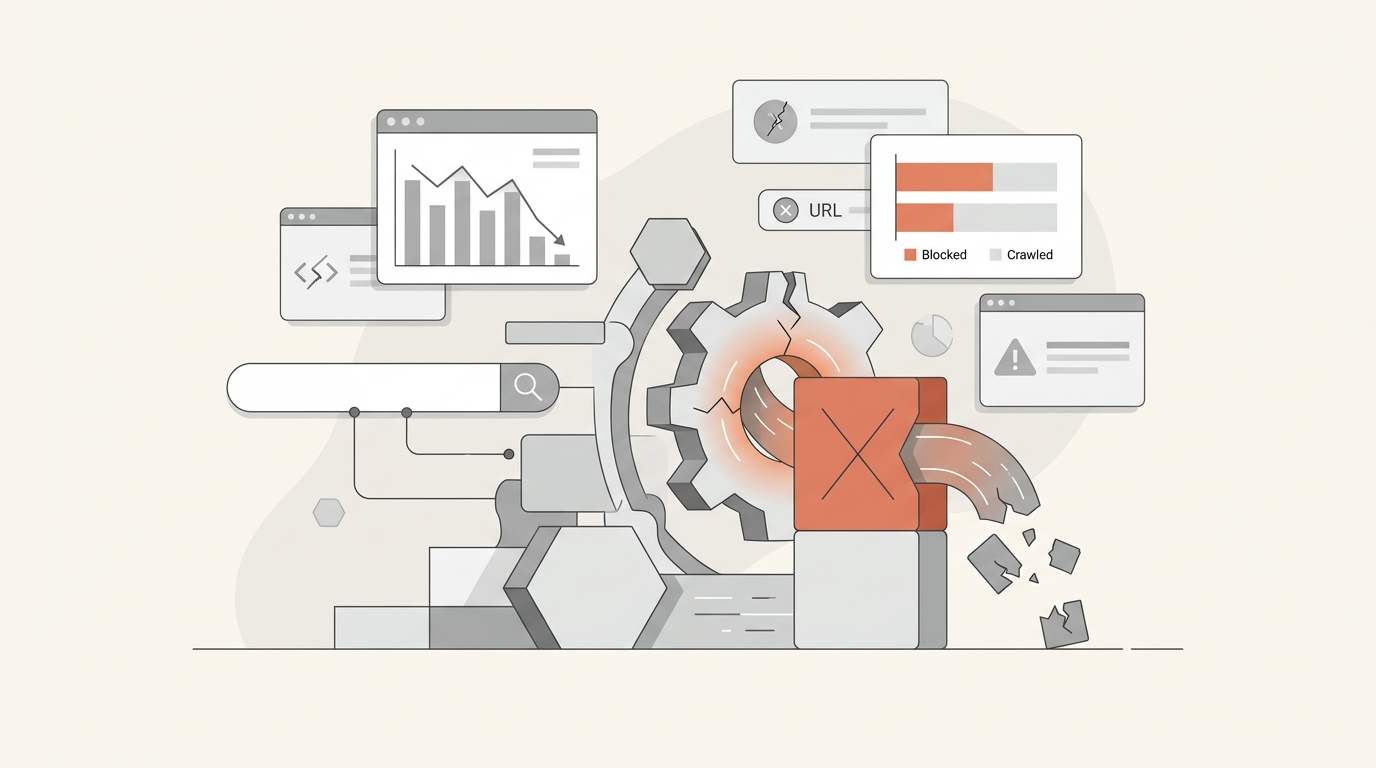
Content decay is the gradual loss of organic traffic and search engine rankings over time. Unlike a sudden penalty or technical issue that drops you overnight, decay is a slow leak. Your page might slip one position per month, lose a few clicks per week, or see engagement metrics slowly trend downward.
This happens to everyone. Even your best-performing evergreen posts aren’t immune. The reason? The internet isn’t static. Search intent evolves, competitors publish fresh content, and algorithms change. A post that perfectly matched user needs in 2023 might miss the mark entirely by 2026.
The key symptoms to watch for:
- Declining page views over a 6-12 month trend
- Dropping keyword rankings (especially slipping from position 3 to 8, or 8 to 15)
- Reduced click-through rates even when rankings hold steady
- Lower engagement metrics like time on page and bounce rate
- Fewer conversions from traffic that does arrive
The distinction matters. A sudden 50% traffic drop usually signals a technical problem or algorithm penalty. A gradual 20% decline over six months? That’s classic content decay. Understanding the difference helps you choose the right fix. Our content strategy services can help you build a system to catch these patterns early.
Why content decays: The real causes
Content doesn’t decay because it suddenly becomes bad. It decays because the context around it changes. Let’s break down the main culprits.
Search intent shifts
The way people search evolves constantly. Two years ago, someone searching “remote work software” might have wanted definitions and pros/cons. Today, they likely want a comparison of specific tools like Slack vs. Teams vs. Zoom.
If your post doesn’t match current intent, Google will promote a page that does. This isn’t a quality judgment. It’s a relevance mismatch.
Fresh competition
You’re not the only one trying to rank. Competitors constantly publish newer, deeper, more visually appealing guides. If their content is 10% better than yours, they’ll eventually overtake you. It’s that simple.
Plus, SERP features now capture clicks that used to go to organic results. Featured snippets, AI Overviews, local listings, and answer boxes all siphon traffic from traditional blue links.
Information obsolescence
Nothing kills credibility faster than a statistic from 2019 or a screenshot of software that no longer exists. Users bounce when they see old data, signaling to Google that your page is no longer relevant. Broken external links compound the problem, creating a poor user experience. Our technical SEO services include regular link audits to catch these issues before they hurt your rankings.
Algorithm updates
Google launched thousands of changes to its search systems a year, with an average of 13 changes per day. These updates often reward fresh, high-quality content while pushing outdated pages down the SERPs.
Freshness signals and E-E-A-T (Experience, Expertise, Authoritativeness, Trustworthiness) matter more than ever. Content that lacks clear authorship, outdated credentials, or stale publication dates gets demoted.
The AI search factor
AI citations favor fresh, authoritative content. If your page is outdated, LLMs won’t reference it. They’ll cite your competitor’s 2026 guide instead. This means content decay now affects not just Google rankings, but your visibility across the entire AI search ecosystem. Learn more about optimizing for this shift in our AI search optimization guide.
How to identify content decay on your site
You can’t fix what you can’t see. Here’s how to spot decay before it devastates your traffic.
The metrics that matter
Start with year-over-year comparisons. Month-over-month data is too noisy. Seasonal fluctuations, news events, and random variance can mask real trends. But compare this March to last March? That tells a story.
Key metrics to track:
- Organic traffic – the big picture number
- Keyword rankings – especially positions 11-20 (“striking distance” where a refresh can push you to page one)
- Click-through rate – are people choosing your result?
- Engagement metrics – bounce rate, time on page, pages per session
Tools for detection
Google Search Console is your best friend here. Check the Performance report monthly. Look for pages with declining clicks or impressions. The “Pages” tab shows exactly which URLs are slipping.
Google Analytics (or GA4) tracks engagement. Set up custom reports comparing year-over-year traffic. Watch for pages where time on page drops or bounce rates climb.
Semrush or Ahrefs add competitive context. They show when competitors overtake you and track keyword position changes over time. We also offer an AI brand visibility tracker that monitors how your brand appears across both traditional search and AI platforms.
Setting up a monitoring system
Don’t wait for traffic to tank. Build proactive monitoring into your workflow:
- Quarterly audits for most businesses (review top 20-50 pages)
- Monthly checks for large sites with 1,000+ pages
- Reserve 20% of editorial calendar for content refreshes, not just new creation
Set up automated alerts in your SEO tools when key pages drop positions. The earlier you catch decay, the easier it is to reverse.
The content decay fix framework
Once you’ve identified decaying content, you need a decision framework. Not every page deserves a refresh. Some should be consolidated. Others should be redirected or deleted.
The decision matrix
Use this criteria to decide:
| Criteria | Update | Consolidate | Redirect |
|---|---|---|---|
| Traffic | Still decent | Overlapping topics | Near zero |
| Rankings | Declining | Competing internally | Lost completely |
| Backlinks | Quality links exist | Multiple pages with links | No valuable links |
| Business value | High relevance | Similar intent | None |
Update when the content is solid but dated. It used to perform well and still has potential.
Consolidate when you have multiple pages targeting similar keywords. They cannibalize each other. Merge them into one comprehensive resource.
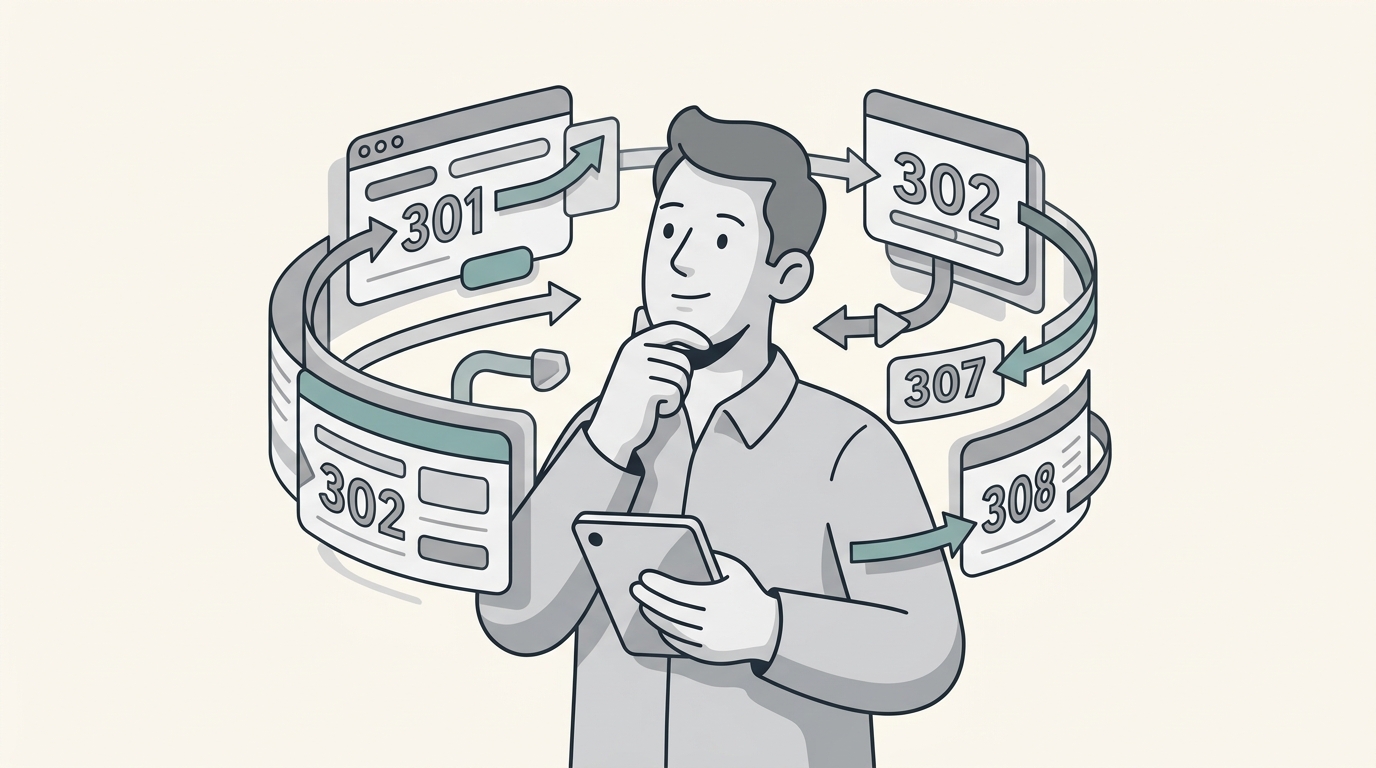
Redirect when the content is truly obsolete. A 301 redirect passes link equity to a relevant, newer page.
Refresh tactics that work
Updating content isn’t just changing the publish date. That’s cosmetic and Google sees right through it. Real refreshes include:
- Update headlines and metadata – especially year references (“2026 guide” not “2023 guide”)
- Refresh statistics and examples – replace anything older than 18-24 months
- Expand thin sections – add new subtopics that competitors cover
- Improve internal linking – connect to newer content on your site
- Add rich media – images, videos, tables, infographics where they add value
The goal is not just freshness signals. It is genuinely making the content more useful than when you first published it. Our GEO services can help optimize refreshed content for both traditional search and AI citations.
Consolidation strategy
Keyword cannibalization happens when multiple pages on your site compete for the same search terms. Neither ranks well because Google cannot decide which to prioritize.
The fix: merge them. Combine the best content from both pages into one comprehensive resource. Then 301 redirect the weaker page to the stronger one. This preserves any link equity while eliminating internal competition.
When to let content go
Sometimes deletion is the right call. If a page has:
- Zero traffic for 12+ months
- Zero valuable backlinks
- Zero relevance to your current business
…then delete it. But if it has any backlinks, redirect it instead. Do not waste link equity.
Prevention: Building a content maintenance system
Fixing decay is reactive. Prevention is proactive. Here’s how to build a system that keeps content fresh.
Create evergreen content when possible
Some topics have built-in expiration dates. An article about “Marketing Trends” will need updates in 2026. “How to Calculate Marketing ROI” will stay relevant for years.
When planning content, ask: will this still be useful in three years? If yes, prioritize it. Evergreen content requires less maintenance and delivers compounding returns.
Schedule proactive audits
Don’t wait for traffic drops. Build content health checks into your calendar:
- Quarterly reviews of top-performing pages
- Prioritize by business impact – conversion pages before blog posts
- Track “striking distance” keywords – pages ranking 11-20 can often hit page one with light updates
Balance creation with maintenance
HubSpot saw a 106% traffic increase from regularly updating old content. Their secret? They treat maintenance as equal to creation.
For mature sites (500+ pages), consider the 80/20 rule: 80% of editorial resources on maintenance, 20% on new creation. New content has a long ramp-up time. Refreshed content can recover traffic in weeks.
This balance also applies to AI search visibility. Our guide on how to track AI visibility shows you how to monitor your brand’s presence across LLMs.
Content decay in the age of AI search
Traditional SEO is only half the battle now. AI assistants like ChatGPT, Perplexity, and Claude are changing how people find information. And they have different freshness requirements than Google.
When an LLM generates a response, it cites sources. Those citations favor:
- Recent publication dates – AI models weight newer content more heavily
- Authoritative domains – established sites with strong E-E-A-T signals
- Comprehensive coverage – content that thoroughly answers the query
- Clear structure – well-organized content that is easy for AI to parse
This means content decay now happens on two fronts. Your page might still rank #5 on Google, but if it’s outdated, ChatGPT will cite your competitor instead.
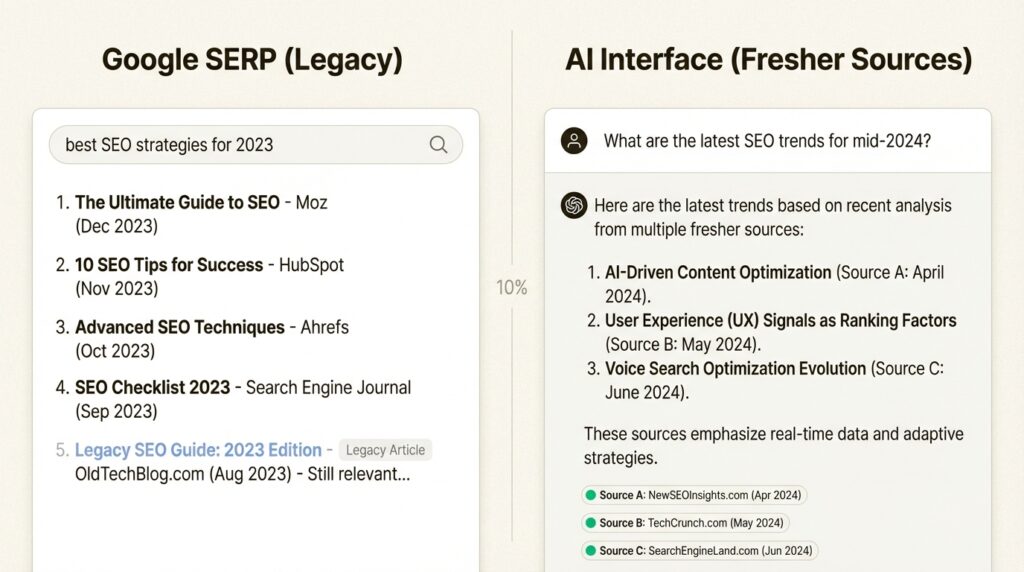
The solution? Treat traditional SEO and Generative Engine Optimization (GEO) as complementary. Refresh content for Google, but also optimize for AI citations. That means clear headings, structured data, and comprehensive topic coverage. Learn more about earning AI citations in our guide on how to get cited by LLMs. You can also run a free AI visibility audit to see how your brand currently appears across AI platforms.
Stop the leak and reclaim your traffic
Content decay is inevitable. The internet moves fast, and yesterday’s perfect answer becomes today’s outdated information. But decay is also manageable. With the right systems, you can catch it early, fix it fast, and prevent most of it from happening.
The ROI speaks for itself. Updating existing content typically delivers faster results than publishing new pieces. The URL already has age and authority. Search engines have already crawled and indexed it. A refresh can show improvements in weeks, not months.
At Decoding, we help businesses build content maintenance systems that work. From identifying decaying pages to optimizing for both Google and AI search, our AI SEO services cover the full spectrum. Whether you need a one-time content audit or ongoing optimization support, we can help.
Ready to stop the leak? Contact us to discuss your content strategy, or check our pricing to see which service tier fits your needs.
Frequently Asked Questions
How long does it take to see results after fixing content decay?
Refreshed content typically shows ranking improvements within 2-4 weeks after re-indexing, much faster than the 3-6 months new content often requires. The existing URL already has authority and backlinks, giving it a head start.
What is the difference between content decay and a Google penalty?
Content decay is a gradual decline over months, usually 10-30% traffic loss. A penalty is sudden and severe, often 50%+ drops overnight. Decay happens naturally as content ages; penalties result from guideline violations.
Should I update the publish date when refreshing content?
Only if you make substantial changes. Changing the date without updating the content can be seen as manipulative. If you do a real refresh, update both the “Last Updated” date and the content itself.
How often should I audit my content for decay?
Quarterly for most businesses, monthly for large sites with 1,000+ pages. Time-sensitive topics (regulations, technology, trends) need more frequent checks than evergreen content.
Can content decay affect my AI search visibility?
Yes. AI assistants like ChatGPT and Perplexity favor fresh, authoritative content. If your page is outdated, LLMs will cite competitors instead. This makes content maintenance critical for both traditional SEO and Generative Engine Optimization.
What tools help identify content decay automatically?
Google Search Console and Google Analytics are free essentials. Paid tools like Semrush, Ahrefs, and Clearscope offer automated monitoring and alerts. For AI search visibility, specialized GEO tools track how often LLMs cite your brand.





Leave a Reply