

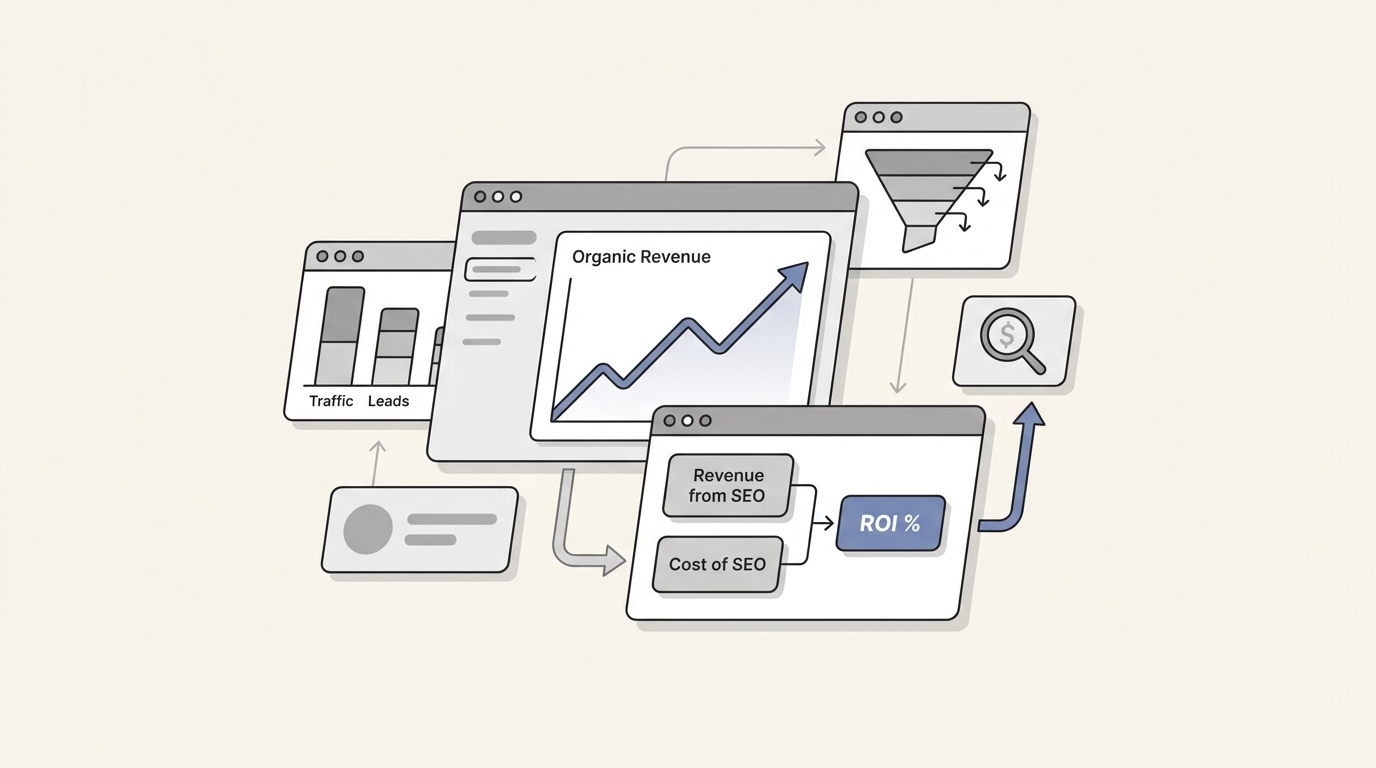
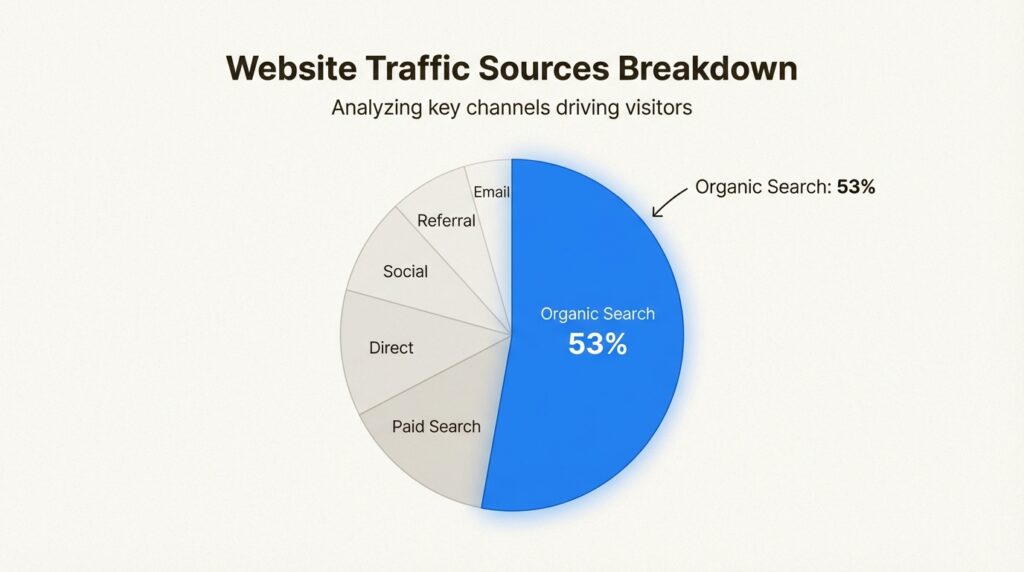
Organic search drives 53% of all website traffic. Yet many businesses struggle to answer a simple question: what is our SEO actually worth?
Without a clear ROI figure, you’re flying blind. You can’t justify budget increases to stakeholders, you don’t know which tactics deserve more investment, and you risk cutting effective campaigns prematurely. Tracking ROI transforms SEO from a “nice to have” into a measurable growth channel with accountable returns.
The problem is that SEO ROI is harder to calculate than paid advertising. With PPC, you know exactly what you spent and what you earned. SEO involves distributed costs, delayed results, and fuzzy attribution. Many teams fall back on vanity metrics (rankings, traffic) that don’t correlate with revenue.
But the measurement challenge is getting more complex, not less. As AI search engines like ChatGPT and Perplexity reshape how people find information, traditional metrics miss a growing piece of the puzzle. Our AI brand visibility tracker helps businesses monitor this emerging channel, but first you need the fundamentals in place.
Here’s how to accurately measure SEO ROI for your business.
The SEO ROI formula explained
The core formula is straightforward:
SEO ROI = (Revenue from SEO – Cost of SEO) / Cost of SEO × 100
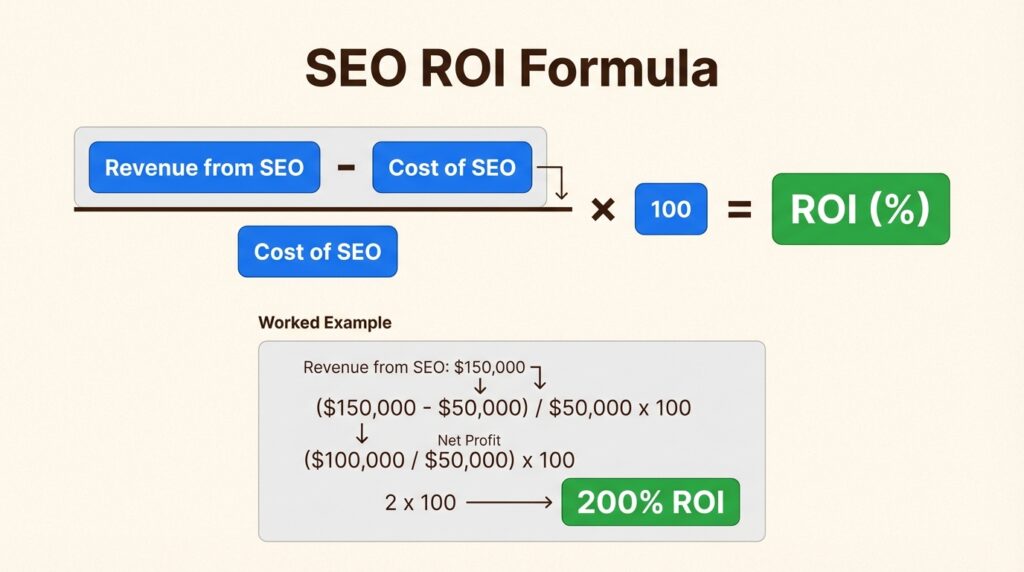
Here’s how it works in practice. Suppose your SEO efforts generate $150,000 in attributed revenue over 12 months. Your total SEO investment (salaries, tools, agency fees, content costs) was $50,000.
($150,000 – $50,000) / $50,000 × 100 = 200% ROI
This means every dollar invested in SEO returned $2 in revenue (plus your original dollar back).
The formula scales to any business size. A local contractor spending $2,000/month on SEO and generating $8,000/month in leads calculates the same way: ($8,000 – $2,000) / $2,000 × 100 = 300% ROI.
It’s worth distinguishing between anticipated ROI and actual ROI. Anticipated ROI is your projection before starting a campaign, based on keyword volumes, conversion rates, and estimated traffic. Actual ROI is the measured result after the fact. Both matter, but only actual ROI should drive budget decisions.
Step 1: Calculate your total SEO investment
Before you can measure returns, you need an accurate picture of costs. SEO investment typically includes several categories:
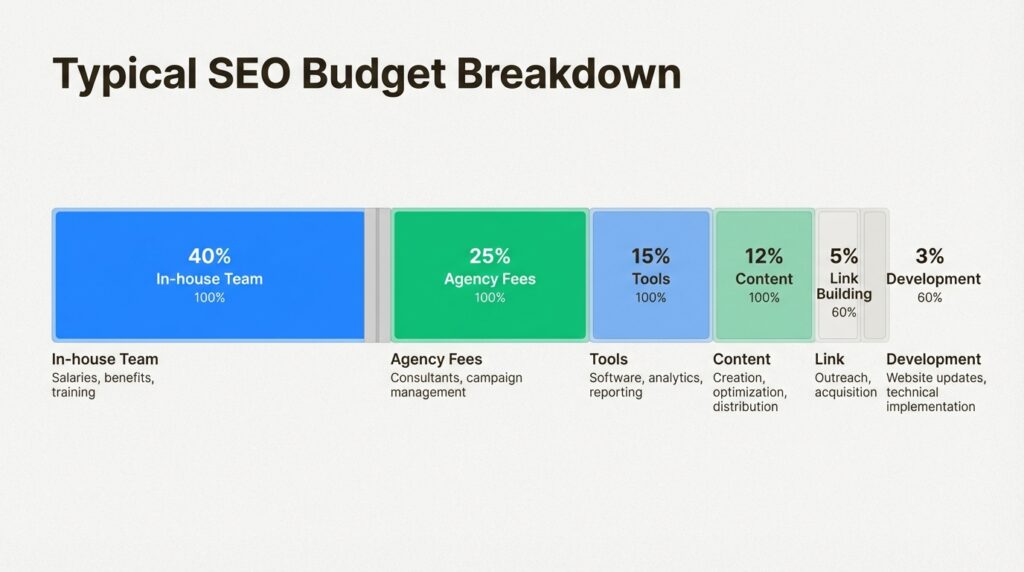
In-house team costs. If you have dedicated SEO staff, use their fully-loaded salary (including benefits). For team members who split time between SEO and other responsibilities, track hours spent on SEO tasks and calculate costs based on hourly rates.
Agency and freelancer fees. These are usually the easiest to track since they come as fixed monthly retainers or project fees. If you’re evaluating agency costs, you can see our pricing for reference on what comprehensive SEO services typically involve.
SEO tools and software. Include subscriptions for analytics platforms, keyword research tools, rank trackers, and technical SEO crawlers. If tools are shared across teams, allocate a percentage based on SEO usage.
Content creation costs. Whether in-house or outsourced, factor in the cost of blog posts, landing pages, videos, and other content produced for SEO purposes.
Link building and outreach. Account for time spent on outreach, costs of digital PR campaigns, and any sponsored content or partnership fees.
Development resources. Technical SEO often requires developer time for site speed improvements, structured data implementation, and fixes.
Add these up for your chosen time period (typically quarterly or annually). Be thorough. Underestimating costs inflates your ROI artificially.
Step 2: Track and value your SEO conversions
This is where most businesses get stuck. You need to connect organic traffic to actual revenue.
Set up conversion tracking in Google Analytics 4. Define what counts as a conversion for your business. For e-commerce, it’s straightforward: completed purchases. For lead generation businesses, conversions might be form submissions, phone calls, quote requests, or demo bookings.
Assign dollar values to lead conversions. This is critical for non-e-commerce businesses. Use historical data to calculate averages:
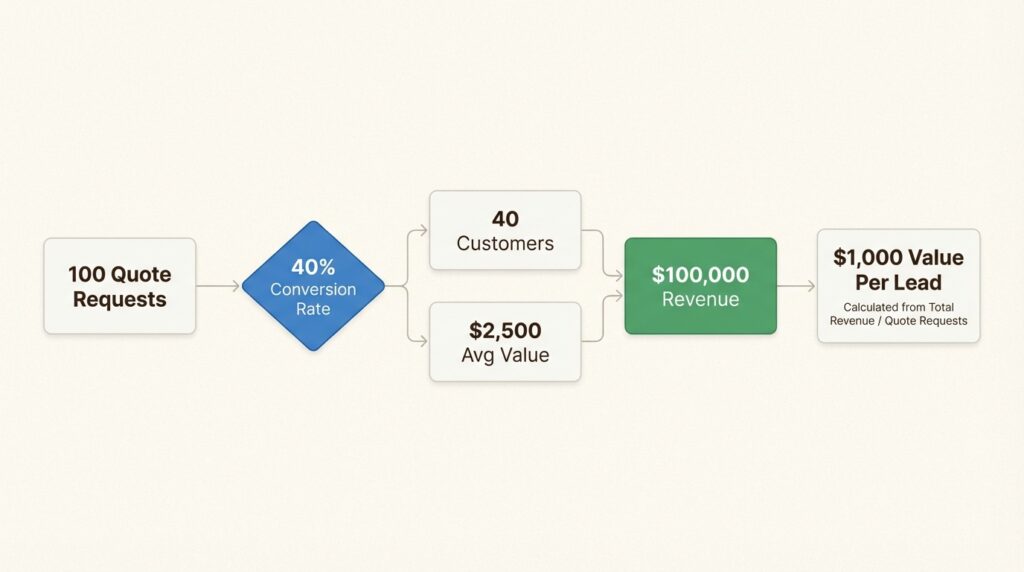
- 100 people request quotes per month
- 40 become customers (40% conversion rate)
- Average customer value is $2,500
- Total monthly revenue: $100,000
- Value per quote request: $100,000 / 100 = $1,000 per lead
If this calculation feels complex, our technical SEO services include analytics setup and conversion tracking configuration to get this right from the start.
Sort conversions by marketing channel. In Google Analytics, navigate to Reports > Attribution > Conversion paths. Filter for “Organic Search” to see conversions where SEO played a role. The “Conversion Value” column shows the dollar amount based on the values you assigned.
Account for different attribution models. Last-click attribution (the default) gives SEO credit only when it’s the final touchpoint before conversion. But SEO often plays an assist role earlier in the customer journey. Use the Assisted Conversions report to see the full picture.
Step 3: Account for assisted conversions
The customer journey rarely follows a straight line. A prospect might discover you through organic search, follow your newsletter for months, then convert after clicking a retargeting ad. Last-click attribution gives all credit to the ad. That’s not the full story.
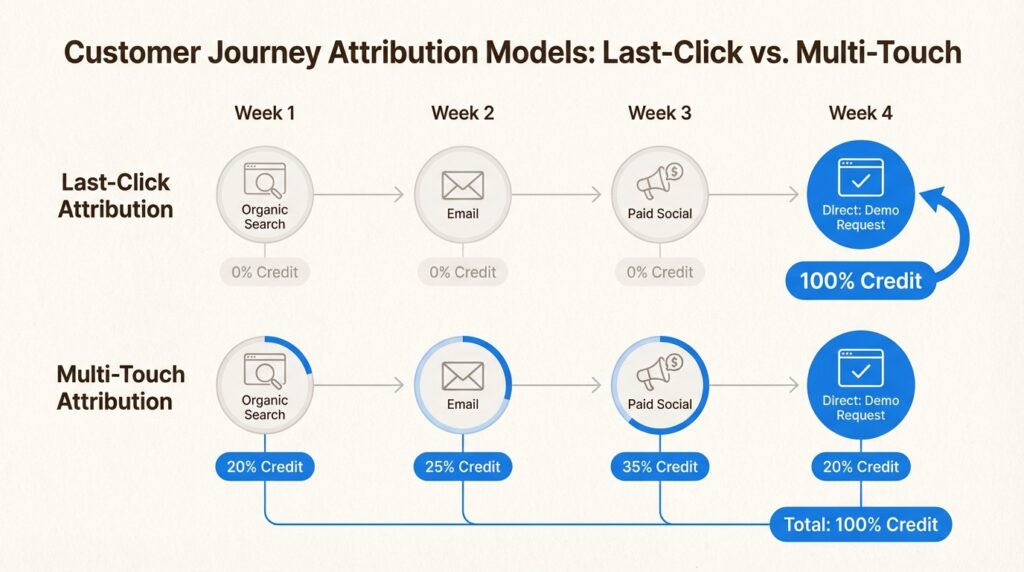
Google Analytics’ Assisted Conversions report shows how often each channel contributed to conversions without being the final touchpoint. For SEO, this often reveals significant hidden value.
To access this data:
- Go to Reports > Attribution > Conversion paths
- Set your date range (use at least 90 days for meaningful data)
- Review the “Top Conversion Paths” to see common sequences
- Check how often “Organic Search” appears in paths that convert
Example customer journey:
- Week 1: Prospect searches “best CRM for small business” and finds your blog post (Organic Search)
- Week 2: Subscribes to your newsletter (Email)
- Week 3: Clicks LinkedIn ad (Paid Social)
- Week 4: Returns directly and requests a demo (Direct)
Last-click attribution gives 100% credit to Direct. But without that initial organic discovery, the conversion might not have happened. The Assisted Conversions report shows SEO’s contribution to this and similar journeys.
When calculating ROI, consider weighting assisted conversions at 25-50% of full conversion value, depending on your sales cycle complexity.
The AI search layer: Measuring GEO ROI
Traditional SEO measurement focuses on Google rankings and website traffic. But a growing portion of search behavior happens inside AI chatbots like ChatGPT, Claude, and Perplexity. This is Generative Engine Optimization (GEO), and it requires new metrics.
Brand citations in AI responses. When someone asks an AI “what’s the best project management software” and your brand gets mentioned, that’s a visibility win. Track how often your brand appears in AI responses for relevant queries.
AI search visibility as an early indicator. AI citations often precede branded search lift. If ChatGPT starts recommending your product, you’ll typically see increased direct traffic and branded searches within 30-60 days.
Correlating AI visibility with business outcomes. While direct attribution is still evolving, you can track correlations between AI citation volume and downstream metrics like branded search volume, direct traffic, and demo requests.
Our GEO services help businesses optimize for AI search visibility, and our AI visibility tracking guide explains the methodology in detail. For a broader strategic view, see our guide to AI search optimization.
The future of attribution will likely involve AI-assisted customer journeys where prospects use chatbots for research before visiting your site. Early movers who establish measurement frameworks now will have a significant advantage.
Common SEO ROI measurement mistakes
Even experienced marketers make these errors:
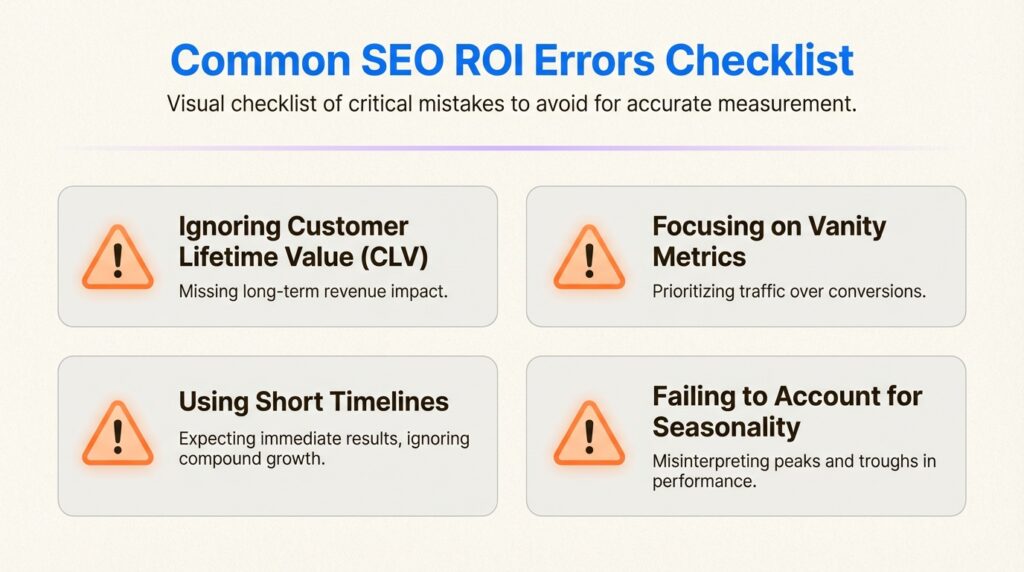
Ignoring customer lifetime value. If your average customer makes multiple purchases over years, your ROI calculation should reflect total LTV, not just first purchase value. A $500 first sale from a customer who spends $5,000 over three years changes your math significantly.
Using vanity metrics as ROI proxies. Rankings and traffic are diagnostic metrics, not business outcomes. You can rank #1 for high-volume keywords that never convert. Track revenue, not just visibility.
Failing to account for compounding returns. SEO builds equity over time. Content published six months ago may drive significant traffic today with minimal ongoing investment. Measure ROI over appropriate timeframes (12+ months) to capture this compounding effect.
Comparing SEO to PPC on short timelines. Paid search delivers immediate results. SEO typically takes 6-12 months to show positive ROI. Comparing month-three SEO performance to month-three PPC performance misrepresents both channels.
Not normalizing for seasonality. A retailer’s Q4 ROI will naturally outpace Q1. Compare year-over-year performance rather than quarter-to-quarter for accurate assessment.
For industry benchmarks and additional context, our SEO statistics and AI search research provides current data on typical ROI ranges across industries.
Start measuring your SEO ROI today
You don’t need perfect data to start. Here’s a quick-start framework:
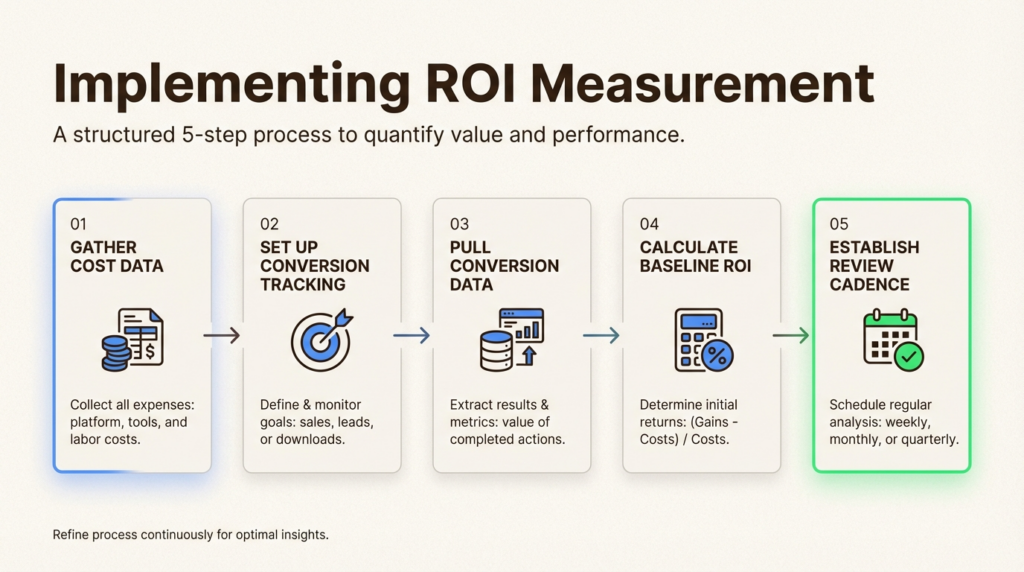
- Gather cost data for the last 12 months (salaries, tools, agency fees, content costs)
- Set up conversion tracking in Google Analytics with assigned dollar values
- Pull conversion data from the Organic Search channel for the same period
- Calculate your baseline ROI using the formula
- Establish a review cadence (quarterly for established campaigns, monthly for new initiatives)
Timeline expectations: Most businesses see negative ROI in months 1-3 as investment exceeds returns. By month 6-9, you should see break-even or positive returns. By month 12-18, well-executed SEO typically delivers 200-500% ROI.
At Decoding, we help businesses build comprehensive measurement frameworks that capture both traditional SEO and emerging AI search visibility. Our AI SEO services include ROI modeling, attribution setup, and ongoing performance tracking. If you’re unsure where your SEO stands, start with a GEO SEO audit to identify quick wins and measurement gaps.
The businesses that master SEO ROI measurement gain a significant competitive advantage. They know exactly which investments drive growth and can justify increased budgets with hard data. In an era of marketing accountability, that’s not optional. It’s essential.
Frequently Asked Questions
What tools do I need to accurately measure SEO ROI for my business?
At minimum, you need Google Analytics 4 for conversion tracking and a spreadsheet for cost tracking. Additional tools like Google Search Console, SEMrush, or Ahrefs help with keyword and traffic analysis, but aren’t required for basic ROI calculation.
How long should I wait before expecting to accurately measure SEO ROI for my business?
Wait at least 6 months before making ROI assessments. SEO is a compounding investment where early months typically show negative returns as you build momentum. Meaningful ROI data usually emerges between months 9-12.
Can I accurately measure SEO ROI for my business if I don’t sell products online?
Yes, but you need to assign dollar values to lead conversions. Calculate your average conversion rate from leads to customers and multiply by average customer value. This gives you a value per lead that makes ROI calculation possible.
Should I include my time in the cost calculation when I accurately measure SEO ROI for my business?
Absolutely. Whether you’re doing SEO yourself or have a team, time spent on SEO has opportunity cost. Track hours spent on SEO tasks and apply an hourly rate (your salary divided by 2,080 annual hours) to get true cost figures.
How do assisted conversions affect how I accurately measure SEO ROI for my business?
Assisted conversions show SEO’s role in multi-touch customer journeys. When calculating ROI, consider counting assisted conversions at 25-50% value in addition to last-click conversions. This prevents undervaluing SEO’s contribution to your sales funnel.
What’s a good SEO ROI benchmark when I accurately measure SEO ROI for my business?
Industry data suggests successful SEO campaigns typically deliver 200-500% ROI annually, meaning every dollar spent returns $2-5 in revenue. HVAC companies specifically see around $30 return per $1 spent. Your benchmark should improve quarter-over-quarter rather than comparing to competitors.








Leave a Reply