


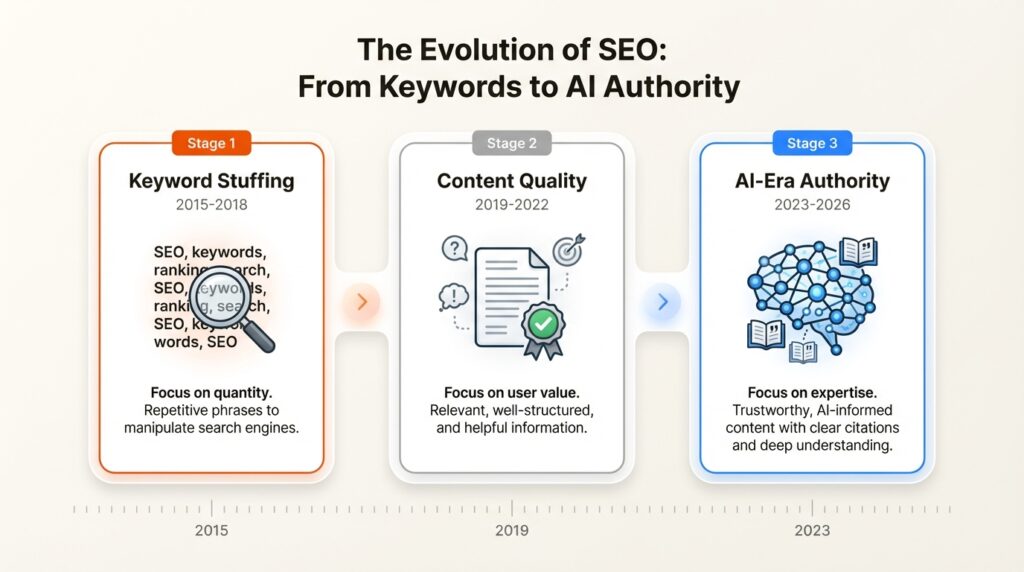
Google’s algorithms have changed. The tricks that worked five years ago (keyword stuffing, thin content, link schemes) do not just fail now. They actively hurt your rankings.
What most businesses miss: the path to ranking well today is not about gaming the system. It is about becoming the kind of source Google actually wants to surface. Authoritative content is not a tactic. It is an outcome of genuine expertise, original thinking, and user-focused execution.
At Decoding, we have spent 16+ years helping businesses navigate these shifts. What we have learned is that authority in 2026 requires a hybrid approach: traditional SEO fundamentals combined with Generative Engine Optimization (GEO) to ensure your content ranks in Google and gets cited by AI systems like ChatGPT and Perplexity.
Let us break down how to build that authority systematically.
What makes content authoritative?
Authoritative content is information that earns trust. Not through claims, but through demonstration.
Think about the last time you read something that genuinely helped you solve a problem. It probably had these qualities:
- It was written by someone who clearly understood the topic deeply
- It answered questions you did not even know you had
- It cited sources you could verify
- It felt like it was created to help you, not to rank for a keyword
Google’s systems are designed to identify and reward exactly this kind of content. The helpful content system specifically targets content created “primarily to attract visits from search engines” and demotes it. Meanwhile, content that demonstrates first-hand expertise and satisfies user intent gets promoted.
The shift is fundamental. Search engines used to match keywords to documents. Now they evaluate credibility signals, cross-reference claims against trusted sources, and prioritize content that demonstrates real-world knowledge.
This is where our GEO services become critical. We help businesses optimize not just for traditional search rankings, but for AI citation across LLMs.
The E-E-A-T foundation
Google’s quality raters evaluate content using the E-E-A-T framework: Experience, Expertise, Authoritativeness, and Trustworthiness. Understanding each element is essential for creating content that ranks.
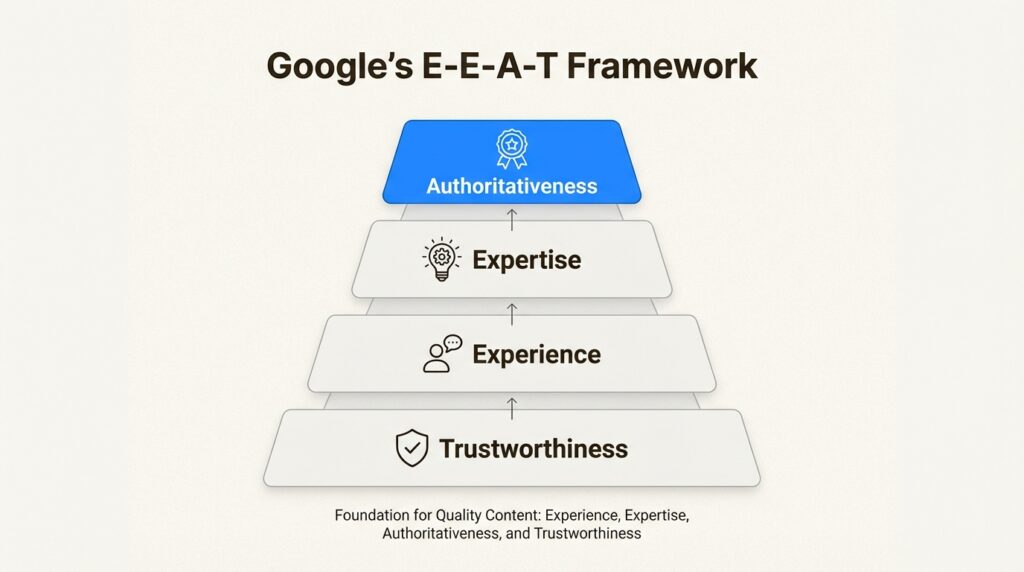
Experience means first-hand knowledge. Did the author actually use the product? Visit the location? Solve the problem they are writing about? Google added this element in December 2022 specifically because AI-generated content can simulate expertise without having real experience.
Expertise is demonstrated depth of knowledge. It is not about credentials alone (though those help). It is about showing you understand nuances, edge cases, and the “why” behind recommendations. Expertise answers the follow-up questions readers have not asked yet.
Authoritativeness is recognition by others. Backlinks from trusted sources, citations in industry publications, and mentions from established experts all signal that your content is worth referencing. The #1 result on Google has, on average, 3.8 times more backlinks than positions 2 through 10, according to Backlinko research.
Trustworthiness is the foundation. Without it, the other elements do not matter. Trust comes from accuracy, transparency about limitations, clear sourcing, and honest presentation of information.
For topics that could impact someone’s health, financial stability, or safety (what Google calls YMYL topics), E-E-A-T requirements are even stricter. Medical advice needs medical credentials. Financial guidance needs financial expertise. Learn more about YMYL in Google’s quality rater guidelines.
Our approach to content strategy starts with auditing your current content against these E-E-A-T signals to identify gaps and opportunities.
Building your authority framework
Creating authoritative content is not about following a checklist. It is about building systems that consistently produce credible, valuable information. Here is the framework we use with clients.
Start with subject matter expertise
Your biggest SEO advantage is not a tool or tactic. It is the expertise already inside your organization.
Subject matter experts (SMEs) have insights that AI cannot replicate: real-world experience, proprietary knowledge, and the ability to identify what actually works versus what theoretically should work. The challenge is extracting that expertise efficiently.
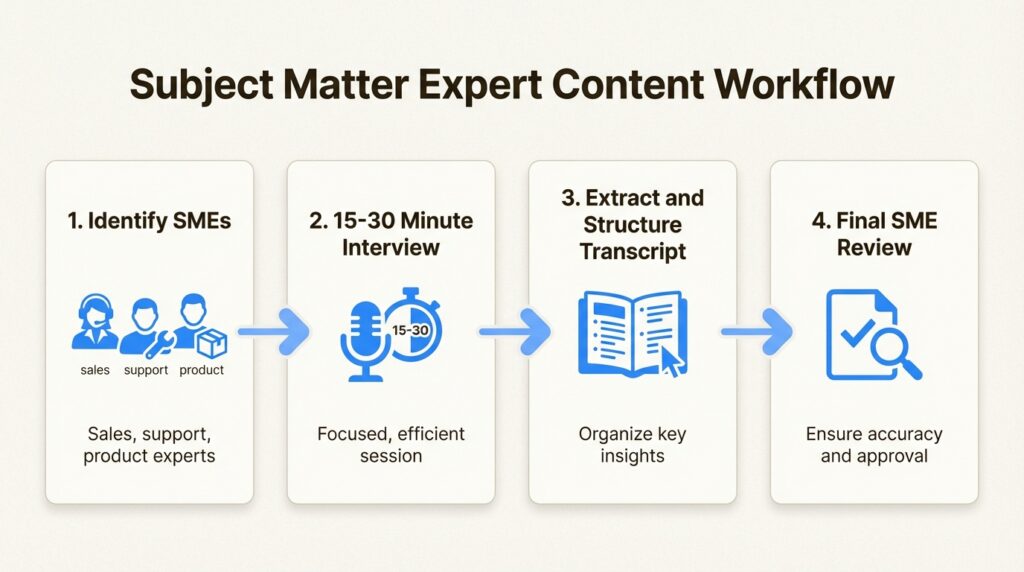
Here is the process that works:
- Identify your SMEs broadly. They are not just executives. Customer support leads hear objections daily. Salespeople understand buyer psychology. Product managers have competitive intelligence. Even customers with implementation experience can provide valuable perspectives.
- Create an input layer. Do not expect SMEs to write full blog posts. Instead, conduct focused 15-30 minute interviews. Ask questions like “What do most people get wrong about this?” or “What have you learned that contradicts conventional wisdom?”
- Extract and structure. Use the interview transcripts to identify key ideas, quotes, and product tie-ins. Let your editorial team shape this into publishable content without losing the expert’s voice.
- Give SMEs final say, not first draft ownership. This avoids endless rewrites while keeping content credible.
Position SME collaboration as personal brand building, not just marketing help. Experts who build their public profile are more engaged and produce better content.
We help clients implement this exact SME-driven content process as part of our SEO services.
Create original value
Seventy percent of online content gets zero backlinks, according to Backlinko. The reason is obvious: it is generic. Consensus content that summarizes what everyone already knows has no reason to be cited.
Original value comes from:
- First-party data. Surveys of your audience, anonymized usage patterns, or internal benchmarks become proprietary insights no one else can offer.
- Original research. Even small-scale studies with proper methodology earn citations. A survey of 100 customers about their challenges is more valuable than speculation about what customers might think.
- Proprietary frameworks. Turn your SME insights into repeatable methodologies. Frameworks give readers something concrete to apply and reference.
- Information gain. Ask yourself: what does my audience know after reading this that they did not know before? If the answer is “nothing new,” keep working.
This is particularly important for getting cited by LLMs. AI systems prioritize sources that add unique value to the information ecosystem, as research from Arion Research confirms.
Structure for both humans and AI
The best content serves two audiences: human readers who scan and skim, and AI systems that parse and evaluate.
For humans:
- Use clear H2 and H3 headings that guide readers through your argument
- Keep paragraphs short (3-4 sentences maximum)
- Lead with the most important information
- Use bullet points for lists, numbered lists for sequences
- Include visuals to break up text and illustrate concepts
Nielsen Norman Group research found that users read at most 28% of the words on a web page. They scan for information. Format accordingly.
For AI systems:
- Use descriptive headings that include key concepts (AI parses these for topic understanding)
- Include structured data markup where appropriate
- Create topic clusters that demonstrate breadth and depth of coverage
- Use tables for comparative information
- Write clear topic sentences that summarize each paragraph’s main point
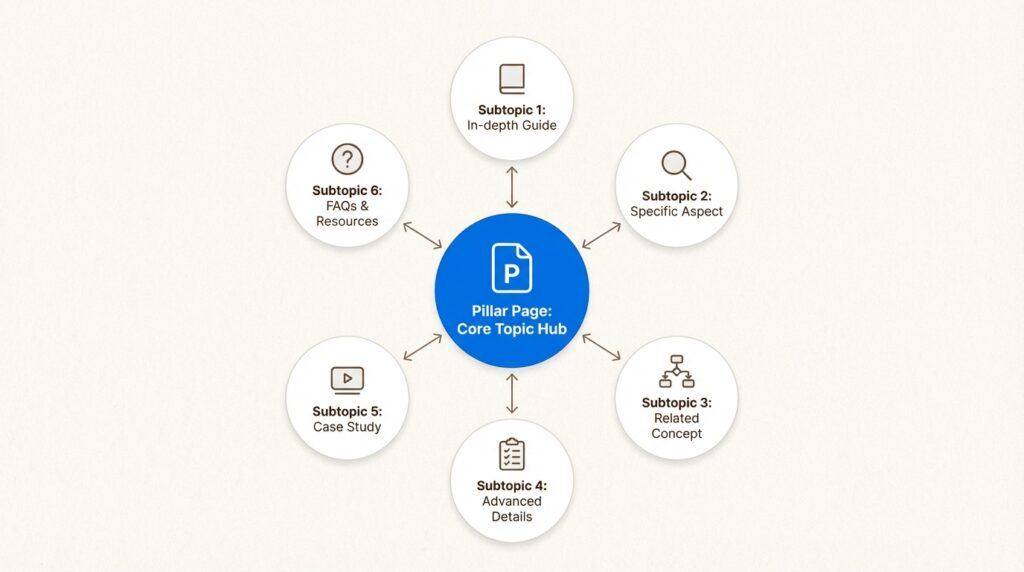
Topic clusters are particularly effective. Create one central “pillar” page for a broad topic, then link to detailed “cluster” pages on specific subtopics. This structure demonstrates both comprehensive knowledge and organizational clarity.
Our technical SEO services include implementing the schema markup and site architecture that help AI systems understand and cite your content.
The GEO dimension: authority for AI search
Traditional SEO optimizes for ranking in search results. Generative Engine Optimization (GEO) optimizes for citation in AI-generated responses.
The difference matters. When someone asks ChatGPT or Perplexity a question, these systems synthesize information from multiple sources to create comprehensive answers. GEO ensures your content becomes part of those synthesized responses.
Here is how AI systems evaluate authority differently:
- Citation over ranking. Success means being referenced as a source, not necessarily appearing first in traditional results.
- Context over keywords. AI understands semantic meaning, making contextual relevance more important than keyword density.
- Authority over optimization tricks. AI models evaluate credibility signals that cannot be gamed through technical tactics.
- Comprehensive answers over clicks. Content must provide complete, accurate information rather than teasing users to click through.
The implications are significant. First-person experience, original research, and clear expertise signals matter more than ever. Generic summaries get bypassed for sources offering deeper analysis.
This is why we take a hybrid SEO + GEO approach with all our clients. The strategies that build traditional authority increasingly overlap with what AI systems prioritize, as documented in our comprehensive GEO guide.
Measuring your authority progress
Building authority is a long-term investment. But you can track progress with the right metrics.
Traditional indicators:
- Organic rankings for target keywords
- Organic traffic growth over time
- Backlink profile growth and quality
- Time on page and engagement metrics
- Brand mention volume across the web
Emerging indicators for the AI era:
- AI citations. Manually test queries in ChatGPT, Claude, and Perplexity to see if your content is referenced.
- LLM brand mentions. Track when your brand appears in AI-generated responses.
- Direct traffic growth. As users discover you through AI recommendations, direct visits increase.
- Referral traffic from AI platforms. Some AI tools now link directly to sources.
HubSpot famously used “historical optimization” (updating old content with fresh information) to more than double their organic traffic in one year, as documented in their case study. This illustrates an important principle: authority compounds when you maintain and improve existing content, not just publish new pieces.
Our AI Brand Visibility Tracker helps clients monitor how often their brand appears across LLMs and AI search engines, giving you concrete data on your GEO performance.
Start building authoritative content today
The framework is clear: demonstrate expertise through SME collaboration, create original value that earns citations, structure content for both humans and AI, and measure progress across traditional and emerging metrics.
But knowing the framework and implementing it are different challenges. Most businesses struggle with:
- Extracting expertise from busy SMEs efficiently
- Creating original research with limited resources
- Balancing SEO requirements with genuine helpfulness
- Tracking the right metrics to prove ROI
This is where we can help. At Decoding, we specialize in helping SMBs and agencies build authoritative content systems that work in both traditional Google search and emerging AI search environments. We do not do 50-page reports that sit on shelves. We build actionable roadmaps and help you execute them.
Our pricing starts at $3,000/month for one-time strategy projects, with ongoing partnership tiers for businesses ready to commit to long-term authority building.
The shift from keyword-focused SEO to credibility-first content is not temporary. As AI systems become primary information gateways, authority will only matter more. The businesses that invest in genuine expertise today will become the sources AI systems cite tomorrow.
Frequently Asked Questions
What is the first step in learning how to create authoritative content for Google?
Start by auditing your existing content against Google’s E-E-A-T criteria. Identify which pieces demonstrate real expertise and which are generic. Then prioritize updating or replacing the thin content before creating new material.
How long does it take to see results when you create authoritative content for Google?
Authority building is a long-term strategy. Most businesses see meaningful ranking improvements within 6-12 months of consistent, high-quality content publication. However, AI citation through GEO can happen faster if your content answers specific questions comprehensively.
Can small businesses create authoritative content for Google without enterprise budgets?
Absolutely. Authority comes from expertise and originality, not budget size. A small business with deep industry knowledge can outrank larger competitors by leveraging SME insights, conducting original surveys, and creating proprietary frameworks that larger companies are too slow to produce.
Does creating authoritative content for Google require hiring subject matter experts full-time?
No. Most businesses already have SMEs internally (salespeople, support staff, product managers). The challenge is extracting their knowledge efficiently through interviews and structured processes, not hiring new people.
How is creating authoritative content for Google different in the AI era?
AI systems evaluate authority through different signals than traditional search. First-person experience, comprehensive coverage, and clear expertise demonstration matter more than keyword optimization. Content that gets cited by LLMs often differs from content that ranks traditionally, which is why a hybrid SEO + GEO approach is essential.
What role does technical SEO play when you create authoritative content for Google?
Technical SEO is the foundation that lets your authority shine. Schema markup helps Google understand your expertise signals. Site speed and mobile-friendliness affect user experience signals. Topic clusters and internal linking demonstrate comprehensive coverage. Without technical fundamentals, even the best content struggles to rank.
How do you balance creating authoritative content for Google with creating content for AI systems?
The good news is that the strategies increasingly overlap. Both prioritize expertise, originality, and comprehensiveness. The key differences are structural: AI systems benefit from clear semantic organization, FAQ sections, and natural language patterns. A well-structured authoritative piece serves both audiences.







Leave a Reply