


Picture this: it’s the middle of July, 95 degrees outside, and a homeowner’s air conditioner just died. They pull out their phone and search “emergency AC repair near me.” The companies at the top of those search results are about to get the call. The ones on page two? They might as well not exist.
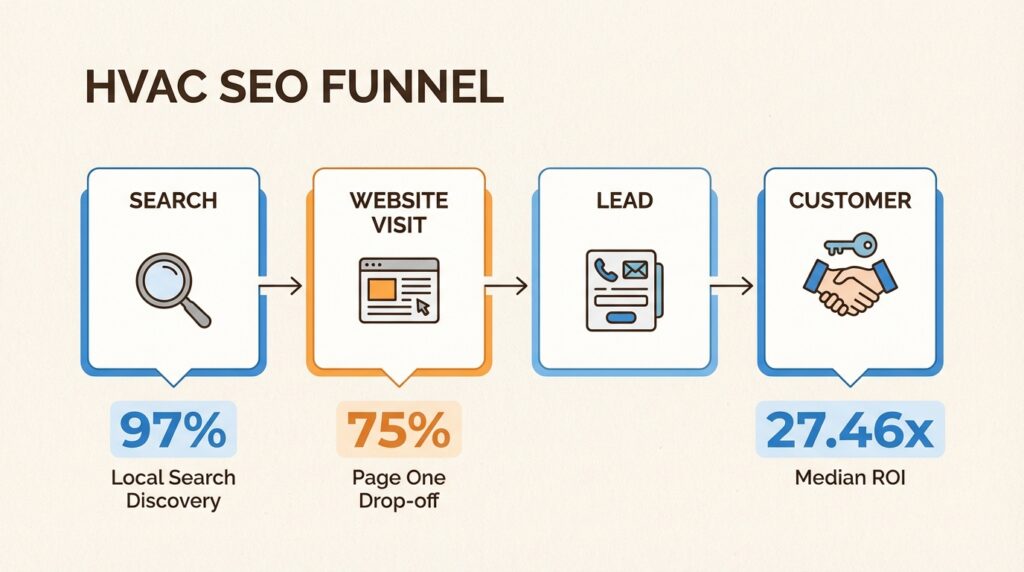
This is the reality of running an HVAC business in 2026. 97% of people learn about local companies online more than anywhere else, and 75% never click “next” to see the second page of search results. If your HVAC company isn’t showing up when potential customers search, you’re handing those jobs directly to your competitors.
The good news? SEO for HVAC companies isn’t rocket science. It’s a set of proven tactics that, when executed consistently, can transform your business from invisible to dominant in your local market. At Decoding, we’ve spent 16 years helping contractors do exactly that. Let’s break down what actually works.
Why SEO matters for HVAC companies
Let’s talk numbers. The median HVAC SEO ROI in 2025 was 27.46x, meaning every dollar spent on SEO returned $27.46 in revenue. Top performers saw ROI as high as 60x. Compare that to the industry average cost per lead of $75-$153 for traditional marketing, while SEO-driven leads cost $15-$40 on average.
But the real advantage isn’t just cost. It’s intent. Someone searching “furnace repair Denver” isn’t browsing. They’re ready to buy. That’s why 60% of HVAC contractors say SEO and blog content are their top source for high-quality leads. These aren’t tire-kickers. They’re homeowners with broken systems and open wallets.
The cost of invisibility is real. Every day you’re not on page one, you’re losing jobs to competitors who are. And in the HVAC business, where a single installation can be worth $10,000 or more, those losses add up fast.
The foundation: Local SEO for HVAC contractors
If you only do one thing for your SEO, make it local optimization. 77% of HVAC companies generate leads through their Google Business Profile. This is your digital storefront, and it needs to be polished.
Google Business Profile optimization
Your Google Business Profile (GBP) is often the first thing potential customers see. Here’s how to optimize it:
Claim and verify immediately. An unverified profile has zero authority. Use your exact business name as it appears on your trucks and signage.
Choose the right categories. Your primary category should be “HVAC Contractor.” Add secondary categories like “Air Conditioning Repair Service,” “Heating Contractor,” and “Furnace Repair Service.” Each relevant category expands the queries that trigger your profile.
Fill out every field. Include accurate hours, a local phone number (not toll-free), your service area by zip code, and a compelling description. Upload at least 100 high-quality photos: your team, your trucks, completed jobs, before-and-after shots. In 2026, Google prioritizes vertical videos over photos, so post short videos showing your technicians at work.
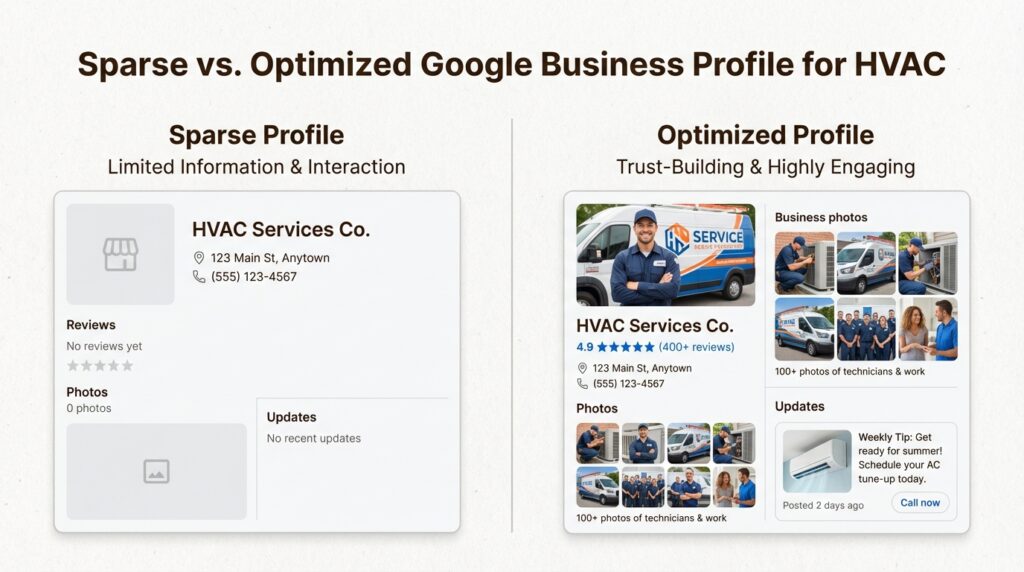
Post weekly updates. Google Posts expire after 7 days, so consistency matters. Tie your posts to seasonal demand: pre-summer tune-up specials, emergency repair availability, furnace safety inspections. This signals an active, responsive business.
Generate reviews systematically. Aim for 400+ total reviews with a 4.7+ star average and 15-20 fresh reviews monthly. Build a repeatable system: automated texts after service completion, QR codes on invoices, technician incentives. Respond to every review within 24 hours, both positive and negative.
Local citations and directory listings
Your NAP (Name, Address, Phone) must be identical everywhere it appears online. Even small differences like “Street” versus “St.” can hurt your rankings. List your business on:
- Yelp
- Angi
- Better Business Bureau
- Nextdoor
- Bing Places
- Your local chamber of commerce
Location-specific landing pages
Create a dedicated page for each city or region you serve. Each page needs unique content reflecting local services and keywords. Don’t just swap out the city name and call it done. Google penalizes duplicate content, and more importantly, generic pages don’t convert. Include local landmarks, specific neighborhoods you serve, and locally-relevant service details.
On-page SEO strategies that drive leads
Once your local foundation is solid, it’s time to optimize your website itself.
Keyword research for HVAC
Not all keywords are created equal. Focus on transactional keywords that signal buying intent: “furnace repair cost,” “AC installation quote,” “emergency HVAC service.” These drive customers ready to book.
Long-tail keywords (longer, more specific phrases) often convert better than broad terms. “Emergency furnace repair in Austin” will convert higher than just “furnace repair” because it captures someone with an immediate, location-specific need.
Free tools like Google Keyword Planner can get you started. For more advanced research, SEMrush and Ahrefs show competitor keywords and search volumes.
Service page optimization
Google ranks web pages, not websites. You need dedicated pages for each core service: AC repair, furnace installation, heat pump service, duct cleaning, air quality solutions. Each page should target specific keywords and include:
- A clear, keyword-rich title tag (under 60 characters)
- A compelling meta description (150-160 characters)
- Proper header structure (H1 for the main title, H2s for sections, H3s for subsections)
- Location-specific content
- Clear calls to action (phone number, contact form, “Book Now” buttons)
Content marketing for HVAC
Blog content builds authority and captures long-tail traffic. Write about what your customers actually ask: “How often should I change my AC filter?” “Why is my furnace making that noise?” “What’s the difference between a heat pump and a furnace?”
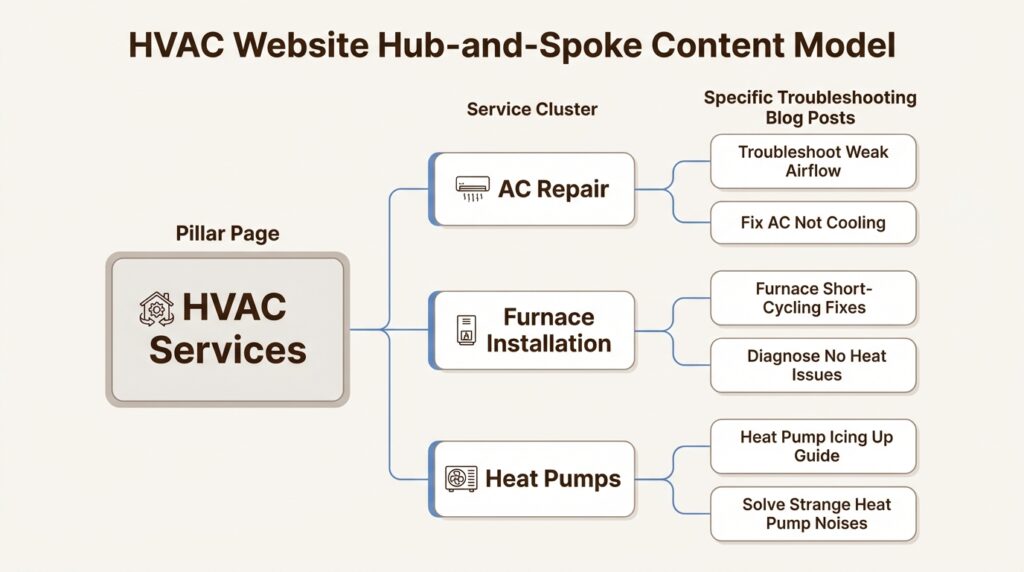
Content built around real service issues achieves 20-35% higher organic conversion rates than generic blog posts. Use a service cluster architecture: create comprehensive “pillar” pages for major services, then link to related “cluster” content. This hub-and-spoke approach delivers 25-45% higher organic visibility.
Video content matters too. YouTube is the second-largest search engine. Post maintenance tips, troubleshooting guides, and customer testimonials. Optimize video titles and descriptions with HVAC keywords.
Technical SEO essentials
You can have great content, but if your site is slow or broken, Google won’t rank it.
Page speed optimization
53% of mobile users abandon sites that take over 3 seconds to load. Use Google PageSpeed Insights to check your score. Quick wins include:
- Compressing images (use WebP format when possible)
- Enabling browser caching
- Using a content delivery network (CDN)
- Minimizing JavaScript and CSS files
Mobile optimization
Over 60% of Google searches happen on mobile devices. Your site must be fully responsive, with click-to-call phone numbers and easy-to-tap buttons. Test your site on actual phones, not just desktop browsers.
Website security and structure
- Use HTTPS (SSL certificate), as it’s a ranking factor and builds trust
- Submit an XML sitemap to Google Search Console
- Use robots.txt to guide search engine crawlers
- Implement LocalBusiness schema markup so Google understands your business type, hours, and services
Building authority through off-page SEO
What happens off your website matters just as much as what happens on it.
Review generation and management
87% of consumers read online reviews for local businesses. Reviews are a major ranking factor for the local map pack. Build a systematic approach:
- Request reviews immediately after service completion when satisfaction is highest
- Make it easy: send direct links via text message
- Respond to every review personally
- Address negative reviews professionally and constructively
Link building for HVAC companies
Quality backlinks signal authority to Google. Focus on local relevance:
- Join your local chamber of commerce (usually includes a directory link)
- Sponsor local events or youth sports teams
- Partner with complementary businesses (plumbers, electricians, home inspectors)
- Guest post on local home improvement blogs
- Get listed on manufacturer “find a dealer” pages
Avoid buying links or participating in link exchanges. Google’s algorithm is sophisticated enough to detect manipulation, and penalties can tank your rankings.
Social media presence
While social signals aren’t direct ranking factors, they increase brand awareness and drive traffic. Facebook and Instagram work well for HVAC. Share before-and-after photos, maintenance tips, and community involvement. Engage with local groups and respond to comments promptly.
The future: Optimizing for AI search
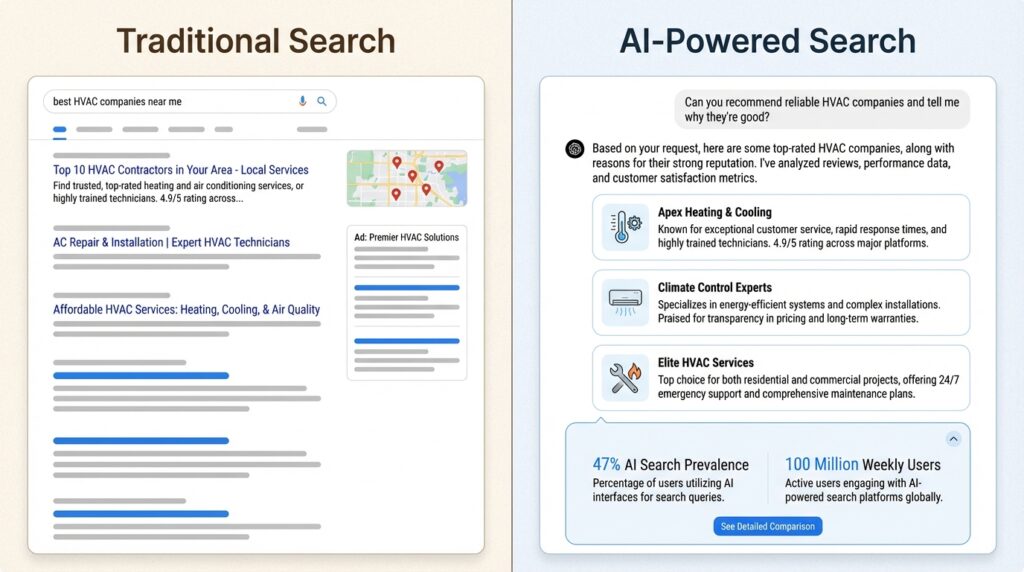
Here’s where most of your competitors are behind the curve. Traditional SEO gets you into Google’s search results. But a growing number of potential customers are skipping Google entirely and asking AI tools like ChatGPT, Perplexity, and Google AI Overviews for recommendations.
What is AI search optimization (GEO/AEO)?
Generative Engine Optimization (GEO) is about getting your business recommended directly by AI. The shift is significant:
- Old way: Customer searches “AC repair near me” → sees 10 results → clicks and compares
- New way: Customer asks ChatGPT “who’s the best HVAC company in my area?” → AI recommends 2-3 businesses → customer calls the top recommendation
47% of searches now feature Google AI Overviews, and over 100 million people use ChatGPT weekly. This isn’t the future. It’s happening now.
How to appear in AI search results
Strengthen your digital footprint. AI tools cross-reference multiple sources. Ensure your business information is consistent across your website, Google Business Profile, Yelp, Angi, BBB, and manufacturer directories.
Publish authority-building content. Create comprehensive guides, FAQ pages, and case studies. Use a Q&A format and conversational tone. Target voice queries like “How much does AC repair cost in [city]?” or “Who fixes furnaces on weekends near me?”
Implement structured data. Pages with valid FAQ schema are 36% more likely to appear in AI summaries. Use LocalBusiness schema, Service schema, and FAQ schema with concise 40-60 word answers.
Ensure AI crawlability. Some CDNs block AI bots by default. Make sure your site isn’t inadvertently blocking ChatGPT, Perplexity, or other AI crawlers.
Tracking AI visibility
Monitor whether your brand appears when people ask AI tools about HVAC services in your area. Tools like our AI Visibility Platform can track how often you’re mentioned in AI responses compared to your competitors. This is becoming as important as tracking your Google rankings.
Measuring SEO success for HVAC
You can’t improve what you don’t measure. Here’s what to track:
Key metrics to track
- Local pack rankings: Where do you appear in the map results for target keywords?
- Organic traffic growth: Month-over-month increases in website visitors
- Phone calls and form submissions: Actual leads generated, not just traffic
- Cost per lead: Compare SEO leads to paid advertising
- Conversion rates: SEO leads convert at 2.1-2.6% on average, with phone calls converting at 18-35%+
Tools for tracking
- Google Analytics 4 for traffic and user behavior
- Google Search Console for rankings and click-through rates
- Call tracking solutions like CallRail to attribute phone calls to specific marketing channels
Setting realistic expectations
SEO isn’t instant. Most HVAC companies see initial movement in 90-120 days, with dominant market positioning achievable in 6-12 months of consistent effort. The trade-off? Unlike paid ads that stop working the moment you stop paying, SEO compounds over time. The work you do today continues generating returns months and years from now.
Common HVAC SEO mistakes to avoid
Learn from others’ failures:
- Keyword stuffing: Forcing keywords unnaturally into content hurts rankings and readability
- Duplicate content: Copying manufacturer descriptions or duplicating location pages triggers penalties
- Ignoring mobile users: A site that looks great on desktop but breaks on mobile is losing you customers
- Neglecting Google Business Profile: An incomplete or unverified GBP is invisible to local searchers
- Inconsistent NAP information: Variations in your business name, address, or phone number confuse search engines
- Buying backlinks: Low-quality link schemes result in penalties that can take months to recover from
- Expecting overnight results: SEO requires patience. Anyone promising instant rankings is selling snake oil.
Getting started with HVAC SEO today
You don’t need to do everything at once. Here’s your priority order:
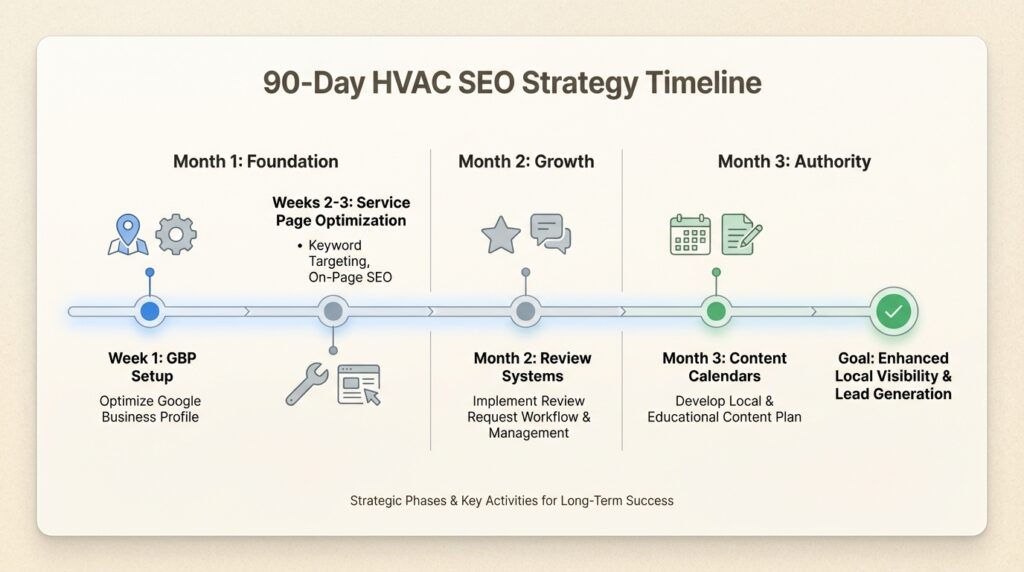
Week 1: Claim and fully optimize your Google Business Profile. Fix any NAP inconsistencies across directories.
Week 2-3: Optimize your top three service pages with proper titles, headers, and local keywords.
Month 2: Implement a review generation system. Start posting weekly Google Posts.
Month 3: Launch a content calendar. Publish one blog post per week answering common customer questions.
Ongoing: Build local citations, earn quality backlinks, and monitor your metrics.
When to DIY vs. hire an agency
If you have the time and technical aptitude, you can handle basic local SEO yourself. But most HVAC contractors are already working 60+ hour weeks running their business. That’s where we come in.
At Decoding, we specialize in helping HVAC companies dominate local search. We don’t do cookie-cutter strategies. We learn your business, analyze your market, and build a custom SEO roadmap focused on one thing: generating qualified leads that turn into revenue.
Our approach combines traditional SEO with cutting-edge AI search optimization (GEO/AEO), so you’re visible everywhere your customers are searching, including ChatGPT and Google AI Overviews.
Ready to stop losing jobs to competitors? Schedule a free SEO audit and let’s see where you stand.
Frequently Asked Questions
How long does SEO for HVAC companies take to show results?
Most HVAC companies see initial ranking improvements in 90-120 days, with significant lead generation improvements in 3-6 months. Dominant market positioning typically takes 6-12 months of consistent optimization.
What is the average cost of SEO for HVAC contractors?
Average monthly SEO investment ranges from $1,500 to $5,000 depending on market competitiveness and scope. The median ROI is 27.46x, meaning every dollar spent returns $27.46 in revenue.
Can I do SEO for my HVAC business myself?
Basic local SEO tasks like Google Business Profile optimization can be handled in-house if you have the time. However, technical SEO, content strategy, and link building often require specialized expertise that busy contractors don’t have time to develop.
How is AI search optimization different from traditional SEO for HVAC?
Traditional SEO focuses on ranking in Google’s search results. AI search optimization (GEO) focuses on getting your business recommended directly by AI tools like ChatGPT and Google AI Overviews. This requires structured data, comprehensive content, and consistent digital footprints across multiple platforms.
What are the most important ranking factors for HVAC local SEO?
The top factors are: (1) Google Business Profile optimization and activity, (2) review quantity and quality, (3) NAP consistency across citations, (4) website relevance and authority, and (5) proximity to the searcher.
How do I track if my SEO for HVAC is working?
Track local pack rankings for target keywords, organic traffic growth in Google Analytics, phone calls and form submissions (actual leads), and cost per lead compared to paid advertising. Phone call tracking is especially important for HVAC since most customers prefer to call rather than fill out forms.










Leave a Reply to Joe Cancel reply