

The way people find information is changing fast. Instead of typing keywords into Google and clicking through blue links, more users are asking ChatGPT, Perplexity, and Google AI Overviews for direct answers. Gartner predicts a 50% decline in organic traffic by 2028. Meanwhile, 80% of consumers now resolve 40% of their online queries without clicking any links at all.
This shift means your brand needs to be visible where the answers are being generated. Not just on search results pages, but inside AI responses themselves. Here’s how to track your AI brand visibility and what to do with the data once you have it.
Why AI brand visibility matters now
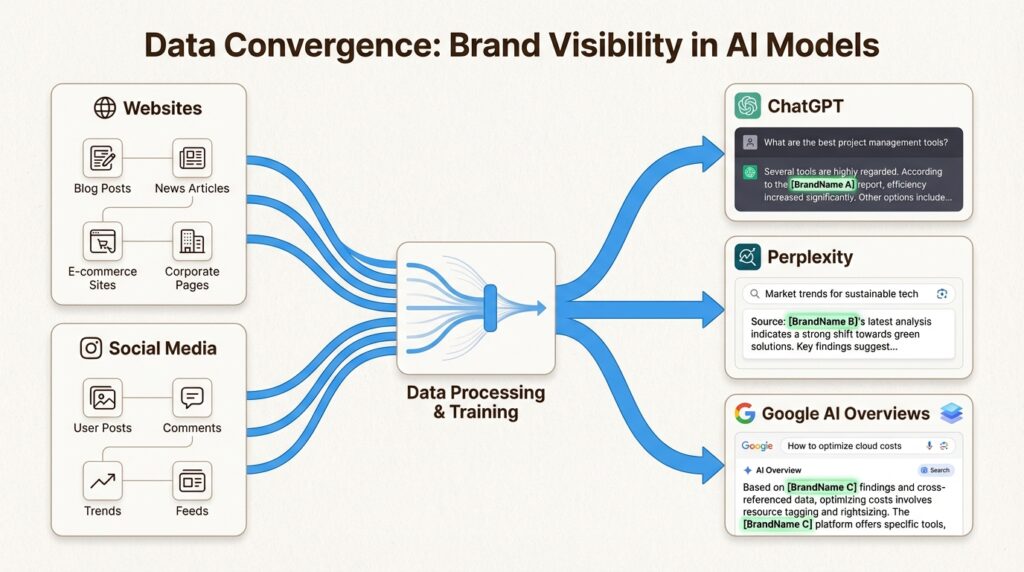
Traditional SEO focused on ranking #1 in Google. That still matters, but it’s no longer enough. When someone asks ChatGPT “what’s the best CRM for startups,” they get a direct answer with brand recommendations. If your brand isn’t in that answer, you’ve lost a high-intent prospect before they ever visited a search engine.
AI brand visibility is about understanding:
- Whether AI systems mention your brand in relevant conversations
- How often you appear compared to competitors
- What sentiment surrounds your mentions (positive, neutral, or negative)
- Which sources AI systems cite when discussing your industry
The businesses that figure this out now will gain an edge. The ones that wait risk becoming invisible to an entire generation of AI-assisted buyers.
For more context on how AI is reshaping search, see our SEO statistics for AI search.
What you’ll need to get started
Before diving into tracking, gather these basics:
- Access to AI platforms: Free accounts work fine for ChatGPT, Perplexity, Claude, and Gemini
- A list of target prompts: The questions your prospects actually ask (start with 10-20)
- Competitor list: 3-5 key competitors to benchmark against
- Tracking method: A spreadsheet for manual tracking, or budget for automated tools
- Time commitment: 2-3 hours for initial setup, then 30-60 minutes weekly for monitoring
The good news? You can start tracking AI brand visibility for free. The manual method takes more time but costs nothing. As your needs grow, specialized tools can automate the heavy lifting.
How to track AI brand visibility manually
Manual tracking gives you direct insight into how AI systems present information. It’s time-intensive but valuable for understanding the landscape before investing in tools.
Step 1: Identify your target prompts
Start by brainstorming the questions your prospects actually ask. Think across the entire funnel:
- Awareness: “What is [category]?” “How does [solution] work?”
- Consideration: “Best [category] for [use case]” “[Your brand] vs [competitor]”
- Decision: “[Your brand] pricing” “[Your brand] reviews”
Aim for 10-20 high-value prompts to start. You can always expand later. The key is choosing questions that mirror real user intent.
Need inspiration? Check out our AI search prompt templates for industry-specific examples.
Step 2: Run searches across AI platforms
For each prompt, check multiple AI platforms:
- ChatGPT: The most widely used conversational AI
- Perplexity: Cites sources explicitly, making tracking easier
- Google AI Overviews: Appears directly in Google search results
- Gemini: Google’s conversational AI with web search integration
- Claude: Anthropic’s AI assistant, popular for detailed responses
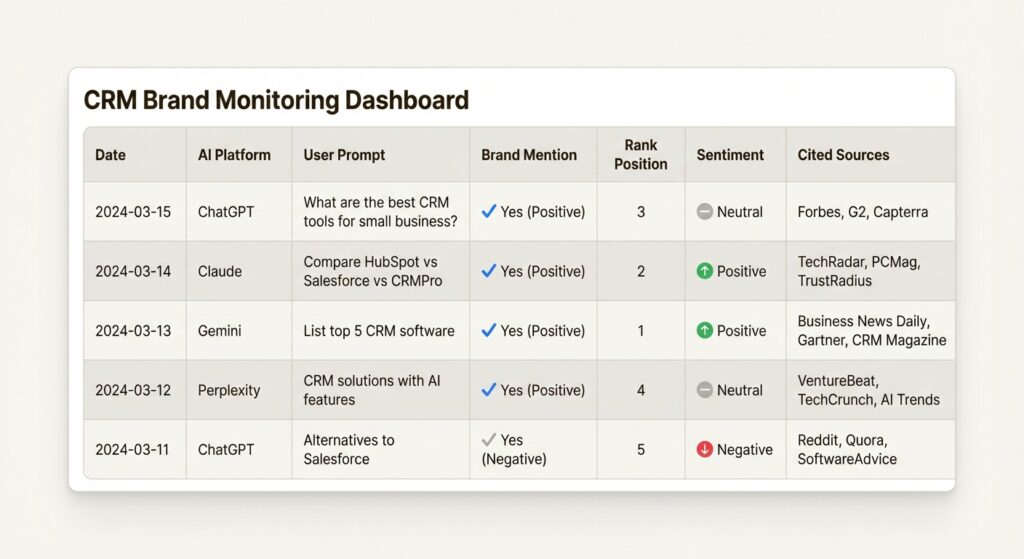
Document the date, platform, and full response for each query. Save screenshots or copy the text verbatim. Consistency matters here. Run the same prompts weekly or monthly to track changes over time.
Step 3: Record brand mentions and citations
For each response, track:
- Mention: Was your brand named? (Yes/No)
- Position: Where did you appear? (1st, 2nd, 3rd recommendation, etc.)
- Sentiment: Was the mention positive, neutral, or negative?
- Competitor mentions: Which competitors appeared and in what position?
- Sources cited: Which websites did the AI reference?
Create a simple spreadsheet with columns for Date, Platform, Prompt, Your Brand Mentioned, Position, Sentiment, Competitors Mentioned, and Sources Cited. This becomes your baseline dataset.
Step 4: Analyze source citations
AI systems don’t generate answers from thin air. They pull from specific sources across the web. Understanding which sources AI trusts in your industry is crucial.
Common source categories include:
- Editorial sites: Major publications, industry blogs
- Review platforms: G2, Capterra, Trustpilot
- UGC platforms: Reddit, Quora, YouTube
- Reference sites: Wikipedia, knowledge bases
- Official sources: Company websites, documentation
Track which domains appear most frequently as citations. These are the sites you want to either optimize your presence on or pursue coverage from.
For strategies on getting cited by AI systems, read our guide on how to get cited by LLMs.
Step 5: Monitor trends over time
Set a regular cadence for checking your prompts. Weekly is ideal for active campaigns, monthly works for baseline monitoring. Over time, you’ll spot patterns:
- Which prompts consistently mention your brand?
- Where are you losing ground to competitors?
- Do mentions spike after specific marketing activities?
- Which platforms favor your brand most?
Calculate your visibility percentage: mentions divided by total queries run. Track this metric over time to measure progress.
AI visibility tracking tools comparison
Manual tracking works for small-scale monitoring, but it doesn’t scale. If you’re tracking dozens of prompts across multiple platforms, you’ll want dedicated tools. Here’s how the major players compare.
Decoding
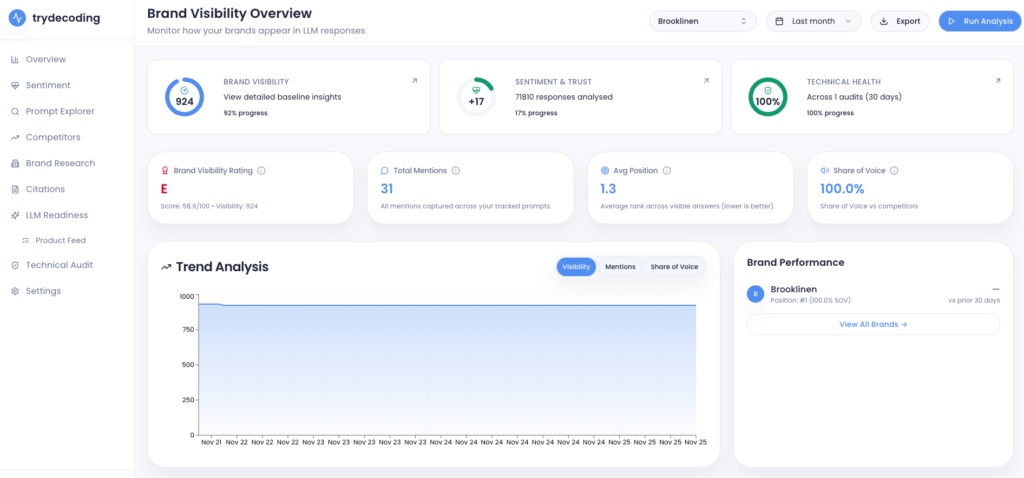
Decoding is a ChatGPT visibility tracker built specifically for SEOs, marketers, and business owners who need to understand how their brand appears in AI search. Unlike enterprise-focused platforms, Decoding is designed for small and mid-size teams that want actionable insights without the enterprise price tag.
Platforms tracked: ChatGPT (with plans to expand to Google Gemini, AI Overviews, AI Mode, and Perplexity)
Key features:
- Track up to 50 custom prompts targeting strategic questions for your brand
- Monitor brand mentions, citations, and competitor appearances at the prompt level
- Visibility score (0-100) combining citation rate, position, and sentiment
- Explicit and implicit citation tracking
- Automated prompt generation using Jobs-to-Be-Done methodology
- Actionable checklist to improve LLM visibility
- Competitor benchmarking and gap analysis
Pricing:
| Plan | Key Features |
|---|---|
| Free Trial | 7-day free trial with full access |
| Paid Plans | Flexible plans based on prompt volume |
Decoding offers a 7-day free trial with no heavy investment required, making it accessible for teams who want to test AI visibility tracking before committing. Setup takes under 3 minutes with no code required.
What makes Decoding different:
- Built by AI search specialists with experience since 2008
- Focused on small and mid-size teams, not just enterprise
- Transparent, data-driven metrics rather than vanity scores
- Actionable recommendations beyond just reporting
- Multi-platform coverage roadmap (ChatGPT today, more LLMs coming)
Otterly.AI
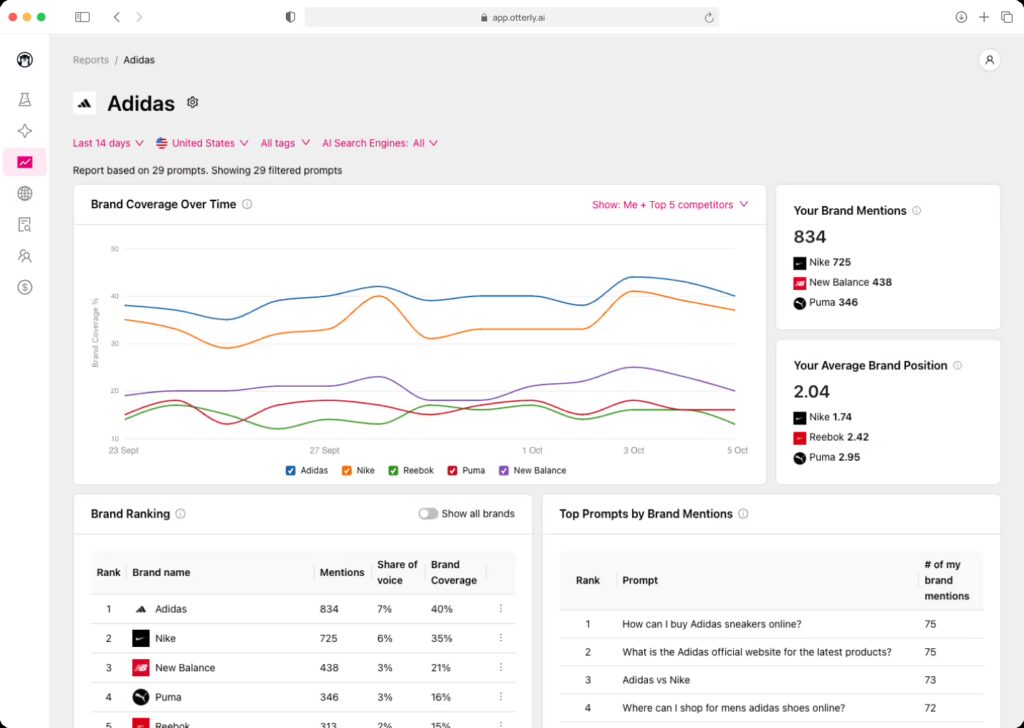
Otterly.AI positions itself as the most accessible comprehensive AI search monitoring tool. Starting at $29 per month, it’s the most affordable option for SMBs and agencies.
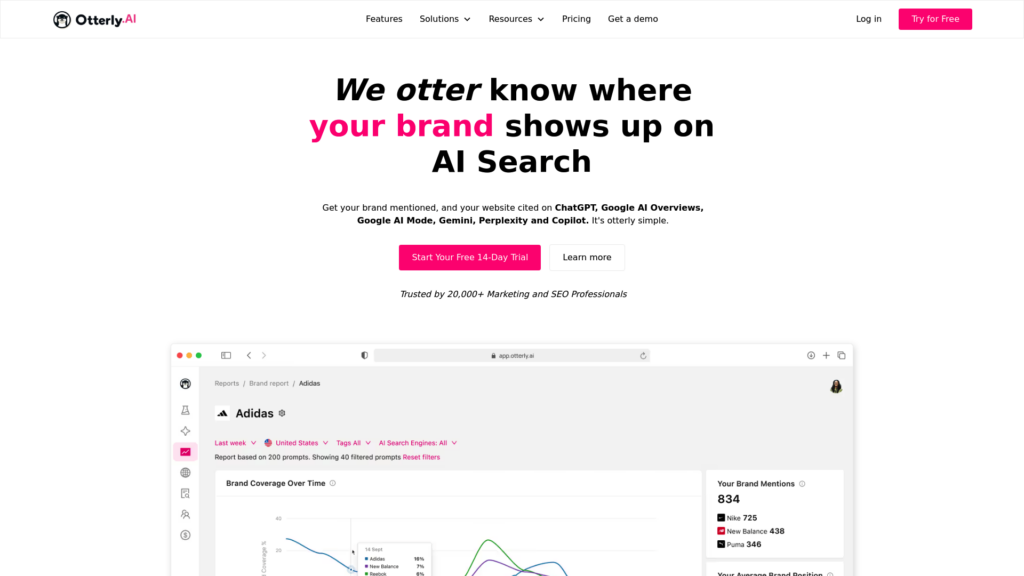
Platforms tracked: ChatGPT, Google AI Overviews, Perplexity, Microsoft Copilot (with Google AI Mode and Gemini available as add-ons)
Key features:
- AI Prompt Research Tool to discover relevant search prompts
- Daily automated monitoring across all platforms
- Brand Visibility Index to track industry presence
- GEO Audit with SWOT analysis
- Domain ranking and citation tracking
- Google Looker Studio connector
- Multi-country support (50+ countries)
Pricing:
| Plan | Monthly Price | Annual Price | Prompts | GEO Audits |
|---|---|---|---|---|
| Lite | $29 | $25 | 15 | 1,000/month |
| Standard | $189 | $160 | 100 | 5,000/month |
| Premium | $489 | $422 | 400 | 10,000/month |
All plans include unlimited brand reports, unlimited team members, daily tracking, and multi-country support. A 14-day free trial is available.
Otterly.AI was named a Gartner Cool Vendor in 2025 and is used by 20,000+ marketing professionals. Notable customers include Opera, Avis Budget Group, and Sportradar.
Peec AI
Peec AI targets marketing teams wanting detailed analytics and reporting. With €89 per month starting price, it’s positioned for teams ready to invest seriously in AI visibility.
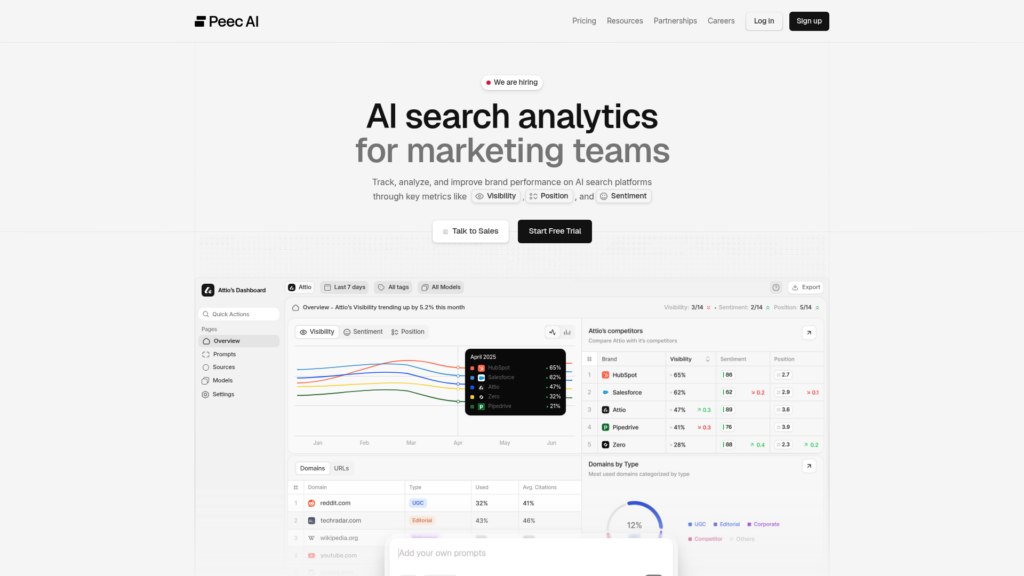
Platforms tracked: ChatGPT, Perplexity, Google AI Overviews (with Gemini, AI Mode, Claude, DeepSeek, and Grok available as €20-30/month add-ons each)
Key features:
- Visibility, Position, and Sentiment metrics
- Competitor benchmarking with side-by-side comparisons
- Citation source analysis at domain and URL level
- Looker Studio integration for custom dashboards
- API access for automated reporting
- Daily prompt execution across selected models
Pricing:
| Plan | Monthly Price | Prompts | AI Answers | Key Features |
|---|---|---|---|---|
| Starter | €89 | 25 | 2,250/month | Email support |
| Pro | €199 | 100 | 9,000/month | Sentiment analysis, Slack support |
| Enterprise | Custom | 300+ | 27,000+/month | SSO, dedicated account rep |
All plans include unlimited countries and unlimited seats. A 15% discount is available for annual billing.
Peec AI has raised $29M in funding and is used by 1,500+ marketing teams. Notable users include teams at Wix, Glide, and Amsive.
Profound
Profound takes a different approach, positioning itself as a full-stack marketing platform for AI search rather than just a tracking tool. It uses autonomous marketing agents to optimize visibility.
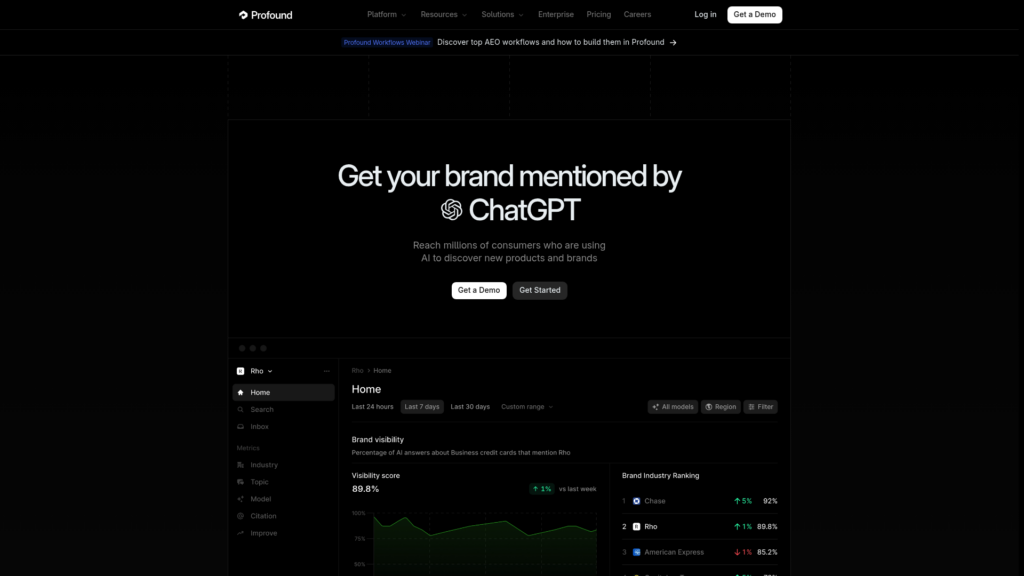
Platforms tracked: Perplexity, ChatGPT, Claude, Gemini, Grok, Microsoft Copilot, Meta AI, DeepSeek, Google AI Overviews
Key features:
- Prompt Volumes: See what millions of people ask AI
- Answer Engine Insights: Monitor brand representation in AI conversations
- Marketing Agents: Autonomous workers for SEO, content, and PR functions
- Agent Analytics: Track how AI systems crawl and interpret your site
Pricing: Not publicly disclosed. Profound targets enterprise clients with custom pricing.
Notable customers include Calendly, Zapier, Plaid, Figma, US Bank, Deel, Mercury, Docusign, MongoDB, Ramp, and G2.
Profound hosts Zero Click 2026, a conference for marketers building the future of AI search.
Amplitude AI Visibility
Amplitude AI Visibility is unique because it’s free for anyone using the Amplitude platform. It connects AI visibility data directly to your analytics, session replay, and experimentation tools.
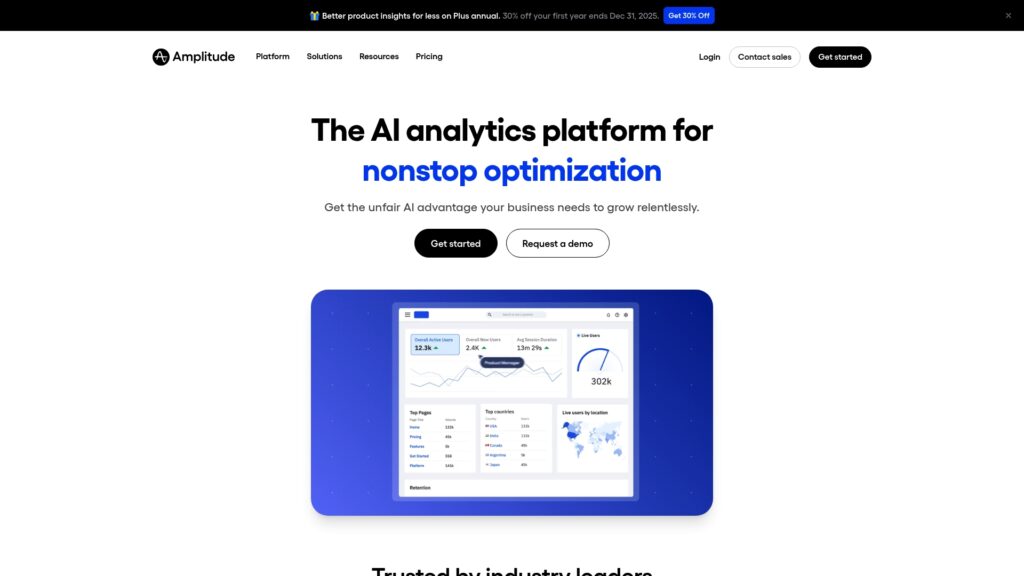
Platforms tracked: ChatGPT, Google AI Overview
Key features:
- AI Visibility Score across hundreds of prompts
- Competitive rankings and share of voice
- Sentiment monitoring (recommendations vs warnings)
- Weekly progress updates
- Direct connection to traffic and revenue metrics
- Source citation analysis
Pricing: Free for all Amplitude customers across all plans
| Amplitude Plan | Price | AI Visibility Prompts |
|---|---|---|
| Starter | Free | 500 |
| Plus | From $49/mo | 1,000 |
| Growth | Custom | 2,500 |
| Enterprise | Custom | 5,000 |
Amplitude AI Visibility is ideal if you’re already using Amplitude for product analytics and want to connect AI visibility to your existing data stack without additional cost.
SE Ranking AI Visibility Tracker
SE Ranking integrates AI visibility tracking into a comprehensive SEO platform. It’s designed for teams that want unified traditional SEO and AI visibility monitoring.
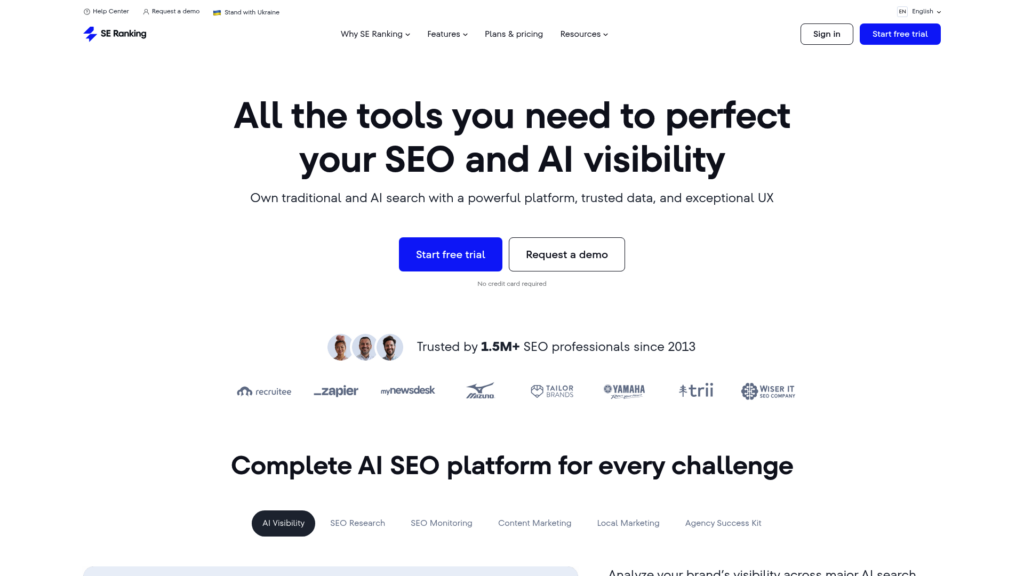
Platforms tracked: AI Overviews, AI Mode, ChatGPT, Gemini, Perplexity
Key features:
- AI Results Tracker for monitoring brand mentions and links
- AI Competitor Research across AI engines
- AIO Research Tool for Google AI snippet analysis
- Historical data and trend tracking
- Integration with SE Ranking’s full SEO toolkit
Pricing:
| Plan | Monthly Price | Annual Price | Prompts | GEO Domains |
|---|---|---|---|---|
| Core | $129 | $103.20 | 100/day | 5 |
| Growth | $279 | $223.20 | 250/day | 15 |
| Enterprise | Custom | Custom | Flexible | Custom |
AI Search add-on available from +$71.20/month for additional prompts. A 14-day free trial includes 20 AI prompts daily and AI competitive research for 3 domains.
SE Ranking is used by professionals in 150+ countries and offers integrations with Looker Studio, Matomo, GA4, and Google Search Console.
Comparison summary
| Tool | Starting Price | Platforms Tracked | Best For |
|---|---|---|---|
| Decoding | 7-day free trial, then $49/mo | ChatGPT (more coming) | SMBs and mid-size teams wanting actionable insights |
| Otterly.AI | $29/mo | 6 (ChatGPT, G AIO, AI Mode, Perplexity, Gemini, Copilot) | SMBs, agencies, affordable comprehensive tracking |
| Peec AI | €89/mo | 3+ optional (add-ons for more) | Marketing teams wanting detailed analytics |
| Profound | Custom | 9+ | Enterprise, full-stack AI marketing |
| Amplitude AI | Free with Amplitude platform | 2 (ChatGPT, Google AI Overview) | Teams already using Amplitude |
| SE Ranking | $129/mo (+$71 for AI add-on) | 5 | Teams wanting unified SEO + AI visibility |
Note: Decoding offers a 7-day free trial and flexible pricing for SMBs. Paid plans are customized based on prompt volume and team size.
Key metrics to monitor
Regardless of which method or tool you choose, focus on these core metrics:
Visibility/Share of Voice: The percentage of AI responses that mention your brand. Calculate this by dividing mentions by total queries run.
Mentions: Raw count of brand appearances. Frequency matters. The more often you’re cited, the more attention your brand receives.
Position/Rank: Where your brand appears in recommendations. First position carries more weight than fifth. Most tools weight positions (1st = 100%, 2nd = 90%, etc.) to calculate visibility scores.
Sentiment: Whether AI describes your brand positively, neutrally, or negatively. Visibility is good, but positive visibility is what drives results.
Source Citations: When your content is referenced even without a brand mention. This indicates AI systems trust your content as an authoritative source.
Topic Coverage: Which question categories you appear in. High visibility in commercial and transactional topics suggests strong conversion potential.
Competitive Benchmark: How you compare to rivals across all metrics. Understanding relative performance helps prioritize efforts.
Our ChatGPT visibility tracker can help you get started with monitoring these metrics systematically. It tracks up to 50 custom prompts, monitors brand mentions and citations, and provides a visibility score (0-100) that combines citation rate, position, and sentiment.
Turning insights into action
Tracking visibility is only valuable if you act on the data. Here’s how to turn insights into improved AI presence:
Optimize high-citation sources: If AI systems consistently cite G2, Reddit, or specific publications when discussing your industry, ensure you have strong presence on those platforms. Update your G2 profile, engage in relevant Reddit discussions, or pursue coverage on frequently cited sites.
Close competitive gaps: Identify prompts where competitors appear but you don’t. Create content that directly addresses those questions. Structure it clearly with headings, bullet points, and direct answers that AI systems can easily extract.
Improve content structure: AI systems favor content with clear structure, factual statements, and direct answers. Use descriptive headings, concise paragraphs, and structured data where appropriate.
Build digital PR targeting trusted domains: Identify which editorial sites AI systems cite in your industry. Prioritize outreach to those publications. One mention on a trusted domain can improve your visibility across multiple AI platforms.
Test and iterate: Make changes, monitor results, and refine your approach. AI systems update their training and retrieval mechanisms regularly. What works today may need adjustment tomorrow.
For a comprehensive approach to optimizing your AI presence, read our guide to AI search optimization or consider our GEO services. You can also request an AI visibility audit to identify your biggest opportunities.
Start tracking your AI brand visibility today
You have two paths forward. The manual approach costs nothing but time. Set up a spreadsheet, identify your key prompts, and start checking them weekly. You’ll learn a lot about how AI systems view your industry, and you’ll spot immediate opportunities to improve.
When you’re ready to scale, specialized tools can automate the tedious work and provide deeper analytics. The right choice depends on your budget, team size, and how deeply you want to integrate AI visibility into your marketing workflow.
At Decoding, we built our ChatGPT visibility tracker specifically for SEOs, marketers, and business owners who need to understand how their brand appears in AI search. Unlike enterprise-only platforms, we focus on small and mid-size teams with flexible plans and a 7-day free trial. You can track up to 50 custom prompts, monitor competitor appearances, and get actionable recommendations to improve your AI presence. Setup takes under 3 minutes with no code required.
The shift to AI-powered search isn’t coming. It’s here. The brands that start tracking and optimizing their AI visibility now will dominate the next era of search. The ones that wait will be playing catch-up in a landscape that’s already moved on.
Frequently Asked Questions
What is the best way to track AI brand visibility for small businesses with limited budgets?
Start with manual tracking using a spreadsheet. Identify 10-20 key prompts your prospects ask, then check them weekly across ChatGPT, Perplexity, and Google AI Overviews. Document mentions, position, and sentiment. This costs nothing but time and gives you valuable baseline data. When budget allows, Otterly.AI at $29/month is the most affordable automated option.
How often should I check my AI brand visibility?
For active campaigns or new product launches, check weekly. For baseline monitoring of established brands, monthly is sufficient. The key is consistency. Run the same prompts on the same schedule so you can spot trends and measure the impact of your optimization efforts.
Can I track AI brand visibility for my competitors?
Yes, and you should. All the major tools (Otterly.AI, Peec AI, SE Ranking) include competitor benchmarking. Even with manual tracking, document which competitors appear in responses alongside or instead of your brand. Understanding where competitors win helps you identify content gaps and opportunities.
What is the difference between AI brand visibility and traditional SEO?
Traditional SEO focuses on ranking in search engine results pages. AI brand visibility focuses on appearing in AI-generated answers. A user might never visit Google if they get their answer directly from ChatGPT. You need both strategies. Traditional SEO helps you get cited as a source. AI visibility ensures you’re mentioned in the final answer.
How do I improve my AI brand visibility once I start tracking it?
Focus on three areas: First, optimize content on platforms AI systems frequently cite (G2, Reddit, major publications). Second, create clear, structured content that directly answers common questions in your industry. Third, build digital PR relationships with editorial sites that AI systems trust as sources. Track which changes move the needle and double down on what works.
Which AI platforms should I prioritize for brand visibility tracking?
Start with ChatGPT and Google AI Overviews. They have the largest user bases and appear most frequently in research. Add Perplexity if your audience skews technical or research-oriented. Consider Gemini and Claude as secondary priorities depending on your specific audience demographics.



Leave a Reply to Jimmy Cancel reply